
TF is short for “the f***,” a mild swear word used to add strong emotion, like shock, confusion, or disbelief, to a question or statement. It’s most often seen in phrases like “what tf” or “who tf.”
You’re reading a text or a comment thread and someone drops “tf” into their message, and it stops you for a second. It’s short, it’s blunt, and if you’re not already familiar with it, it’s easy to misread the tone entirely. So what does tf mean in text, and why do so many people use it instead of just spelling things out?
In this guide, we’ll break down exactly what TF stands for, where it came from, how people use it across texting and social media, and when it’s fine to use yourself.
What Does TF Mean in Text?
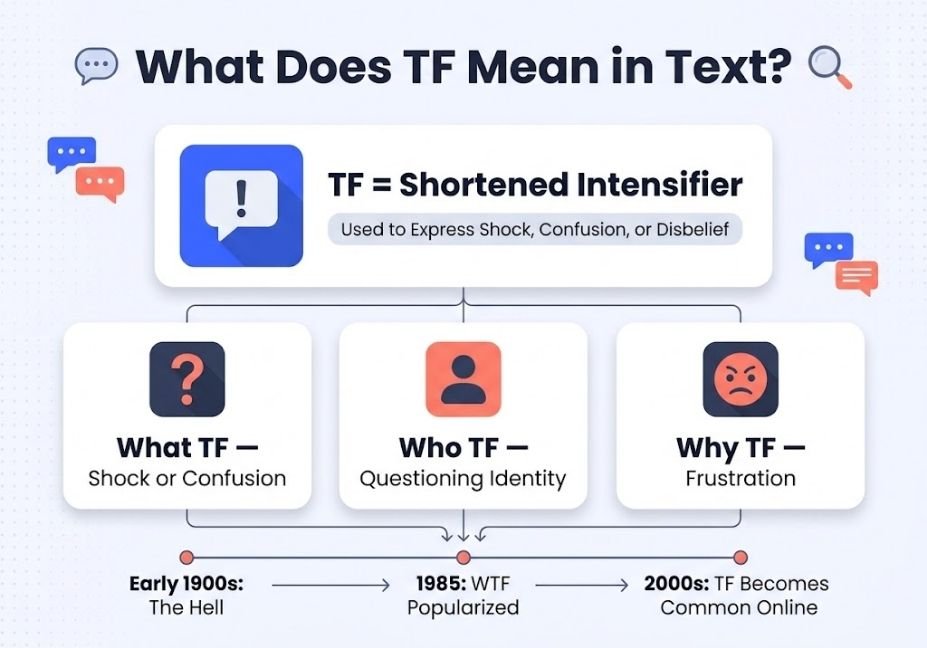
TF stands for “the f***,” using a shortened version of a common swear word. It functions as an intensifier, meaning it adds emotional weight to a sentence without necessarily being aimed at anyone. According to Dictionary.com’s coverage of internet acronyms, TF works as an all-purpose way to express disbelief, confusion, or disgust, and it’s almost always attached to a question or short reaction rather than standing completely on its own.
You’ll usually see it plugged into short phrases like “what tf,” “who tf,” or “why tf,” each one dialing up the emotion of an otherwise ordinary question.
Where Did TF Come From?
TF didn’t appear out of nowhere. It’s a shortened piece of a much older phrase. “The f***” has been used as a coarser stand-in for “the hell” since at least the early 1900s, showing up in questions like “who the f*** are you talking to.”
Over time, that phrase got trimmed down to just “the f***” on its own, used to express dismay or disbelief without a full sentence around it.
Once WTF (“what the f***”) became widely popular online by the mid-1980s, TF followed as a natural shorthand, stripping the phrase down even further for a generation of texters who wanted maximum emotion with minimum typing. By the 2000s, TF was firmly established across chat rooms, forums, and early social media, and it has only grown more common since.
How People Use TF Today
TF rarely stands alone. It almost always attaches to a short question or exclamation, adding punch to what would otherwise be a fairly plain sentence. A few common patterns show up again and again:
- “What tf” is used to express shock or confusion about something.
- “Who tf” questions someone’s identity with added disbelief.
- “Why tf” adds frustration or exasperation to a question.
- “Tf” on its own reacts to something surprising or absurd.
Here are a couple of realistic examples of how it shows up in conversation:
Example 1: “Wait, tf? I thought you already left.”
Example 2: “Why tf would he say that in front of everyone?”
In both cases, TF isn’t really about the literal word behind it. It’s doing the job of a tone marker, signaling that the sender is genuinely caught off guard, annoyed, or amused.
Is TF Always Meant to Be Aggressive?
No, and this is where a lot of the confusion comes from. TF can sound sharp out of context, but tone depends heavily on the relationship between the people texting and what’s happening around it.
Between close friends, TF often reads as playful or exaggerated, almost like a punchline. In an argument or a tense conversation, the same two letters can land as genuinely angry or hostile. Reading the rest of the message, along with any emojis or punctuation, usually makes the intended tone clear within a sentence or two.
Does TF Ever Mean Something Else?
Occasionally, yes, though it’s far less common than the slang meaning. In professional or organizational settings, TF can stand for “Task Force,” referring to a dedicated team assigned to a specific project.
Among gamers, TF sometimes refers to Team Fortress, a well-known multiplayer game franchise, or in League of Legends communities, it can refer to a specific in-game character.
In everyday texting and social media, though, the swear-word meaning dominates by a wide margin. Unless the context is clearly professional or gaming-related, TF almost always carries its slang meaning.
Common Misconceptions About TF
Because TF is short and easy to misread, a few misconceptions tend to stick around. Clearing them up makes the term a lot less confusing.
- TF is always vulgar. In practice, it’s usually a toned-down version of a harsher phrase.
- TF has many everyday meanings. In casual chats, it almost always means the swear-word version.
- It’s fine to use TF anywhere. It’s still too informal for professional or formal settings.
- TF always signals anger. Just as often, it signals surprise, humor, or disbelief instead.
Understanding these small distinctions makes it much easier to read TF the way the sender actually intended it.
Softer Alternatives to TF
If you like the emphasis TF adds but want to avoid the swear word underneath it, a few milder options carry a similar punch without the profanity.
- “What on earth” works as a cleaner stand-in for “what tf.”
- “Who in the world” softens “who tf” without losing the emphasis.
- “Seriously, why” captures the frustration behind “why tf.”
- A simple “wait, what?” covers the shock TF often expresses on its own.
These alternatives are especially useful in mixed company, family chats, or any setting where casual profanity feels out of place, while still letting you express the same genuine reaction.
TF vs. WTF: What’s the Difference?
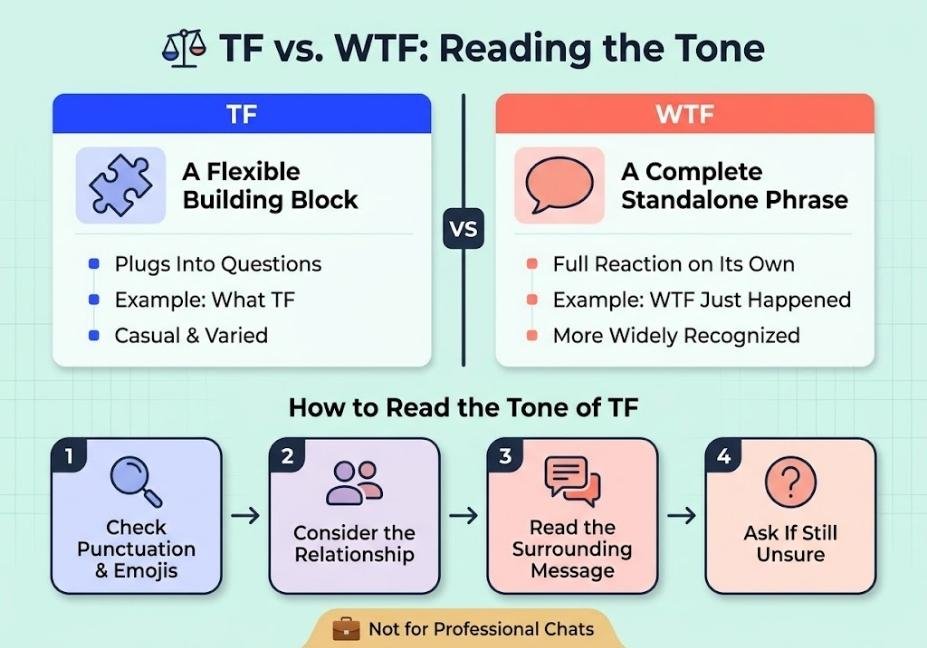
TF and WTF are close relatives, but they’re not identical. WTF stands for “what the f***” and functions as a complete reaction on its own. TF, by contrast, is usually a smaller piece plugged into a longer question, like “what tf” or “who tf,” rather than standing in as a full sentence by itself.
Think of TF as a flexible building block and WTF as one specific, already-assembled phrase built from that same block. Both carry a similar level of emotional intensity, but TF shows up in more varied sentence structures.
Who Uses TF the Most?
TF’s popularity breaks down fairly clearly along generational lines. Younger millennials helped bring TF into mainstream internet culture first, using it regularly across early social platforms and messaging apps. Gen Z picked it up from there and now uses it casually across texting, TikTok comments, and memes, often without thinking of it as particularly shocking language anymore.
Older generations tend to recognize TF when they see it, but they’re less likely to use it themselves, which highlights how differently each age group treats casual swearing online.
That generational gap is common across a lot of internet slang, but it’s especially visible with abbreviations tied to profanity, since comfort with that kind of language varies a lot by age and personal style.
Where You’ll See TF Most Often
TF shows up heavily wherever casual, fast-paced conversation happens. It’s common in text messages between friends, comment sections on TikTok and Instagram, group chats, and gaming voice or text chats reacting to unexpected moments. It also appears frequently in memes and captions, where a short, punchy reaction fits better than a full sentence.
It’s rare to see TF used in any kind of formal writing, and that’s intentional. The whole appeal of the term is that it’s blunt, quick, and casual, which is exactly what makes it a poor fit for anything more polished.
Where You’ll See TF Most Often
TF shows up heavily wherever casual, fast-paced conversation happens. It’s common in text messages between friends, comment sections on TikTok and Instagram, group chats, and gaming voice or text chats reacting to unexpected moments. It also appears frequently in memes and captions, where a short, punchy reaction fits better than a full sentence.
It’s rare to see TF used in any kind of formal writing, and that’s intentional. The whole appeal of the term is that it’s blunt, quick, and casual, which is exactly what makes it a poor fit for anything more polished.
Reading Tone Correctly When You See TF
Because TF can shift from playful to genuinely upset depending on context, it helps to have a quick way to gauge tone before reacting. A few signals usually point the way.
Punctuation and emojis matter a lot. “Tf 😂” reads very differently from “tf.” with a flat period and nothing else. The relationship also matters, since a close friend using TF after a funny story almost never means the same thing as someone using it mid-argument. Finally, pay attention to what surrounds it. A TF sitting inside an otherwise calm, friendly message rarely signals real anger, while one following several short, clipped messages in a row often does.
When in doubt, it’s always reasonable to ask what someone meant rather than assuming the worst from two letters alone.
Is It Okay to Use TF Yourself?
It depends entirely on who you’re talking to and where the conversation is happening. Among close friends who already use casual language, TF usually blends in without raising any eyebrows. In more mixed company, family group chats, or anywhere near a professional or academic setting, it’s safer to leave it out, since it’s still rooted in a swear word even in its shortened form.
If you’re not sure how someone will take it, a good rule of thumb is to match whatever tone they’re already using. If they’ve never used casual profanity around you, it’s probably not the moment to introduce it.
TF Across Different Platforms
TF’s tone shifts slightly depending on where it shows up. On TikTok and Instagram, it’s usually reactive, dropped into comments under surprising or funny videos as a quick emotional beat rather than a serious statement. In group texts between friends, it often works as a running joke, especially when someone shares an unbelievable story.
In gaming chats, it tends to react to sudden losses, glitches, or unexpected plays, functioning almost like a verbal shrug. On X and other public platforms, TF frequently appears in captions and headlines aiming for a punchy, attention-grabbing tone, since the abbreviation reads as blunt and current without spelling out the full word.
Recognizing platform differences can help you understand how seriously to take TF. The same two letters can have a very different tone depending on where they appear. A TF in a meme comment often feels playful or exaggerated. In a heated group chat, it may sound much more intense.
On platforms like TikTok, X, and Instagram, TF is usually a quick reaction. People often use it when something seems funny, surprising, or unexpected. In these situations, the abbreviation is often meant casually.
Private conversations can be different. There, TF may express real confusion, frustration, or disbelief. The meaning depends heavily on the context.
Pay attention to the topic, the tone of the discussion, and the relationship between the people involved. These clues usually make the intended meaning clear. Understanding the setting helps you interpret the message correctly and respond appropriately.
Frequently Asked Questions
What does tf mean in text from a guy?
It carries the same meaning regardless of who sends it: a shortened swear word used to express shock, confusion, or disbelief.
Is TF the same as WTF?
Not exactly. WTF is a full standalone phrase, while TF is usually plugged into a shorter question like “what tf” or “who tf.”
Is TF considered rude?
It’s based on profanity, so some people find it inappropriate, though many use it casually without meaning any real offense.
Can TF mean something other than the swear word?
Occasionally. It can stand for “Task Force” at work or refer to games like Team Fortress, though the slang meaning is far more common.
Is it okay to use TF at work?
No. It’s informal slang rooted in profanity and doesn’t fit professional or formal communication.
Final Takeaway
So, what does tf mean in text? Most of the time, it’s shorthand for “the f***,” a quick way to add shock, confusion, or frustration to an otherwise simple question or reaction. It grew out of older, longer phrases and eventually settled into the compact two-letter form people use constantly today.
Context is everything with TF. The same two letters can read as playful teasing between friends or genuine frustration depending on the conversation around them, so it’s worth paying attention to tone before assuming the worst, or before typing it yourself.