
You’re scrolling through a group chat or a comment section, and there it is: “smdh.” No context, no explanation, just four letters sitting at the end of someone’s message. If you’ve ever paused mid-scroll wondering what does smdh means, you’re not alone. It’s one of the most common acronyms people ask about.
This guide breaks it down in plain terms. You’ll learn exactly what does smdh means, where it came from, how people use it differently depending on who’s texting you, and what to say back so you don’t look confused. By the end, you’ll be able to tell a playful jab from real frustration just by reading the words around it.
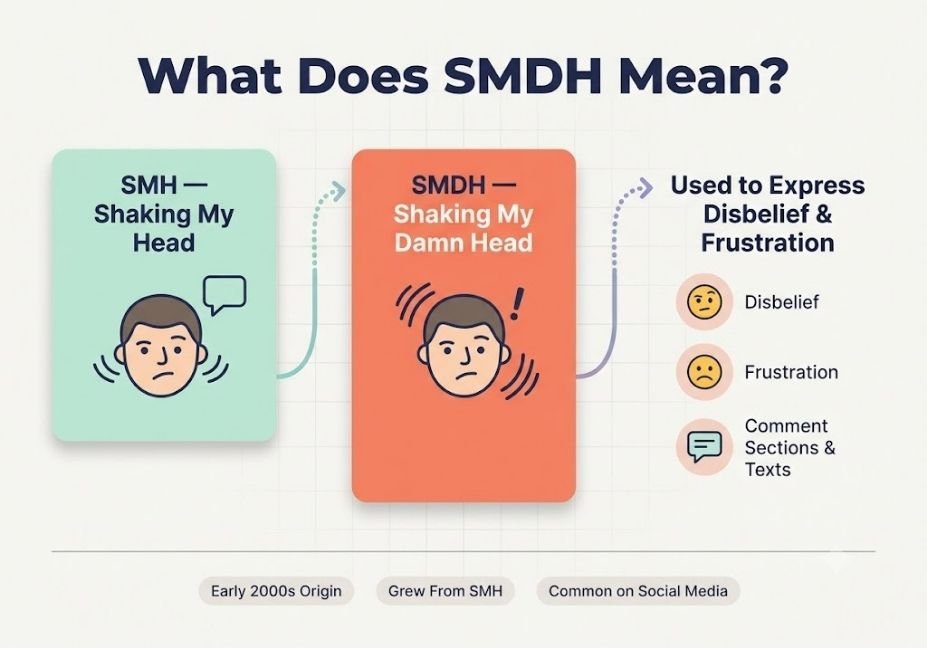
SMDH stands for “shaking my damn head.” People use it to react to something disappointing, ridiculous, or hard to believe, kind of like an eye-roll you can type.
Also read article: Spiritual Thanksgiving Message Everyone Needs to Read
What Does SMDH Means? (Quick Definition)
SMDH is short for “shaking my damn head.” It’s a beefed-up version of the more familiar SMH, which just means “shaking my head.” Adding the extra letter turns a mild reaction into a stronger one.
Picture someone physically shaking their head side to side because they can’t believe what they’re looking at. That’s the feeling behind the letters. Someone might type it after hearing about a friend’s bad decision, watching a clumsy video, or reading a wild news headline.
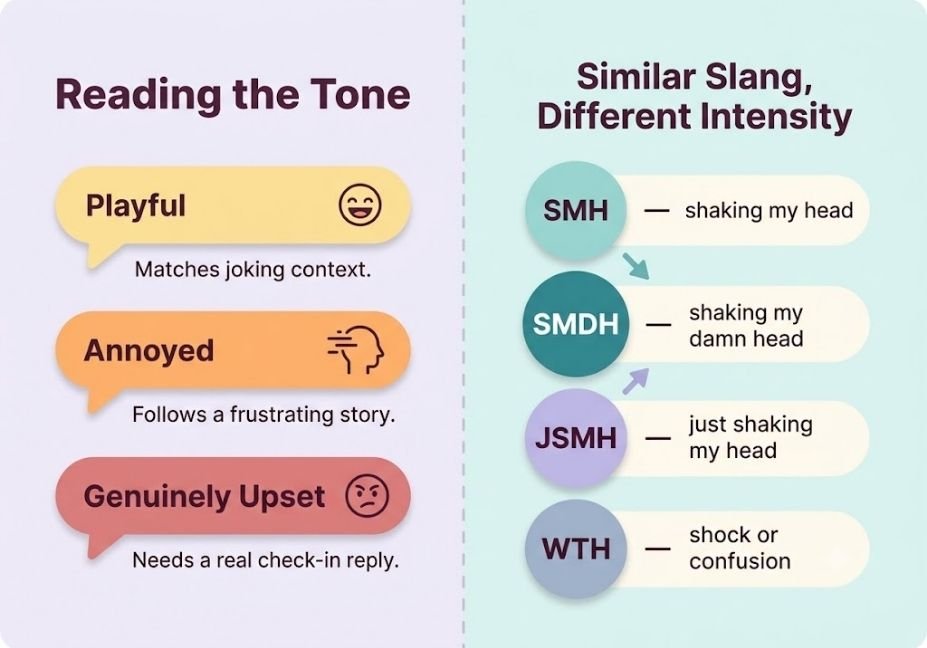
The tone can shift depending on the situation. Sometimes it’s genuinely annoyed. Other times it’s closer to a joke, the texting equivalent of laughing while shaking your head at something silly. Reading the rest of the message usually tells you which one it is.
SMDH also works as a stand-in for actual eye contact. In face-to-face conversation, a head shake does a lot of the talking without needing extra words. Typing it out lets someone carry that same non-verbal cue into a text thread or a comment section, where body language doesn’t exist. That’s part of why it caught on so widely: it fills a gap that plain text can’t cover on its own.
It’s also worth noting what SMDH is not. It isn’t a term for excitement, agreement, or celebration, and it isn’t typically used to express sadness on its own. It’s specifically tied to disbelief and mild-to-moderate frustration, which keeps its meaning fairly narrow compared to broader slang terms that shift depending on context.
Also read article : Lydia Hu Age: How Old Is the Fox Business Reporter?
Where Did SMDH Come From?
SMDH grew out of an older, simpler acronym: SMH, which has been floating around chatrooms and text messages since the early 2000s. Once social platforms like Twitter and Instagram took off, people started looking for ways to add more punch to short reactions, and SMDH was one result.
The extra “D” stands for “damn,” a small addition that makes the phrase feel sharper and more emphatic. Instead of a plain head shake, it reads like someone shaking their head while muttering under their breath.
There isn’t one single person or post credited with inventing it. Like most internet slang, it spread organically through comment sections, group chats, and reposts until it became common enough that most regular social media users recognize it on sight. Slang trackers and online dictionaries, including sites that document internet language the way Merriam-Webster tracks new entries into everyday English, have logged SMDH as an established variant of SMH rather than a passing trend.
The timing lines up with a broader shift in how people communicated online during that era. As phones got smaller and typing got faster, short reaction acronyms became a kind of shorthand for entire emotions. LOL, SMH, and later SMDH all served the same basic purpose: compress a feeling into a handful of letters so a reply could happen in seconds instead of a full sentence.
By the time smartphones and app-based messaging took over, SMDH had already settled into everyday use. It didn’t need to be explained the way brand-new slang often does, because it built directly on a term people already understood. That head start is a big reason it spread faster than many other acronyms competing for attention at the same time.
Also read article : Gemini Pick Up Lines: Genius or Cringe? You Decide
How People Use SMDH in Texts and On Social Media
SMDH shows up almost like punctuation. It rarely opens a sentence. Instead, it lands at the very end, wrapping up a thought with a final reaction.
A few common ways it appears:
- After describing something someone did wrong: “He forgot the tickets again. Smdh.”
- As a standalone comment under a video of a mistake or fail.
- Replying to a friend’s story about a frustrating day.
- Reacting to a news headline that sounds too ridiculous to be real.
On social media specifically, SMDH tends to show up in comment threads more than in captions. It’s a quick way to react without writing a full sentence, which fits the fast pace of scrolling through a feed. In direct texts, it usually caps off a longer message rather than standing completely alone, since the person receiving it needs context to know what’s being shaken at.
SMDH on Twitter/X, Instagram, TikTok, and in Texts
The acronym shows up a little differently depending on the platform. On Twitter or X, it often reacts to news, viral clips, or a public figure’s comment, dropped as a quick quote-reply or standalone post. On Instagram and TikTok, it usually lives in the comment section under a video, reacting to a fail, a plot twist, or something outrageous someone did on camera.
In one-on-one texting, SMDH behaves a bit differently. It almost always follows a story the other person just told, functioning as a reaction rather than an opener. Group chats blend both patterns: it can react to something a friend shared, or it can pile on after several people already responded to the same piece of news or gossip.
Across every platform, the underlying job stays the same. SMDH lets someone register disapproval or disbelief instantly, without slowing down the conversation to type out a longer reaction.
SMDH Meaning From a Guy or a Girl
The core meaning of SMDH doesn’t actually change based on who’s sending it, but the emotional weight behind it often does, and that’s where people get confused.
From a guy, SMDH in a text often reads as light frustration or teasing, especially in casual conversations with friends. It’s rarely meant to be taken too seriously unless the rest of the message sounds genuinely upset.
From a girl, SMDH can carry the same casual, joking tone with friends, but in a more personal or flirty conversation it sometimes signals real annoyance, especially if it follows a comment about someone’s behavior or a missed plan. The safest move is always to read the sentence around it rather than the acronym alone. Punctuation, emojis, and the topic of conversation matter more than the four letters themselves.
How to Respond When Someone Sends You SMDH
Getting an SMDH can feel a little awkward if you’re not sure whether the person is joking or actually annoyed. A few solid ways to respond:
- Ask directly: “Haha wait are you serious right now?”
- Match the tone with a laughing reply if the topic feels lighthearted.
- Apologize briefly if you were the cause and the mood seems genuine.
- Send a simple “lol I know” to acknowledge it without escalating.
- Change the subject gently if the reaction feels like mild venting.
The goal is reading the full conversation, not just those four letters. If everything before it was playful, the SMDH is probably playful too. If the messages before it sound tense, it’s worth checking in with a real question instead of a joke.
SMDH vs. SMH vs. Other Similar Slang
SMDH belongs to a small family of head-shaking, disbelief-style acronyms that often get mixed up. Here’s how they compare:
- SMH: “Shaking my head,” the mildest and most common version.
- SMDH: “Shaking my damn head,” a stronger, more emphatic version of SMH.
- JSMH: “Just shaking my head,” used similarly but slightly less common.
- FFS: Expresses pure frustration, with no head-shaking gesture involved.
- WTH or WTF: Signals shock or confusion rather than disappointment.
SMH is by far the most frequently used of the group, largely because it’s shorter and works in almost any casual reaction. SMDH tends to show up when someone wants to emphasize that the situation is a little more frustrating than a plain SMH would suggest.
Is It Okay to Use SMDH at Work or School?
SMDH is casual slang, so it fits best in texts, group chats, and social media comments among friends. It’s generally not a great choice for formal emails, school assignments, or messages to a boss, since it can come across as unprofessional or a little too blunt.
That said, plenty of workplaces have relaxed group chats or team Slack channels where casual reactions are normal. In that kind of setting, SMDH usually reads as harmless as long as the overall tone of the workplace supports casual banter. When in doubt, it’s safer to save it for personal conversations and stick to plain language in anything official.
A simple rule of thumb: if you’d feel comfortable rolling your eyes out loud in that setting, SMDH probably fits fine. If the setting calls for a more polished tone, like an email to a client or a message to a teacher, it’s better to swap it for a plain sentence describing how you feel instead.
Also read the article Birthday Pick Up Lines That Actually Work in 2026
Regional and Generational Differences
SMDH is used broadly across English-speaking internet spaces, but it skews younger. Teens and young adults who grew up texting and using social media daily use it far more often than older generations, many of whom stick with the simpler SMH or skip acronyms altogether.
There isn’t strong evidence of major regional differences in meaning, since the term spread mainly through social platforms rather than any one country or community. What does shift regionally is frequency. It shows up constantly in group chats and comment sections among younger users, while older or more formal communities tend to favor spelling things out.
Parents and teachers encountering SMDH for the first time sometimes assume it hides something more serious, since it looks unfamiliar next to other coded slang. In reality, it’s one of the more harmless acronyms floating around, closer to an eye-roll emoji than anything that needs extra concern. Understanding where it fits among everyday internet shorthand makes it much easier to read a teenager’s messages without misreading the tone.
FAQs
What does SMDH mean from a girl?
Same core meaning as anyone else uses it, though tone can range from playful teasing to real annoyance depending on the conversation.
Is SMDH rude to say?
Not usually. It’s casual slang expressing disbelief or frustration, though tone and context can make it feel sharper.
What’s the difference between SMH and SMDH?
SMH means “shaking my head.” SMDH is a stronger version adding “damn” for extra emphasis.
What does SMDH mean in a text message?
It signals the sender is reacting to something disappointing, ridiculous, or hard to believe.
Is it okay to use SMDH at work?
It’s fine in casual team chats but best avoided in formal emails or official communication.
Conclusion
So, what does smdh means in the end? It’s a short, punchy way to show disbelief or frustration without typing out a whole sentence, an internet-age head shake packed into four letters. It grew out of the simpler SMH, picked up an extra “damn” for emphasis, and now shows up everywhere from group chats to comment sections.
The real trick to understanding it isn’t memorizing the acronym, it’s reading the message around it. Once you get a feel for tone, whether it’s a joke between friends or a genuine bit of frustration, you’ll never have to pause and wonder again the next time it lands in your inbox.