
You just got a text back that says “np,” and now you’re stuck staring at your phone wondering what it means. Don’t worry, you’re not missing anything complicated. What does np mean in text usually comes down to one simple, friendly phrase that people type dozens of times a day without even thinking about it.
This guide breaks down exactly what np means in text, where it came from, and how to use it (or reply to it) the right way. You’ll also learn when np can mean something totally different, and how to avoid sounding cold when you use it.
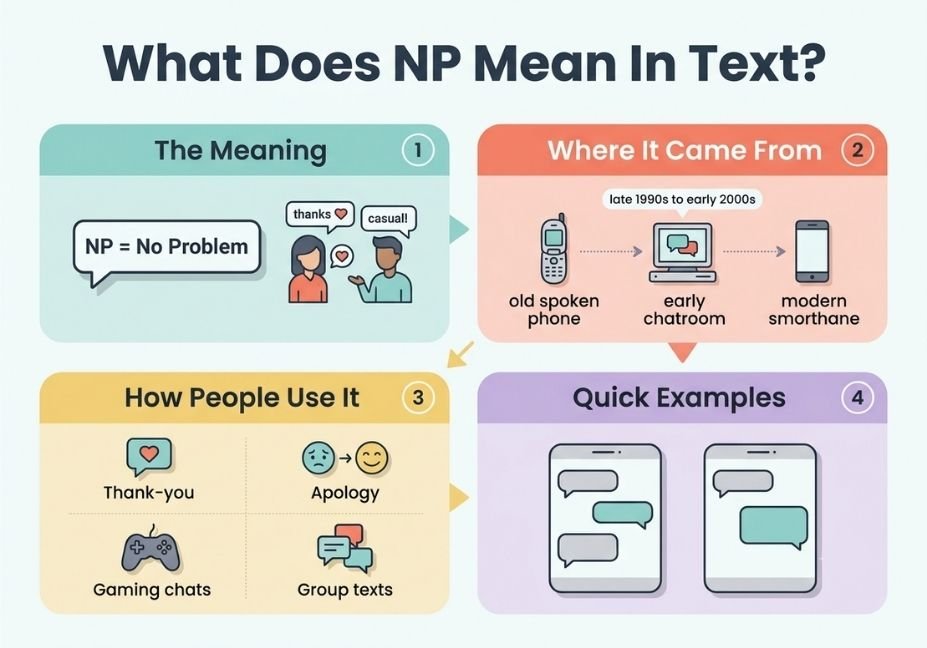
NP means “No Problem.” People text it as a casual, friendly way to say something isn’t a big deal, usually after a thank you or an apology. It’s the texting version of saying “you’re welcome” or “it’s fine.”
|Also read this article: Disney Pick Up Lines So Cute, They Actually Work
Where NP Comes From
NP is short for “no problem.” The phrase itself has been part of casual spoken English for decades, long before texting existed. People said “no problem” out loud as a relaxed alternative to “you’re welcome” well before the internet made abbreviations popular. Once instant messaging and early chatrooms took off in the late 1990s and early 2000s, people started shortening common phrases to type faster.
“No problem” turned into “np” for the same reason “you” turned into “u” and “because” turned into “bc.” Typing on a flip phone or in a slow chatroom took real effort, so shorter was always better. Every extra keystroke cost time, and time mattered in fast-moving conversations. Gamers picked it up especially quickly, since fast typing during a match mattered more than full, polite sentences. A missed shot or a small mistake needed a fast reassurance, not a paragraph.
According to Merriam-Webster‘s ongoing tracking of internet and text slang, abbreviations like this one tend to stick around once they cross over from a small online community into everyday texting. NP did exactly that. It moved from gaming lobbies and chatrooms into regular text conversations between friends, coworkers, and family. By the time smartphones and touchscreen keyboards became standard, np was already a normal part of daily texting rather than a niche gamer term. It no longer signals that someone is “extremely online.” It’s just how people talk now.
What makes np interesting compared to other slang is how little it has changed. Words like “lol” have picked up sarcastic or filler meanings over time, drifting away from their original purpose. NP has mostly stayed put. It still means exactly what it meant twenty years ago, just typed by a much wider range of people across a much wider range of apps.
|Also read this article: Fairy Pick Up Lines That Sounds Like Pure Magic
How People Use NP In Texting
NP shows up constantly, but the exact feeling behind it depends on the situation. Here’s how it plays out in real conversations across different apps and moments.
NP After A Thank You
This is the most common use by far. Someone thanks you, and you reply with np instead of “you’re welcome.”
- Friend: “Thanks for grabbing my mail while I was gone!”
- You: “np, anytime.”
It’s quick, friendly, and doesn’t make a big deal out of a small favor. This version of np is almost automatic. Most people don’t even think about typing it, the same way you might not think twice before saying “sure thing” out loud.
NP After An Apology
NP also works as a reply to an apology, similar to saying “it’s okay” or “don’t worry about it.”
- Coworker: “Sorry I’m running 10 minutes late.”
- You: “np, take your time.”
This use tells the other person they don’t need to feel guilty or stressed. It carries a small dose of reassurance along with the dismissal of the issue, which is why it tends to feel kinder than staying silent or leaving someone on read after an apology.
NP In Gaming Chats
In gaming, np often shows up after a mistake or a missed play. A teammate misses a shot, apologizes, and someone replies “np” to keep the mood light and move on to the next round.
- Teammate: “sry I missed that”
- You: “np, next round”
Speed matters here more than almost anywhere else. A match is moving in real time, so a full sentence would slow things down and pull attention away from the game. NP lets a player acknowledge a mistake without breaking focus.
NP In Group Chats And Social Media
On platforms like Snapchat, Instagram, and WhatsApp, np works the exact same way it does in one-on-one texting. It’s just as common in a group chat reply as it is in a private message, and it carries the same casual, easygoing tone either way. In group settings, np also does a small extra job: it signals to everyone watching the thread that a small issue has already been resolved, so nobody else needs to jump in and address it.
NP In Voice And Video Call Follow-Ups
NP isn’t limited to typed conversations. It’s common to see someone text “np” right after a phone or video call to wrap up a small thank-you that happened out loud. Someone might say “thanks for calling me back” on the phone, then follow up with a quick “np :)” text a few minutes later just to keep the exchange friendly and closed out.
What Does NP Mean From A Girl Or A Guy?
This is a common search, but the honest answer is that np doesn’t carry a different meaning based on gender. Whether it’s texted by a girl or a guy, np still means “no problem.” What can shift is tone, and tone comes from context, not gender.
A short “np.” with a period can feel a little flat or distant. A relaxed “np :)” or “np lol” usually signals warmth and ease. The words are the same, but punctuation and follow-up messages tell you far more than who sent it.
Does NP Always Mean The Same Thing?
Almost always in texting, yes. But NP does show up in other spaces with a completely different meaning, and that’s worth knowing so you don’t mix things up.
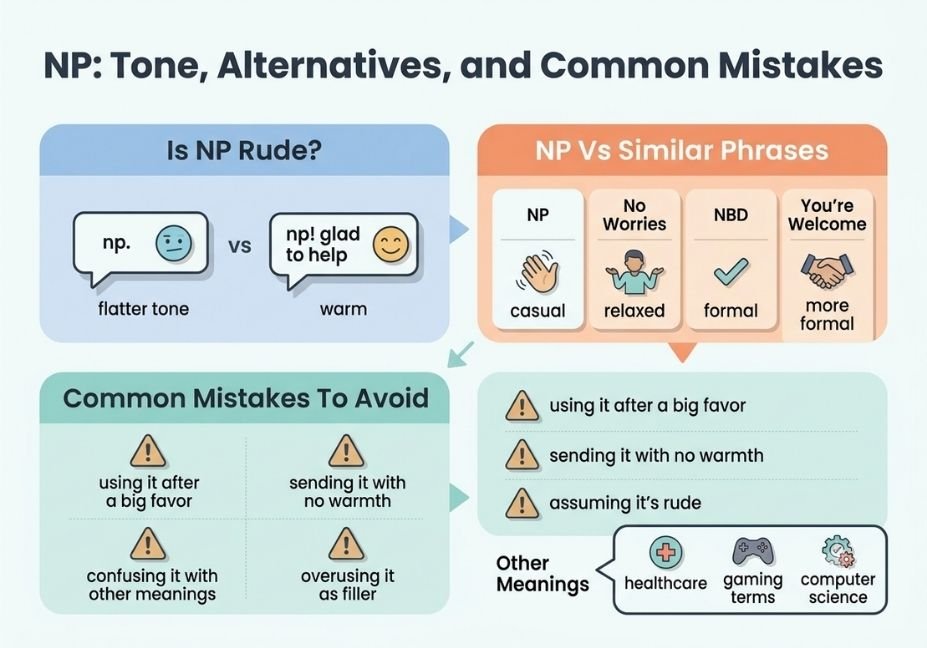
- In healthcare settings, NP commonly stands for nurse practitioner.
- In gaming and software, NP can label something as non-playable or not applicable.
- In computer science, NP refers to a complexity class used in algorithm theory, which has nothing to do with texting at all.
If you’re reading a casual text from a friend, none of these apply. Context makes it obvious. A doctor’s office form and a text from your roommate are never going to confuse each other.
Is NP Rude Or Just Casual?
This is where a lot of people get tripped up. NP is not inherently rude, but it can come across as cold depending on how it’s delivered. A one-word “np” with no punctuation, sent after someone put in real effort to thank you, can feel a little dismissive.
Context fixes this fast. Add a small detail, an emoji, or a follow-up sentence, and the same two letters instantly feel warmer.
Compare these two replies:
- “np.” (feels short, maybe distant)
- “np! glad I could help” (feels warm and genuine)
Same meaning, very different tone. If you want to sound approachable, pairing np with a little extra warmth goes a long way, especially in professional or new relationships where tone matters more.
NP Vs Similar Phrases
NP isn’t the only shorthand way to brush off a thank you or apology. A few common alternatives carry slightly different vibes.
- No worries: Feels a bit warmer and more reassuring than np.
- NBD (no big deal): Downplays the situation even more directly.
- You’re welcome: Feels more formal and traditional.
- No prob: A slightly more spelled-out version of np with the same casual tone.
None of these are wrong. They just carry small shades of formality and warmth that shift depending on who you’re texting.
Regional And Generational Differences
NP is used across basically every English-speaking region, but younger texters and gamers tend to use it more often and more casually than older generations. Older texters are statistically more likely to type out “no problem” or “you’re welcome” in full, while younger users lean on np as a default, near-automatic reply. This isn’t about one group being more polite than the other. It mostly comes down to how much time each generation spent typing in fast-paced chat environments where shortcuts became second nature.
Regionally, the meaning stays consistent across English-speaking countries. Texters in the United States, the United Kingdom, Australia, Canada, and beyond all use np the exact same way. Slang abbreviations like this one travel fast online, so regional splits in meaning are rare. What does shift slightly by region is how often it’s used compared to alternatives like “no worries,” which tends to be more common in Australian and British texting than “np” alone.
NP In Professional And Work Texting
Workplace texting culture affects how comfortable people feel using np. In casual work environments, especially ones with younger teams or remote-first cultures, np has become an accepted, low-effort reply to quick thank-yous over Slack, email, or text. It signals that something took no real effort and doesn’t need to be acknowledged further.
In more traditional or formal workplaces, spelling things out is still the safer choice. Replying “np” to a client or a senior manager can read as too casual, even if that’s not the intention behind it. A safe rule of thumb is to match the formality of the person you’re texting. If they write in full sentences with proper punctuation, mirror that. If they’re already using shorthand themselves, np fits in naturally.
Common Mistakes People Make With NP
A few small missteps can change how np lands, even though the word itself never changes meaning.
- Using np after something that clearly wasn’t small, like a major favor, can feel dismissive of real effort.
- Sending a bare “np.” with no punctuation or emoji in an emotional moment can read as cold instead of reassuring.
- Assuming np always means “no problem” outside texting, when fields like healthcare or gaming use the same letters differently.
- Replying with np to a serious apology instead of acknowledging the actual issue being raised.
- Overusing np so often that it starts to feel like a filler word rather than a genuine response.
Avoiding these small traps keeps np doing what it’s supposed to do, which is smoothing over small moments without adding awkwardness.
How To Reply When Someone Texts You NP
You usually don’t need to reply to a simple “np” at all. It’s meant to close out a small exchange, not start a new one. If you do want to respond, a quick “thanks again” or a simple emoji keeps things natural without over-explaining a two-letter reply.
Frequently Asked Questions
What does np mean from a girl or guy specifically? It means the same thing either way: no problem. Gender doesn’t change the meaning, only tone and punctuation might hint at warmth or distance.
Is it rude to just say np instead of you’re welcome? Not usually. It can feel a little flat without extra warmth, but it’s not considered rude in casual texting culture.
What does np mean in gaming or Discord? Same meaning as texting: no problem. It’s often used after a missed play or small mistake to keep the mood relaxed.
Does np always mean no problem, or can it mean something else? In texting, yes, it almost always means no problem. Outside texting, NP can mean nurse practitioner or refer to technical terms in gaming and computer science.
How do you respond when someone texts you np? You don’t have to reply at all. If you want to, a short “thanks” or a friendly emoji works fine.
Conclusion
At its core, np is just a fast, casual way of saying “no problem” in a text. It shows up after thank-yous, apologies, missed plays in games, and quick favors between friends. The two letters themselves never change meaning in a texting context, but tone, punctuation, and a little extra warmth can shape how the message actually lands.
Next time you see np pop up on your screen, you’ll know exactly what it means and how to read the tone behind it. And if you want to send one yourself, a quick “np!” with a little personality behind it is usually all it takes to keep the conversation warm and easy.