
What does owo mean? Owo is an emoticon, not a word. Two capital O’s and a lowercase w form “owo,” creating a cute, surprised face. People type it to react to something exciting, adorable, or unexpected, kind of like typing “whoa” with a wink built in.
If a friend just sent you a text with “owo” in it and you’re now staring at your phone wondering what on earth that means, you’re in good company. Millions of people search [What does owo mean] every year, usually right after seeing it pop up in a group chat, a gaming lobby, or a comment section. The short version is that owo is a face, not an acronym, and people use it to show surprise, excitement, or playful curiosity.
In this guide, you’ll learn exactly what owo means, where it came from, how people use it differently depending on who’s sending it, and how it’s different from its cousin uwu. By the end, you’ll be able to spot it, understand it, and use it yourself without feeling lost.
What Does Owo Mean?
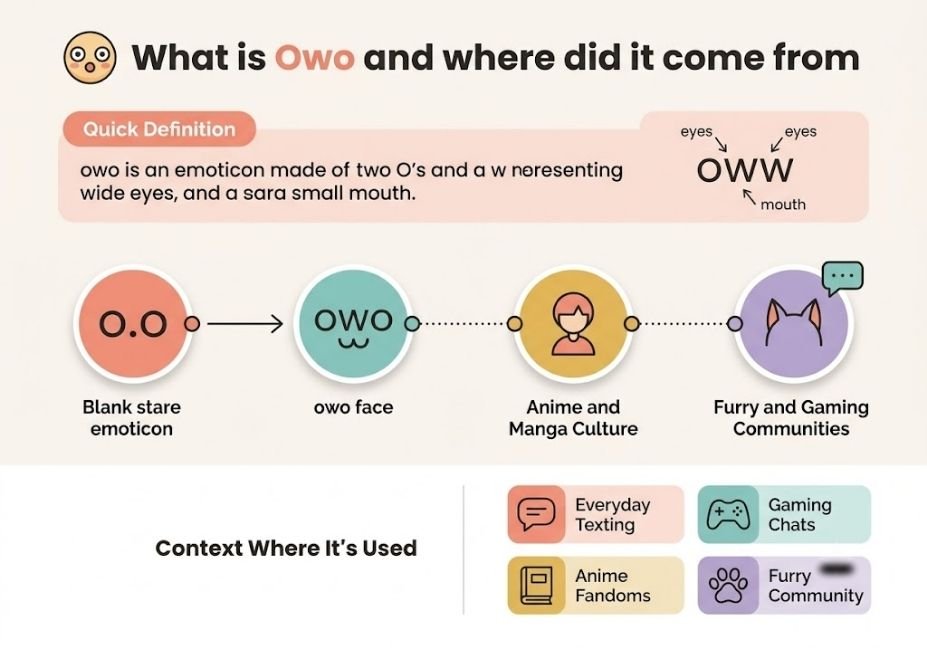
Owo is what’s called an emoticon, a small picture made out of regular keyboard characters instead of an actual image. Turn your head slightly and look at it sideways: the two O’s are wide, surprised eyes, and the w in the middle is a small, round mouth. Put together, it looks like a face that just saw something it wasn’t expecting.
Unlike abbreviations such as LOL or BRB, owo doesn’t stand for any actual words. It’s purely visual. That’s part of why it confuses so many people the first time they see it. You can’t sound it out and land on a phrase, because there isn’t one hiding inside it.
Most commonly, owo is used to express:
- Surprise or shock at something unexpected
- Excitement about good news or a fun moment
- Playful curiosity, often paired with “what’s this?”
- Affection or admiration in a lighthearted, joking way
You’ll usually see it written as owo, OwO, or OWO. Capitalization doesn’t change the meaning, it’s mostly a style choice. Some people also stretch it out as owowowo for extra emphasis, the same way you might type “omggggg.”
Where Did Owo Come From?
The exact birthplace of owo isn’t nailed down to one single post or person, but its roots trace back to early internet emoticon culture. Long before owo existed, there was a simpler face called “o.o,” used to show a blank, slightly stunned stare. Over time, people started adding a w in the middle to soften that blank stare into something cuter and more expressive, and owo was born.
From there, it spread through communities that already loved expressive, character-based text: anime fan forums, gaming chats, and early messaging platforms like AIM and MSN. Anime and manga culture, both from Japan, had already normalized exaggerated facial emoticons, so owo fit right in as an import into English-speaking internet spaces.
By the mid-2010s, owo had picked up strong momentum in two particular groups: anime fandoms and the furry community, which is made up of people interested in anthropomorphic, animal-like characters. According to language tracking from Collins English Dictionary, owo is now recognized as a general slang exclamation used especially in text messaging and on social media, which shows just how far it traveled from those niche beginnings.
By around 2018, owo had crossed over into much wider use, showing up on Twitter, Tumblr, Discord, TikTok comments, and gaming platforms like Roblox and Discord servers for kids and teens.
How People Use Owo Today
Owo shows up in a lot of different corners of the internet, and the context usually tells you exactly what someone means by it.
In everyday texting
When a friend sends owo in a normal text conversation, they’re almost always just reacting to something surprising or exciting. If you tell a friend you got a new job and they reply “owo really??” that’s the digital version of raising their eyebrows and grinning.
In Gaming and Discord Chats
In gaming spaces, especially Roblox, Minecraft, and Discord servers, owo often appears as a quick reaction to something unexpected happening in the game, such as a surprise win, a funny glitch, or an over-the-top move by another player.
Players also use owo to express excitement, amusement, or playful disbelief during fast-paced conversations, making it a common part of gaming slang.
In Anime Fandoms
Within anime communities, owo has long been used to convey cuteness, surprise, or lighthearted excitement. Fans frequently include it in comments, memes, fan art captions, and roleplay conversations to create a friendly, expressive tone.
Anime fans frequently use owo to react to a plot twist, a favorite character showing up, or a scene that hits emotionally. It works as a stand-in for “I did not see that coming” or “this is so good.”
In the furry community
The furry fandom, a community built around anthropomorphic animal characters, adopted owo early and heavily. Here it’s often used to express excitement about character art or a playful, animal-like reaction. The phrase “owo what’s this?” became something of a running joke and meme within and about the community, sometimes used sincerely and sometimes used to poke fun at furry stereotypes.
What Does Owo Mean From a Guy or a Girl?
One of the most common follow-up questions is whether owo means something different depending on who sends it. The honest answer is: usually not much. Whether it comes from a guy or a girl, owo almost always means the same basic thing, surprise, excitement, or playful reaction.
That said, tone matters more than gender here. If someone you’re texting flirtatiously sends owo after a compliment or a slightly bold message, it can carry a teasing, flirty undertone. But that comes from the surrounding conversation, not from the emoticon itself. Owo alone is not inherently romantic or flirty; it’s a neutral expression until the surrounding context gives it that meaning.
Owo vs Uwu: What’s the Difference?
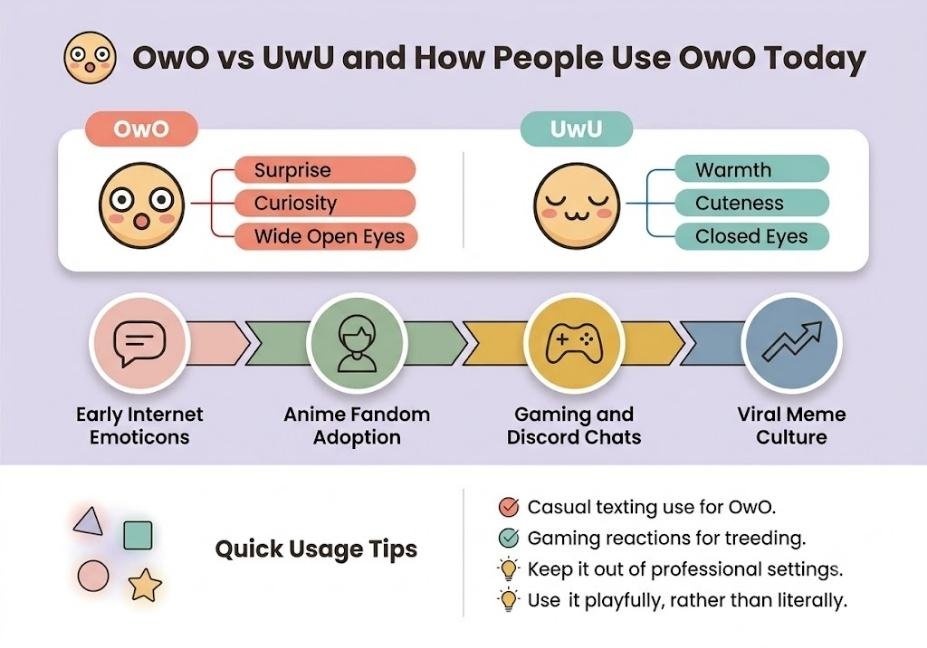
Although owo and uwu are close relatives, people mix them up all the time. OwO typically expresses surprise, excitement, or playful curiosity, while uwu conveys a softer, cuter, or more affectionate emotion. Understanding the difference helps you choose the right emoticon for the mood you want to express. Here’s the simplest way to tell them apart:
- Owo has open, wide eyes and usually signals surprise or curiosity
- Uwu has closed eyes and usually signals warmth, cuteness, or contentment
- Owo often pairs with “what’s this?” for shock or discovery
- Uwu often pairs with affectionate or wholesome messages
- Most people see both as cute, informal, and playful rather than serious.
Think of it this way: uwu is a happy, relaxed smile with closed eyes, while owo is that same face caught off guard, eyes wide open. They share the same emoticon family tree, but they express slightly different emotional moods.
Other Meanings of Owo
Like a lot of short internet terms, the letters O-W-O have picked up a completely separate, adult-industry abbreviation in certain explicit contexts that has nothing to do with the cute emoticon. If you’ve seen it used in a way that seems out of place with everything above, that unrelated meaning is likely why. It’s worth knowing this second meaning exists
Owo in Memes and Pop Culture
Owo didn’t stay confined to niche forums for long. Once it caught on with gamers and anime fans, it started showing up in memes, YouTube comments, and viral posts across nearly every major platform. The phrase “owo what’s this?” became a meme format on its own, often used as a caption for anything unexpected, a plot twist, a random object, or even a joke about someone’s browser history.
Streaming culture picked it up too. On platforms like Twitch, viewers sometimes type owo in chat as a quick reaction, especially during a surprising play or an awkward moment on stream. TikTok comment sections use it the same way, as a low-effort way to react without typing out a full sentence.
Because it’s so tied to fandom spaces, owo also gets used ironically. Some people type it sarcastically to poke fun at overly cutesy internet speak, almost like putting quotation marks around their own tone. This dual use, sincere in one post and joking in the next, is part of why context matters so much when you’re trying to figure out what someone actually means by it.
Regional and Generational Differences
Owo skews heavily toward younger internet users, particularly teens and people in their twenties who grew up active in gaming and fandom communities. Older generations or people outside these online spaces are far less likely to recognize it at all, which is exactly why so many people end up searching [What does owo mean] the first time it lands in their inbox.
There isn’t much regional variation in meaning, since owo spread primarily through English-language internet spaces rather than any single country or dialect. However, its popularity does track closely with anime and gaming culture, so it tends to show up more often in communities built around those interests, regardless of where in the world someone is chatting from.
Owo in Action: Example Conversations
Seeing owo used in real conversation often makes the meaning click faster than any definition can. Here are a few quick examples of how it plays out:
- Friend 1: “I just got tickets to the concert!” Friend 2: “owo no way, lucky!”
- Gamer 1: “I clutched that round with one health left.” Gamer 2: “owo how”
- Fan account: “New chapter just dropped and the ending owo”
- Group chat: “guess who just got promoted” Reply: “OWO WHAT”
In each case, owo is standing in for a raised-eyebrow reaction, doing the job an emoji or a longer sentence would normally do, just faster and with a bit more personality.
Is Owo a Bad Word?
No, owo itself is not a bad word or an insult. It’s a lighthearted emoticon used to express reaction and emotion, similar to typing “whoa” or using a wide-eyed emoji. Some people find it childish or overused, and it can come across as immature in a formal or professional setting, but it isn’t offensive on its own.
How to Use Owo Yourself
If you want to try using owo naturally, treat it the way you’d treat an emoji rather than a word. A few easy ways to use it:
- React to surprising news: “wait you got the job?! owo”
- Respond to something cute or funny someone shares
- Use it in casual chats with friends, gaming groups, or fandom spaces
- Avoid it in professional emails, work chats, or formal writing
Because it reads as very casual and youth-coded slang, it’s best kept to relaxed, informal conversations rather than anything work-related or serious.
Frequently Asked Questions
What does owo mean from a girl?
It usually means the same thing it means from anyone: surprise, excitement, or playful reaction. Tone from the rest of the conversation shapes the meaning more than gender does.
Is owo a bad word?
No. It’s a casual, playful emoticon, though it can seem immature in professional settings.
What’s the difference between owo and uwu?
Owo has open eyes and signals surprise or curiosity, while uwu has closed eyes and signals warmth or cuteness.
Where did owo come from? It grew out of earlier internet emoticons like “o.o” and spread through anime, gaming, and furry fandom communities online.
What does “owo what’s this” mean?
It’s a playful way of reacting to something new, surprising, or intriguing, often used jokingly within furry and anime fan communities.
Final Takeaway
So, [What does owo mean]? At its core, it’s a simple, keyboard-made face meant to show surprise, excitement, or playful curiosity, nothing more mysterious than that. It grew out of early internet emoticon culture, picked up steam in anime, gaming, and furry fandom spaces, and eventually became common enough that almost anyone active online will run into it sooner or later.
Next time it shows up in your messages, you’ll know exactly what’s going on: someone is reacting to something that caught them off guard, in the cutest way the internet could come up with.