
If you’ve seen “FJB” pop up in a text, a comment section, or a meme and had no idea what it meant, you’re not alone.People often drop this short internet acronym into conversations as if everyone already knows what it means, leaving you scrambling to figure out the FJB meaning in text before you respond to the wrong thing at the wrong time.
This guide breaks it down in plain language. You’ll learn exactly what the letters stand for, where the phrase came from, how people actually use it online and in texts, and how to handle it if it lands in your inbox.
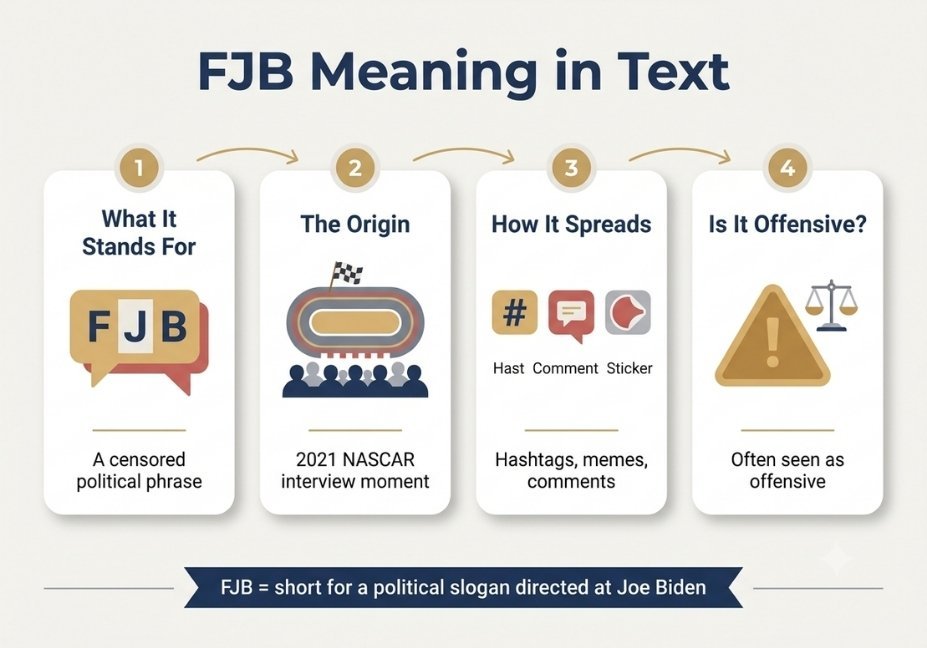
FJB stands for “F*** Joe Biden.” People use this political slogan online and in texts to express anger or criticism toward former President Joe Biden. Because it contains censored profanity, many people consider it informal and often offensive.
What Does FJB Stand For?
People use FJB as shorthand for a profane phrase aimed at Joe Biden. People type the initials instead of spelling out the full phrase because it’s faster, it slides past some platform filters, and it softens the visual impact of the swear word while still getting the point across.
It’s almost always political. Every major write-up on the term agrees on this core meaning, and it’s the definition you should assume by default if someone sends it to you without any other context clues.
That said, letters can mean more than one thing depending on where they show up. A handful of writers point out that FJB occasionally shows up as someone’s initials, a small business name, or a random username, especially outside political contexts. Those cases are rare. When you see FJB in a hashtag, a news-post comment, or a text about current events, people almost certainly intend the political meaning.
Where Did FJB Come From?
The story behind FJB starts with a NASCAR race. In October 2021, driver Brandon Brown won a race at Talladega Superspeedway, and during his post-race TV interview, the crowd behind him started chanting something that sounded like “F*** Joe Biden.” The NBC reporter on the scene, trying to keep things broadcast-friendly, told viewers the crowd was chanting “Let’s Go Brandon” instead.
That moment went viral almost instantly. “Let’s Go Brandon” became a coded, radio-friendly stand-in for the original chant, and it spread across sports broadcasts, bumper stickers, and social media within days. FJB grew out of the same wave of frustration, just as the blunt, uncensored version rather than the winking euphemism.
From there, FJB spread the way most political slang does now: through hashtags, meme accounts, protest signs, hats, stickers, and comment sections. Because it’s only three letters, it fit easily into character-limited platforms and image captions, which helped it stick around long after the initial NASCAR moment faded from the news cycle.
The spread happened fast. Within weeks of the race, “Let’s Go Brandon” merchandise showed up at rallies, truck rallies, and online stores, while FJB became the shorthand version people used when they weren’t trying to keep things broadcast-safe. News outlets covered both phrases heavily through late 2021 and into 2022, which only pushed more people to search for what the letters actually meant. Once a phrase gets that much media coverage, it tends to stick around in the cultural vocabulary for years, even after the original news story fades.
It’s also worth noting that FJB didn’t need a single influencer or celebrity to push it. It spread organically because it was easy to type, easy to recognize, and tied to a real, widely covered event. That’s part of why it has outlasted a lot of other short-lived internet slang from the same era.
FJB vs. “Let’s Go Brandon”: What’s the Difference?
These two phrases express the same core meaning, but people use them differently.
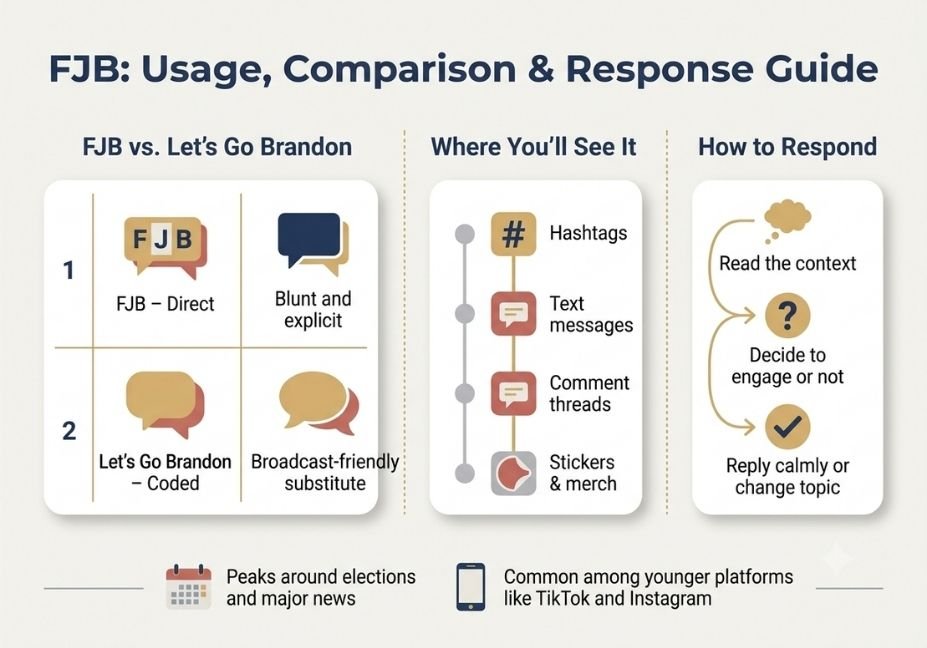
- FJB is direct. It spells out the profanity, just abbreviated.
- “Let’s Go Brandon” is indirect. It’s a coded substitute that lets people say the same thing in polite company or on TV.
- FJB tends to show up in comments, hashtags, and casual texts between people who already share the same views.
- “Let’s Go Brandon” shows up more often in public, family-friendly, or broadcast-safe settings, like merchandise or spoken conversation.
- FJB reads as more blunt and confrontational than its euphemistic cousin.
Think of “Let’s Go Brandon” as the PG version, while people use FJB when they don’t want to soften the message.
How People Use FJB in Texts and Online
People use FJB in a few recurring situations, and the context usually makes its meaning clear.
In political conversations. This is the most common use by far. People post it under news stories, government announcements, or policy debates to signal disagreement without writing out a full sentence.
In memes and image captions.People use FJB on images, flags, stickers, and short video captions as a quick punchline or identity marker rather than a fully reasoned argument.
In texts between friends. Someone might text it after seeing frustrating news, almost like shorthand for “ugh, politics” rather than a deep political statement.
In hashtags. Because it’s short, FJB works well as a hashtag on platforms like X, TikTok, and Instagram, where character space and searchability matter.
As group identity signaling. For some users, dropping FJB into a bio or a comment is less about the specific policy complaint and more about broadcasting which political tribe they belong to.
Real Examples of FJB in Conversation
Seeing the term in a real exchange makes it easier to spot the pattern. Here are a few realistic examples of how it shows up.
Text between friends after a news alert: Friend 1: “Did you see gas prices again? FJB honestly.” Friend 2: “Yeah it’s rough out here.”
Comment under a political news post: “FJB. This policy is going to hurt small businesses.”
Caption under a meme image: “When you check your grocery bill – FJB”
Hashtag on a photo from a rally or event: “#FJB #LetsGoBrandon”
Text that’s more joking than serious: Friend 1: “Traffic made me an hour late again.” Friend 2: “FJB lol” (used as an exaggerated joke, not a real political statement)
Notice how the tone shifts depending on the setting. In a genuine political post, FJB is a real statement of opinion. In a joking text between friends, it can be closer to a sarcastic reflex than an actual political stance, similar to how people jokingly blame the weather or bad luck for something unrelated.
Is FJB Offensive?
Yes, many people consider it offensive, and it’s worth taking that seriously before you use it yourself. The phrase contains implied profanity, it’s aimed directly at a real public figure, and it’s tied to a politically charged moment that still divides opinion. Even though the letters look harmless on their own, most readers instantly decode what they stand for.
That makes FJB a poor fit for professional settings, customer service chats, workplace Slack channels, or conversations with people whose politics you don’t know. In more casual, like-minded group chats or meme pages, it tends to land as expected and doesn’t raise many eyebrows.
If you’re unsure how a specific person or audience will react, it’s safer to leave it out entirely. Slang like this can shut down a conversation fast if the other person disagrees or simply doesn’t want politics mixed into a casual chat.
What to Do If Someone Texts You “FJB”
Getting an unexpected FJB text can feel confusing, especially if you weren’t talking about politics. Here’s how to think through a response:
- Consider the relationship. A close friend venting is different from a coworker or acquaintance.
- Read the surrounding context. Was there a news story, a policy change, or an event that triggered it?
- Decide if you want to engage. You’re not obligated to respond to political commentary just because it showed up in your messages.
- Keep it low-key if you disagree. A neutral reply or simply changing the subject avoids unnecessary conflict.
- Ask directly if you’re confused. “What’s FJB?” is a completely normal question and doesn’t make you look out of touch.
There’s no rule that says you have to match the energy of a political text. You’re free to acknowledge it, ignore it, or steer the conversation somewhere else entirely.
Does FJB Vary by Age Group or Platform?
Not everyone uses FJB the same way, and age plays a real role in how it’s understood.
Older users, especially those who followed the original 2021 NASCAR story closely, tend to use FJB with a clear, deliberate political meaning. For them, it’s a direct statement, not a throwaway joke.
Younger users, particularly on TikTok and Instagram, are more likely to have encountered FJB secondhand through memes rather than the original news event. For this group, the phrase can feel more like a piece of internet culture or a punchline than a considered political opinion, even when the words are identical.
Platform also shapes tone. On X and Facebook, where political discussion is common, FJB tends to appear in genuinely political threads. On TikTok and Instagram, it shows up more often in captions, stitched videos, and comment sections where humor and irony blur the line between a real statement and a joke. Text messages sit somewhere in the middle, since they depend entirely on the relationship between the two people texting.
None of this changes what the letters technically stand for, but it does affect how seriously you should take it when you see it.
Is FJB Still Used in 2026?
The term hasn’t disappeared, but it isn’t at the fever pitch it hit back in 2021 and 2022. Usage tends to spike around elections, major policy news, or anniversaries of the original NASCAR incident, then quiet down in between. Linguists who track internet slang, including researchers who contribute to dictionary sites’ slang-monitoring projects, note that politically charged acronyms like this often follow the news cycle rather than fading away completely. Expect FJB to keep resurfacing whenever U.S. politics dominates headlines again.
Other, Rarer Meanings of FJB
Outside of politics, FJB can occasionally stand for something else entirely, though these cases are far less common:
- A person’s initials on a name tag, email signature, or username
- A small business or brand abbreviation
- A custom hashtag or handle unrelated to politics
If FJB shows up in a context with zero political cues, like a business card or a gaming username, it’s worth pausing before assuming the political meaning. Context is still the best clue you have.
A good rule of thumb: look at what surrounds the letters. If there’s a flag emoji, a news link, a political hashtag, or a comment about a policy nearby, the political meaning applies. If FJB appears next to a name, a job title, or unrelated small talk with no political undertone, it’s more likely one of these rarer, unrelated uses.
FAQs
What does FJB stand for?
FJB stands for “F*** Joe Biden,” a political slang phrase used online and in texts to express criticism or frustration.
Is FJB offensive?
Yes, many people find it offensive since it includes censored profanity aimed at a real public figure.
What’s the difference between FJB and “Let’s Go Brandon”?
They mean the same thing, but FJB is direct while “Let’s Go Brandon” is a coded, broadcast-friendly substitute.
Does FJB always mean something political?
Almost always, though it can rarely stand for initials, a username, or a small business name outside political contexts.
How should I respond if someone sends me FJB?
You can ignore it, ask what it means, or gently steer the conversation elsewhere if you’d rather not engage.
Is FJB the same everywhere online?
Mostly, but tone varies by platform and age group, ranging from serious political statements to joking, meme-style usage.
Can FJB mean something other than politics?
Rarely, it can be initials, a username, or a business abbreviation, but political use is far more common.
The Bottom Line
FJB is short for a profane, politically charged phrase directed at Joe Biden, born out of the viral “Let’s Go Brandon” moment from a 2021 NASCAR interview. It shows up most often in political comment threads, memes, hashtags, and casual texts between people who share the same views, and it’s widely seen as offensive outside of those circles. If it lands in your messages unexpectedly, you don’t need to overthink it: read the context, decide how much you want to engage, and respond in whatever way feels right for that relationship. Now that you know exactly what it means and where it came from, you’ll never be caught off guard by those three letters again.