
You get a text back that just says “k.” Or “sure.” Or “lol ok.” And suddenly you’re staring at your phone trying to figure out what it actually means. That moment of pausing to work out someone’s real intent behind their words is what people are talking about when they say “decoding” a text.
This guide explains exactly what decoding meaning in text refers to, where the term comes from, how it shows up in real conversations, and how to get better at doing it without spiraling into overthinking. By the end, you’ll know how to spot what a message is really saying, not just what it literally says.
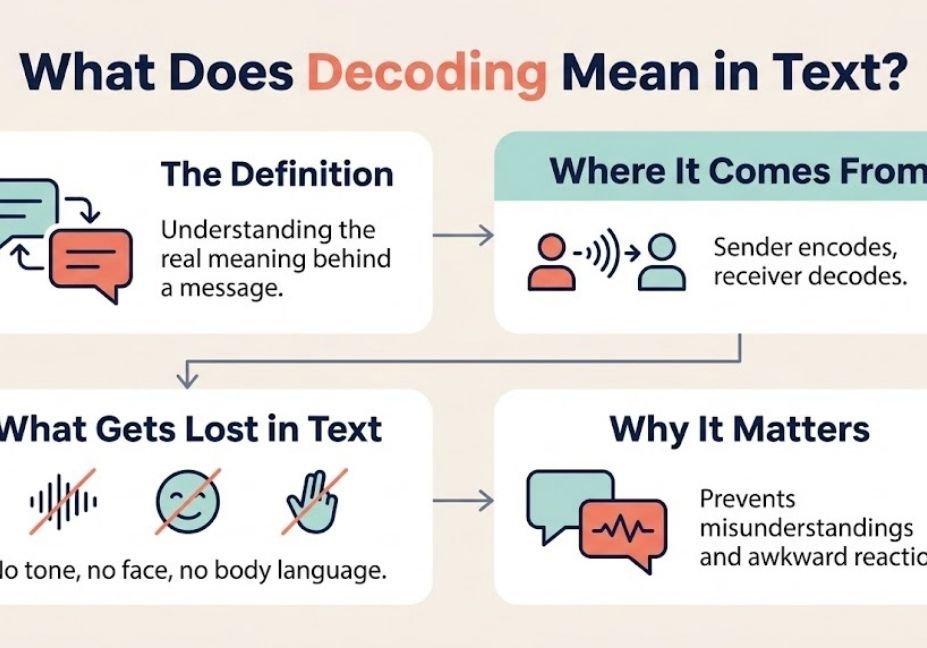
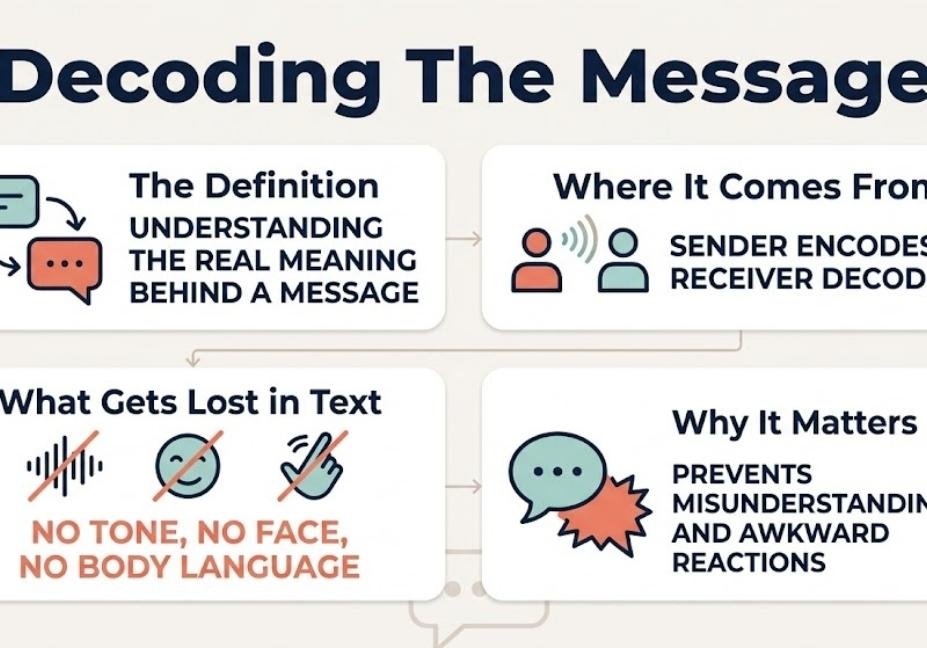
Decoding meaning in text means figuring out what a person actually intends to say in a message, beyond just the literal words. It involves reading tone, context, timing, emojis, and word choice to understand the real message behind a text, DM, or comment.
Also read the article : Staccato Sentences Meaning: How to Use Them
What Does Decoding Mean in Text? (Full Definition)
Decoding meaning in text is the process of interpreting a written message to understand its true intent, tone, or emotion. It’s the opposite of taking a text purely at face value.
When you talk to someone in person, you pick up dozens of small signals without even trying: their tone of voice, facial expression, pacing, and body language all add context to their words. Text strips almost all of that away. All you’re left with is plain words on a screen, sometimes with an emoji or a punctuation mark doing the heavy lifting.
So when someone says they’re “decoding” a message, they mean they’re filling in that missing context using everything else they know: the relationship, the timing of the reply, past conversations, and common texting habits. It’s less about analyzing words in isolation and more about reading the whole situation the words showed up in.
This is also why the same exact text can mean two completely different things depending on who sent it. A one-word “fine” from your best friend might just be a normal, breezy answer. The same word from someone you had an argument with an hour ago probably means something very different. Decoding accounts for that difference instead of ignoring it.
Where the Word Decoding Comes From
The word decode isn’t internet slang. It’s a real English word with roots in classic communication theory. Mid-twentieth-century researchers studying how messages travel between people described communication as a loop: a sender encodes an idea into a message, and a receiver decodes that message to understand it. Dictionary sources like Merriam-Webster still define decode in this original sense, as translating a coded message back into its intended meaning.
Texting culture picked up the word informally because it fits so well. A short reply like “fine” really is a kind of code. The literal word is simple, but the intended meaning depends entirely on who sent it, when, and why. Reading that hidden layer became known, casually, as decoding.
Linguists sometimes describe this missing layer as paralanguage: everything around the words themselves, like tone, pacing, and emphasis, that carries meaning in spoken conversation. Texting has no built-in paralanguage, so people invented substitutes for it over time. Punctuation started doing double duty, capital letters started signaling emphasis or shouting, and emojis became stand-ins for facial expression. Understanding this substitution is a big part of what decoding actually involves.
Also read the article : Text to Text Meaning: What This Phrase Really Means
How People Use Decoding in Everyday Texting
The word shows up differently depending on who’s texting and why. The context of the relationship changes what counts as normal, which is exactly why the same message can be decoded two different ways by two different people.
In Casual Chats With Friends
Friends often use short, blunt replies without meaning anything by it. A one-word “yep” from a close friend usually means exactly what it says, because the relationship already has a baseline of shorthand and trust built in. Decoding here is quick and low-stakes, mostly about matching tone to the relationship rather than searching for hidden meaning that probably isn’t there.
Long-running friend groups also develop their own inside jokes, running bits, and shorthand that would look confusing to an outsider. Decoding within that group often means recognizing a callback to an old joke rather than interpreting the words on their own.
On Social Media
Comments, captions, and DMs get decoded constantly, often by an audience much wider than the original sender intended. A caption like “feeling blessed” might genuinely express gratitude, or it might be a subtle flex aimed at a specific follower. People decode captions by looking at the poster’s usual style, the timing of the post, and the context around it, such as what else has been happening in their life recently.
Comment sections add another layer, since a single comment might be decoded differently by dozens of readers who don’t share the same background knowledge the original poster and commenter do.
In Dating and Texting Someone New
This is where decoding gets the most attention, and probably why so many people search for this topic in the first place. A slow reply, a short answer, or a dry “haha” can spark a lot of second-guessing early in a relationship, because there’s no shared history yet to read the message against. Every early text effectively has to be decoded from scratch, without the baseline that close friends or long-term partners already have.
This is also where decoding most easily tips into overthinking, since the stakes feel high and the evidence is thin. A single lowercase reply gets picked apart far more than it would from someone you’ve known for years.
At Work
Workplace messages get decoded for a different reason: politeness often hides the real point. A message like “let’s circle back on this” usually signals the topic is being deprioritized, not genuinely revisited soon. Similarly, “when you get a chance” often means “soon, please,” dressed up to sound relaxed. Learning to decode workplace phrasing helps you catch what’s actually being communicated instead of taking corporate politeness at face value.
Email and chat platforms like Slack add their own layer here too, since a message posted late at night or with unusually short punctuation can read as more urgent or more curt than the sender intended.
Also read the article : HGS Meaning in Text: What This Slang Really Means
Examples of Decoding Common Texts
Short, common replies and what they often signal once decoded:
- “k” from someone who usually writes full sentences often signals annoyance
- “sure” with no punctuation can read as reluctant rather than enthusiastic
- “haha” alone, with nothing else, often just fills space rather than showing real amusement
- “we should hang out sometime” without a plan usually means no concrete plan is coming
- “no worries” can genuinely mean no worries, or can mask mild irritation depending on timing
- a long pause before a short reply often carries more weight than the words themselves
- a text with excessive exclamation points can signal forced enthusiasm rather than real excitement
- “it’s whatever” almost always means it is not actually whatever to that person
- a one-word reply after a long, detailed message often signals disinterest in the topic
- “I’m fine” sent quickly after a disagreement rarely means the person is actually fine
None of these are fixed rules. The same words from two different people can mean completely different things, which is exactly why decoding depends so heavily on context rather than a fixed dictionary of phrases.
How Emojis and Punctuation Change the Meaning
Since texting has no tone of voice, emojis and punctuation ended up carrying a surprising amount of the emotional weight in a message. Decoding a text often means paying as much attention to these small details as to the actual words.
A period at the end of a short text can read as blunt or final, especially to younger texters who mostly leave periods off casual messages. An exclamation point can turn a flat statement into something that sounds upbeat and friendly. Ellipses tend to signal hesitation, trailing thought, or awkwardness, depending on what comes before them.
Emojis work similarly. A simple “ok 👍” reads as more final and less warm than “ok 😊,” even though the base word is identical. A winking emoji can soften a blunt comment into a joke, while the same comment without it might land as harsh. None of these signals are universal, though. Punctuation habits and emoji choices vary a lot between age groups, cultures, and even individual people, so decoding them accurately depends on knowing how that specific person normally texts rather than applying a one-size-fits-all rulebook.
Capitalization plays a similar role. Writing in full capital letters is widely read as shouting or strong emphasis, while switching to all lowercase, even for full sentences, has become a common way some texters signal a calm or laid-back tone. Recognizing these small formatting choices is often the fastest way to decode the emotional undertone of a message.
The Psychology Behind Why People Decode Texts
There’s a simple psychological reason decoding feels so automatic: humans are wired to look for social meaning in almost any signal, even a minimal one like a text message. This tendency helped people read intent and danger accurately in face-to-face situations for most of human history, long before texting existed.
Text messages give that same instinct very little to work with, so the brain fills in gaps using whatever context is available, including past experience with that person, current mood, and even unrelated stress from earlier in the day. This is part of why the exact same message can be decoded completely differently depending on what else is happening in the reader’s life at that moment.
This also explains why decoding feels more intense in situations with higher emotional stakes, like early dating or a tense work relationship. When the outcome matters more, the brain works harder to extract meaning from limited information, which is exactly the environment where overthinking tends to take over.
Also read the article : This Indian Tribal Pick Up Line Left Everyone Speechless
Common Mistakes People Make When Decoding Texts
Decoding goes wrong in a few predictable ways, and knowing them makes it easier to avoid them.
- Assuming every short reply is negative, when it’s often just genuinely busy typing
- Reading your own mood into someone else’s neutral message
- Ignoring how that specific person normally texts and comparing them to a general standard instead
- Treating one data point, like a single delayed reply, as solid proof of a bigger pattern
- Forgetting that punctuation habits vary a lot by age group and personal style
Most decoding mistakes come from filling in a blank with the worst-case guess instead of the most likely one. Slowing down and checking the pattern against how that person usually communicates fixes most of these errors on its own.
Why Decoding Text Matters
Text removes tone of voice, facial expression, and body language, the three things people naturally rely on most in face-to-face conversation. Without them, plain words become easy to misread. A message meant as neutral can come across as cold. A joke can land as an insult.
Getting decoding right matters because misread texts cause real friction: unnecessary arguments, awkward silences, and relationships that cool off over a misunderstanding that was never actually there. Learning to decode well is really just learning to fill in missing context accurately instead of guessing, and it becomes more valuable the more of your daily communication happens through a screen rather than in person.
There’s also a quieter benefit: people who decode well tend to respond more thoughtfully, since they’re reacting to what someone likely means rather than just the surface-level words. That tends to reduce unnecessary conflict on both ends of the conversation, not just for the person doing the decoding.
How to Get Better at Decoding Messages
Decoding is a skill, and it improves with a few deliberate habits.
- Read the message twice before reacting, once for words and once for tone
- Compare it to how that specific person usually texts, not to texting in general
- Factor in timing, since a reply after five hours reads differently than one after five minutes
- Consider what else might be going on in their day before assuming it’s about you
- Notice punctuation and capitalization patterns, since they often carry the emotional weight
- Ask a direct, low-pressure follow-up question instead of guessing when it really matters
These habits shift decoding from a guessing game into something closer to genuine understanding. Over time, most people build an informal mental model of how each close contact texts, which makes decoding almost automatic for the people they talk to most.
Decoding vs Overthinking: Knowing the Difference
There’s a real line between decoding a text well and overthinking it, and most articles on this topic skip right past it.
Healthy decoding is quick, evidence-based, and done once. You notice a signal, weigh it against what you already know about the person, and move on. Overthinking is what happens when that process doesn’t stop. It’s rereading the same message ten times, hunting for meaning that probably isn’t there, and building an entire theory out of one missing punctuation mark.
A good gut check: if you’ve reread a text more than two or three times and you’re still unsure, you’ve likely left decoding behind and moved into overthinking. At that point, the most accurate way to find real meaning is usually just to ask, rather than keep analyzing. No amount of rereading a short message will ever give you information the sender didn’t actually put there.
Also read the article : Cow Pick Up Lines: The Cheesiest Way to Say Moo I Love You
FAQs
What does it mean when someone says they’re decoding a text?
It means they’re trying to figure out the real intent or emotion behind a message, not just its literal words.
Is decoding a text the same as overthinking it?
Not exactly. Decoding is a quick, one-time read of tone and context. Overthinking is repeatedly rereading a message without reaching a clear answer.
Where does the word decoding come from?
It comes from communication theory, where a sender encodes a message and a receiver decodes it to understand the meaning.
How can I get better at decoding texts?
Compare the message to how that person usually texts, factor in timing, and ask directly when it’s unclear instead of guessing.
Conclusion
Decoding meaning in text simply means reading past the literal words to understand what someone actually intends, using tone, timing, context, and history with that person to fill in what texting naturally leaves out. It’s a normal, everyday skill, not internet slang, and it becomes far more useful once you know how to stop it from turning into overthinking. The next time a short reply leaves you wondering, run through the context instead of the worst-case scenario, and ask directly when you genuinely can’t tell.