
You’re scrolling through a chat and someone says “let’s just do text to text” or “I prefer text to text meaning” pops up somewhere online, and now you’re pausing to figure out what it actually means. It sounds simple, but the phrase carries more than one meaning depending on where you see it, and that’s exactly why so many people search for it.
The good news is that text to text meaning isn’t complicated once you separate the two real contexts it shows up in. Most of the time, it’s about how people choose to communicate, texting instead of calling or meeting up. Less often, especially in tech and AI spaces, it refers to turning one piece of written content into another. This guide breaks down both meanings clearly, shows you real examples, and helps you know exactly which one applies when you see it.
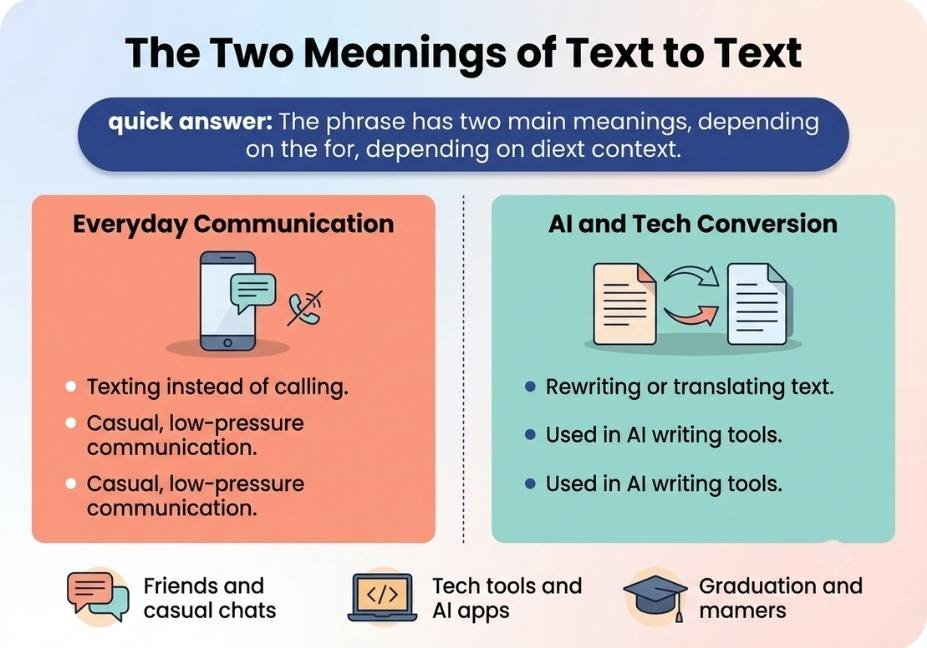
Quick answer: Text to text usually means communicating through written messages instead of phone calls, video chats, or in-person conversation. In technology and AI contexts, it can also mean converting one piece of text into another, like rewriting, translating, or summarizing written content. Context tells you which meaning applies.
The Two Real Meanings of Text to Text
Unlike slang abbreviations that get made up and spread through group chats, “text to text” is a plain English phrase built from two words that already mean something. That’s actually why it has two legitimate meanings instead of five made-up ones. It’s not being reinterpreted randomly, it’s just being used in two genuinely different fields: everyday communication and technology.
1. Communicating Through Text Messages Instead of Calling
This is the meaning almost everyone means when they use the phrase casually. “Text to text” describes a conversation happening entirely through written messages rather than a phone call, video chat, or face-to-face talk. Someone might say “let’s keep this text to text” to mean they’d rather type than talk on the phone.
This usage has grown alongside a broader shift in how people prefer to communicate. Plenty of research on digital communication habits has tracked how younger generations increasingly default to texting over calling, treating a phone call as something reserved for urgent or more formal situations. “Text to text” captures that preference in a short, casual phrase.
Example: “Can we just keep this text to text? I’m not really in the mood to talk out loud right now.”
In this context, it’s rarely about hiding something or avoiding a person. It’s simply a communication preference, similar to saying “let’s just message instead of calling.”
2. Converting or Comparing Written Text (AI, Tech, and Academic Use)
The second meaning shows up in a completely different setting: technology, writing tools, and sometimes academic work. Here, “text to text” describes taking one piece of written content and turning it into another form of written content, without involving audio, images, or video.
This shows up constantly in AI tools. When software rewrites a sentence, translates it into another language, or summarizes a paragraph, that’s a text to text process. The input is text, the output is text, nothing else changes format.
Example: Original: “The weather conditions were unfavorable throughout the weekend.” Rewritten: “The weather was bad all weekend.” Both versions are text, so this is a text to text transformation.
In academic settings, “text to text” sometimes describes comparing two written works, like connecting a theme in one book to a similar idea in another. It’s a slightly different angle on the same core concept: text relating to text, rather than text relating to real-world experience or another format.
This technical sense has become far more visible as AI writing tools have spread into everyday use. Many popular language models are built around exactly this kind of task, taking a written prompt and producing a written response, which is a text to text process at its core. Whether the task is summarizing a long report, translating a paragraph into another language, fixing grammar, or rewriting something in a different tone, the underlying pattern is the same: written words go in, different written words come out. Understanding this meaning helps make sense of why the phrase pops up so often in articles and discussions about AI, even when the writer never explains it directly.
How to Tell Which Meaning Applies
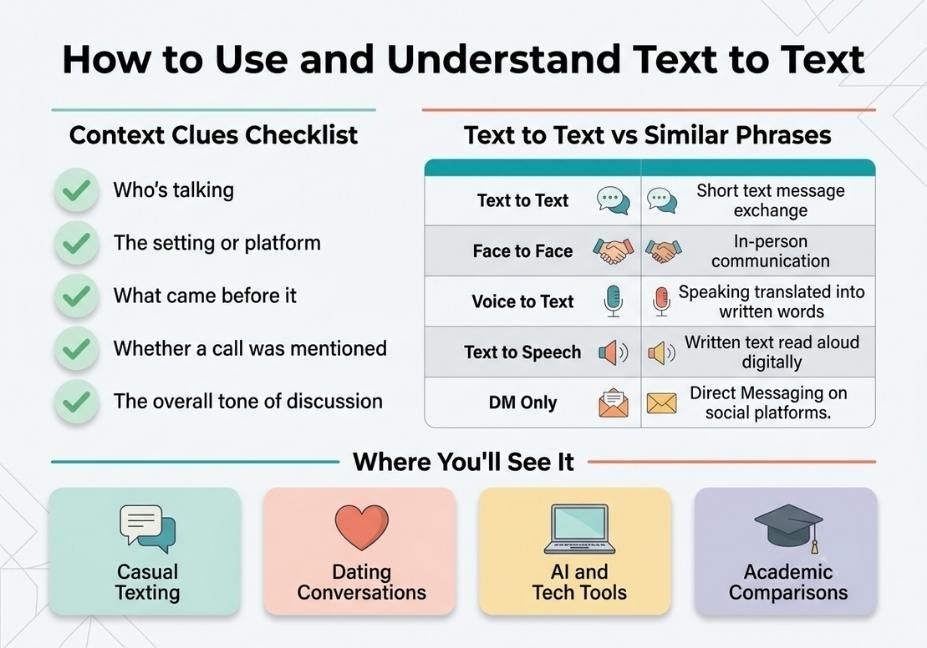
Since the phrase carries two genuinely different meanings, context does all the work of telling them apart. A few quick checks make it obvious almost every time.
- Check who’s talking. Friends and casual chats almost always mean the communication sense.
- Check the setting. Tech tools, AI apps, and coding contexts point to the conversion sense.
- Check what came before it. A rewritten sentence nearby signals text conversion.
- Check if a phone call or meeting was mentioned. That points to the communication meaning.
- Check if it’s a school assignment. That often signals the academic comparison sense.
If you’re texting a friend and they use the phrase, it’s almost certainly about communication style. If you’re reading a tech article or using a writing tool, it’s almost certainly about converting text.
Text to Text in Real Conversations
Seeing the phrase in context makes the difference click faster than definitions alone.
Casual chat: “Can we talk later?” / “Can we just keep it text to text? I’ve got a headache and don’t want to be on the phone.” Here it’s clearly about communication preference, not converting anything.
Dating context: “I know you like calling, but can we do text to text for now?” This usually signals someone wants to keep things lower-pressure or more casual, at least for the moment.
Tech context: “This app uses a text to text model to summarize long articles into short paragraphs.” Here it’s clearly about AI processing written input into written output.
Academic context: “Our assignment is a text to text comparison between the two novels.” This is the comparison sense, connecting themes across two written works.
Each example makes sense once you read the sentence around it. The phrase itself never changes, but the surrounding words point clearly to one meaning or the other.
Text to Text vs. Similar Phrases
Comparing “text to text” to related phrases helps make its meaning even clearer.
- Text to text: written communication only, or converting text into new text.
- Face to face: talking in person, the opposite of text-based communication.
- Voice to text: speaking out loud and having it converted into written words.
- Text to speech: written words converted into spoken audio.
- DM only: a narrower phrase specifically about private messaging, not calls.
Seeing it next to these related terms shows why “text to text” isn’t slang. It follows the same pattern as well-established phrases like “voice to text” or “text to speech,” just applied to written content going in and staying in written form.
Why This Phrase Is Becoming More Common
A few real shifts explain why people run into “text to text” more often now than a decade ago. Texting became the default communication method for most people well before other habits caught up, so naming that preference out loud, “let’s just do text to text,” became a natural way to set expectations early in a conversation.
At the same time, AI writing tools exploded into daily use for students, marketers, and professionals. Every time someone asks an AI tool to rewrite, translate, or summarize something, they’re using a text to text process, even if they never use that exact phrase. The term picked up more visibility simply because the underlying technology became part of everyday work.
Dictionary and language-reference communities that track evolving phrases note that expressions built from plain, everyday words, rather than invented acronyms, tend to spread this way: quietly, through repeated natural use, until enough people start typing them into search bars wondering if there’s a deeper meaning they’re missing. That’s exactly the pattern behind “text to text.”
How Text to Text Communication Has Changed Over Time
Communication habits have shifted a lot over the past two decades, and “text to text” is really a snapshot of where things have landed. Phone calls used to be the default way to reach someone, texting was the backup option for quick, low-stakes messages. That order has essentially flipped for a large share of people, especially younger generations, where a phone call can now feel like the more unusual, even slightly alarming, choice.
That shift explains why naming the preference out loud became useful. When texting was rare, nobody needed to say “let’s do text to text,” because typing back and forth was already the exception. Now that texting is the default for so many relationships and friendships, calling out a preference for staying entirely in text form serves a real purpose, it sets expectations early and avoids any confusion about whether a call might be coming.
This doesn’t mean phone calls have disappeared. Plenty of situations still call for them: emotional conversations, quick logistics, or moments where tone matters and typing risks being misread. “Text to text” as a phrase often appears specifically in situations where someone wants to flag that they’re intentionally choosing the written route instead of defaulting to a call, which is a small but meaningful distinction from just texting without thinking about it.
Text to Text in Professional and Work Settings
The phrase shows up in workplaces too, though usually with a slightly more formal tone than in casual chats. A colleague might say they’d rather keep a conversation “text to text” over email or Slack instead of scheduling a call, especially for quick questions that don’t need a full meeting.
In professional contexts, this preference often comes down to efficiency rather than personal comfort. Written communication creates a natural record of what was said, which can matter for tracking decisions, sharing information across a team, or simply avoiding the back-and-forth scheduling that a call requires. Choosing text to text in a work setting is rarely about avoiding a person, it’s usually about choosing the fastest, clearest path to get a small thing resolved.
That said, complex or sensitive workplace conversations still tend to move to a call or a face-to-face meeting, since nuance and tone are much easier to convey out loud than through typed words alone. The phrase tends to apply mostly to routine, low-stakes exchanges rather than anything requiring real discussion.
Is Text to Text a Red Flag in Dating or Relationships?
Not inherently. Preferring text to text communication, at least for a while, usually just reflects comfort level, personality, or circumstances like a busy schedule or social anxiety around phone calls. It becomes worth paying attention to only if someone consistently avoids any voice or in-person contact over a long period, since that pattern is more about consistent behavior than the phrase itself. A single mention of preferring text to text is rarely meaningful on its own.
Common Mistakes People Make With This Phrase
A few misunderstandings come up often enough to mention directly.
- Assuming it’s slang or an acronym when it’s actually a plain descriptive phrase.
- Missing the AI and tech meaning entirely and assuming it only applies to chatting.
- Reading too much emotional weight into a casual communication preference.
- Confusing it with “text to speech,” which involves converting text into audio instead.
- Ignoring context clues and guessing based on only one possible meaning.
Avoiding these mistakes really comes down to one simple step: read the sentence around the phrase before deciding which meaning fits.
FAQs
What does “text to text” mean? It usually means communicating through written messages instead of calls, or converting one piece of text into another in AI and tech contexts.
Is “text to text” the same as texting? Mostly yes in casual use, though it more specifically emphasizes choosing text over calling or meeting in person.
What does “text to text” mean in AI? It refers to a process where written input is converted into written output, like rewriting, translating, or summarizing text.
Does “text to text” mean someone only wants to message, not call? Often, yes. It usually signals a preference for typing over talking, at least for that conversation.
What’s the difference between “text to text” and “face to face”? Text to text means written communication, while face to face means talking in person.
The Bottom Line
Text to text isn’t a mystery phrase once you separate its two real uses. In everyday conversation, it simply means someone wants to communicate through written messages instead of a call or a face-to-face talk. In tech, AI, and academic settings, it means turning one piece of written content into another. Once you know which world you’re in, whether it’s a casual chat with a friend or a description of how an AI tool works, the meaning becomes obvious almost immediately.