
You’re scrolling through a text or a comment section and someone drops “OG” like it’s obvious. Maybe they called you one. Maybe they used it to describe an old song, a game, or a friend. Either way, you’re left wondering what does og mean and whether you just got complimented or roasted.
Good news: it’s almost always a compliment. This guide breaks down exactly what does og mean, where the term came from, how people use it today in texting and on social media, what to say back when someone calls you one, and how to tell it apart from the handful of unrelated meanings the same two letters can carry in other contexts.
What Does OG Mean?
OG stands for “Original Gangster.” In modern slang, it’s used to describe someone or something that is authentic, respected, experienced, or the first of its kind. You’ll hear it as a compliment, like “you’re such an OG,” meaning you’re old-school, skilled, or a pioneer in whatever you do.
Where Does OG Come From?
The term didn’t start as internet slang. It has real roots in Los Angeles street culture.
According to Dictionary.com’s slang team, the phrase first spread in the early 1970s through the Original Gangster Crips, a gang based in South Central Los Angeles. Members used “OG” as shorthand to identify which part of the gang they belonged to, and it also carried the meaning “we’re the first.”
As the gang grew through the 1970s, the meaning shifted slightly. An OG became someone who had been deeply committed to their group for a long time, a veteran, not just a founder. Younger members used it to show respect toward the elders who had been around the longest.
By the 1980s, OG had crossed into commercialized rap music. Artists used it to describe someone who was impressive, hardened, and respected within gang culture, and audiences outside of that culture picked it up too. Rapper Ice-T is widely credited with helping push the term into the mainstream, using it in his music to describe seasoned, street-smart figures who commanded respect. From there, OG stopped being tied to any single group. It became shorthand that any music fan, athlete, or online community could borrow.
Merriam-Webster’s dictionary entry now defines OG simply as someone or something that is an original or originator, especially one that’s highly respected. That’s the version most people use today, completely separate from any gang connection. It’s a good example of how slang can keep its emotional core (respect, authenticity, being first) while shedding the specific culture it came from.
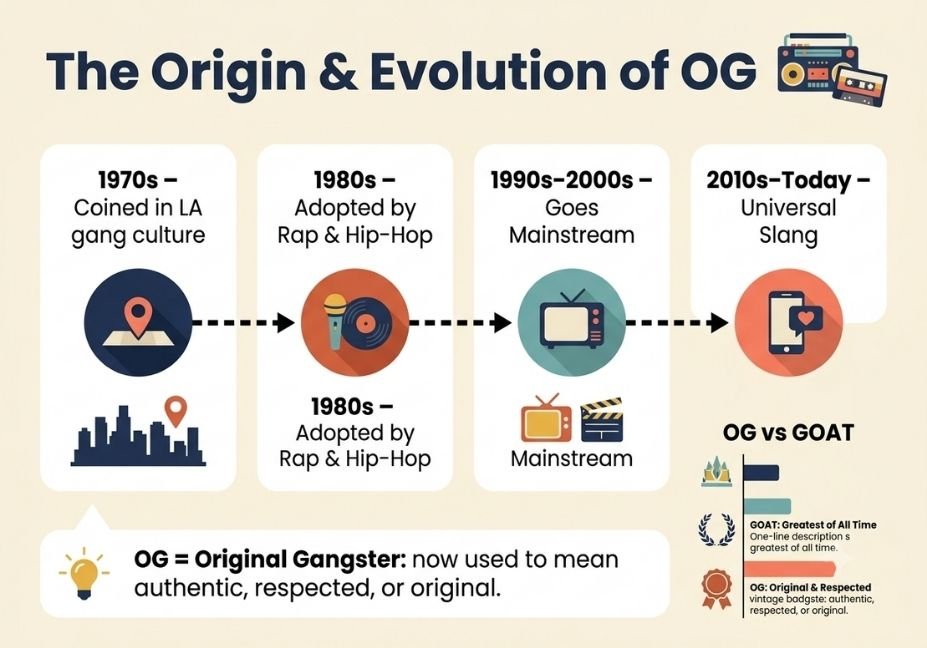
quick timeline of how OG evolved:
- 1970s: Coined by the Original Gangster Crips in Los Angeles as an identity marker.
- 1980s: Adopted by rap and hip-hop artists, spreading the term nationally.
- 1990s to 2000s: Used broadly in music, movies, and sports commentary as a mark of respect.
- 2010s to today: Fully mainstream, used across texting, gaming, and every major social platform.
What Does OG Mean in Texting and Social Media?
In everyday texting, OG has almost nothing to do with gangs anymore. It’s a casual, friendly compliment.
Here’s what it typically signals depending on where you see it:
- In a text from a friend: you’re respected, trusted, or have been around a long time.
- In a gaming chat: you’re a veteran player, not a newbie.
- In an Instagram or TikTok comment: the content, trend, or creator is original and early to the scene.
- In a caption about an old photo: this is the classic, original version of something.
What does OG mean from a guy?
Usually the same thing it means from anyone: respect. If a guy calls you “such an OG,” he’s saying you’re impressive, reliable, or someone he looks up to. It’s rarely flirtatious on its own, more of a friendly nod of admiration.
What does OG mean from a girl?
Same logic applies. Context matters more than gender here. If it’s paired with compliments about your personality or skills, it’s genuine praise. If it’s playful and teasing, it’s still positive, just lighthearted.
Real Example Sentences Using OG
Seeing the word in context makes it much easier to understand. Here’s how people actually use it in day-to-day conversation:
- “You helped me move apartments twice, you’re such an OG.”
- “This is the OG version of the song before the remix.”
- “He’s been playing this game since 2012, total OG.”
- “That restaurant was the OG spot before the chain opened downtown.”
- “My grandma taught me this recipe, she’s the real OG.”
- “Nice, you still have the OG iPhone from years ago.”
Notice the pattern. OG almost always attaches to something that came first, lasted the longest, or earned genuine respect along the way.
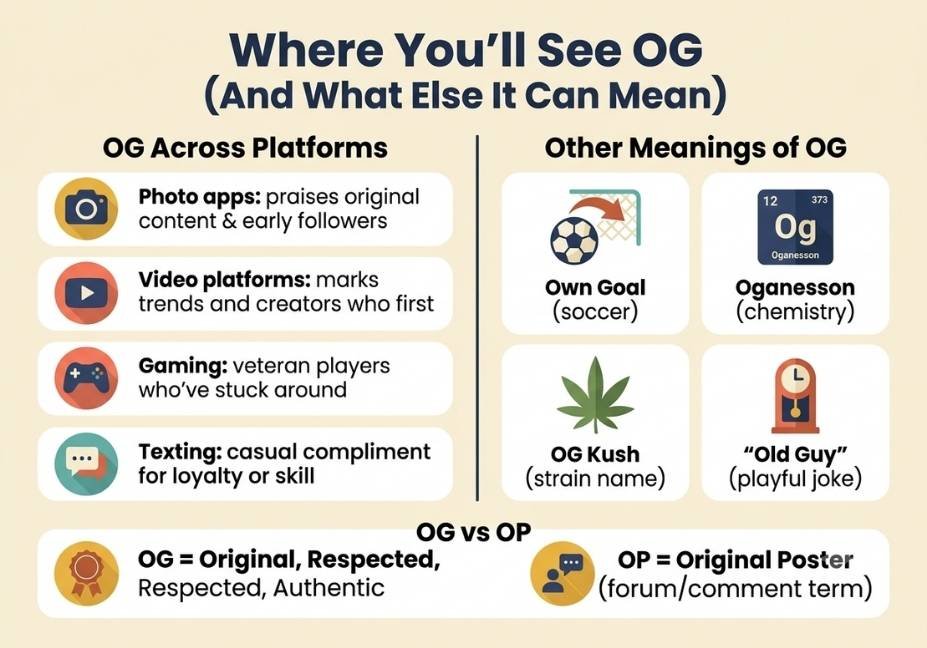
OG on Different Platforms
The term shows up slightly differently depending on where you see it:
- On Instagram, OG usually praises early followers, classic posts, or original content styles.
- On TikTok, OG often describes trends, sounds, or creators who started before something went viral.
- In gaming chats, OG marks veteran players who’ve stuck with a game since launch.
- On X (formerly Twitter), OG can describe accounts, memes, or usernames that predate copycats.
- In group texts, OG is simply a shorthand compliment for loyalty or long-term friendship.
Other Meanings of OG You Should Know
Because OG is a short abbreviation, it gets recycled across totally different fields. If the slang definition doesn’t fit the sentence you saw, one of these might.
- OG in soccer means “own goal,” when a player accidentally scores against their own team.
- Og is the chemical symbol for Oganesson, a synthetic element on the periodic table.
- OG in cannabis culture often appears in strain names like “OG Kush.”
- OG can jokingly stand for “Old Guy” or “Old Guard” in playful, non-slang contexts.
- OG sometimes means “Officer of the Guard” in certain British or military contexts.
If none of those fit, the slang meaning (original, respected, authentic) is almost always the correct read. Context clues usually give it away fast. A sports headline pairing OG with a scoreline is talking about an own goal. A chemistry textbook using Og next to a number is talking about the periodic table. A text from a friend praising your skills is talking about respect.
Common Mistakes People Make With OG
A few misunderstandings come up often enough that they’re worth clearing up directly:
- Assuming OG always references gangs, when in modern use it almost never does.
- Confusing OG with OP, which actually means “original poster” in forums and comments.
- Thinking OG is only for people, when it’s frequently used for songs, shows, and trends too.
- Reading “old guy” jokes as genuinely insulting, when they’re almost always lighthearted.
- Overusing OG in formal writing or professional emails, where it can feel out of place.
OG vs. GOAT: What’s the Difference?
Both terms are compliments, but they aren’t identical.
GOAT stands for “Greatest Of All Time” and focuses purely on being the best at something. OG focuses on history and authenticity, being first, being real, and earning respect over time. Someone can be a GOAT without being an OG if they’re new but exceptionally skilled. Someone can be an OG without being a GOAT if they were simply early or foundational, even if someone else eventually became better.
How to Respond When Someone Calls You an OG
Getting called an OG is a compliment, so there’s no need to overthink your reply. A few natural options:
- Say thanks and keep it casual, like “appreciate that” or “you know it.”
- Return the compliment if it fits, like “you’re one too.”
- Play along with humor if the tone is joking, like acting offended for a laugh.
- Ask what prompted it if you’re genuinely unsure of the context.
Matching the tone of the person who said it is usually the safest move.
Is OG a Compliment or an Insult?
In nearly every modern context, OG is a compliment. It signals respect, authenticity, or long-standing experience. The only exception is the playful “Old Guy” joke version, which can feel like a light tease about age, but it’s still generally affectionate rather than mean-spirited. If you’re ever unsure, the safest assumption is that someone is complimenting you.
Regional and Generational Differences
Older generations, especially those familiar with 1980s and 1990s hip-hop, tend to associate OG closely with its “Original Gangster” roots and gang culture history. For them, calling someone an OG often carries a slightly heavier weight, tied to survival, loyalty, and street credibility earned over years. Younger users, particularly Gen Z on platforms like TikTok and Instagram, use OG far more loosely. To them, it often just means “original,” “classic,” or “was here first,” with little to no connection to the term’s gang-culture origin. Both usages are correct; they’re just different points on the same word’s evolution.
There’s also a noticeable difference in how often each generation uses the term. Millennials and Gen Z reach for OG constantly, applying it to everything from sneakers to streaming shows to childhood friend groups. Gen X and older Boomers are less likely to use the word casually, but they typically recognize it immediately because of its strong association with 1980s and 1990s rap music and film.
Geography plays a role too. In the United States, OG usage is fairly uniform across regions thanks to national media and music exposure. Internationally, the word traveled through hip-hop’s global popularity, so you’ll hear OG used in gaming communities and social media comment sections in the UK, across Europe, and throughout Asia, almost always stripped of its original gang-culture context and used purely as a compliment about being first or respected.
OG in Pop Culture and Branding
The term has moved well beyond casual conversation and into marketing and pop culture references. Brands frequently label their original, classic products as the “OG” version to separate them from newer variations, like an “OG flavor” or “OG design.” Movie and TV fans use OG to distinguish an original cast or original storyline from reboots and spin-offs, saying things like “the OG cast was better.” Even product reviews and unboxing videos lean on the word, comparing a new release to its OG predecessor. This crossover into marketing shows just how far the term has traveled from its 1970s origins, now functioning almost like a stamp of authenticity that companies actively want associated with their products.
FAQs
Is OG a compliment or an insult?
It’s almost always a compliment, meaning someone is respected, authentic, or experienced.
What does OG mean from a guy in texting?
The same as from anyone: respect and admiration, usually with no romantic meaning attached.
What does OG stand for in soccer?
“Own goal,” when a player accidentally scores against their own team.
Is OG only used in hip-hop culture?
No. It started there but is now common in texting, gaming, and social media across all groups.
What’s the difference between OG and GOAT?
GOAT means best ever; OG means original, authentic, or respected, regardless of skill level.
Conclusion
So, what does og mean? At its core, it’s short for “Original Gangster,” a term born in 1970s Los Angeles gang culture that has since evolved into one of the internet’s most common compliments. Today, calling someone an OG means you see them as authentic, respected, experienced, or a true pioneer, whether that’s in gaming, fashion, friendships, or social media. Outside of slang, keep in mind it can also mean “own goal” in soccer or refer to the element Oganesson, so context always matters. The next time someone calls you an OG, take it as the compliment it almost always is.