
You’re scrolling through a group chat or a comment section, and there it is again: “fr.” Two letters, no punctuation, dropped into the middle of a sentence or standing entirely on its own. If you’ve ever paused to wonder whether it’s an abbreviation, a typo, or some inside joke you’re missing, you’re not alone. It’s one of the most common pieces of texting shorthand in circulation today, and once you understand it, you’ll start noticing it everywhere.
FR stands for “for real.” In texting and social media slang, it’s used to signal that someone is being sincere, serious, or in full agreement with whatever was just said. It’s less a word with new meaning and more a compressed version of a phrase people have said out loud for generations just squeezed down to fit the pace of digital conversation.
What Does FR Actually Mean?
At its core, “fr” is a verbal nod. It’s the text equivalent of nodding your head while someone talks, or saying “no, seriously” after you make a claim you’re worried might get brushed off as exaggeration. When someone types “fr” after a statement, they’re underlining that statement confirming they mean it, that it isn’t a joke, and that it isn’t hyperbole.
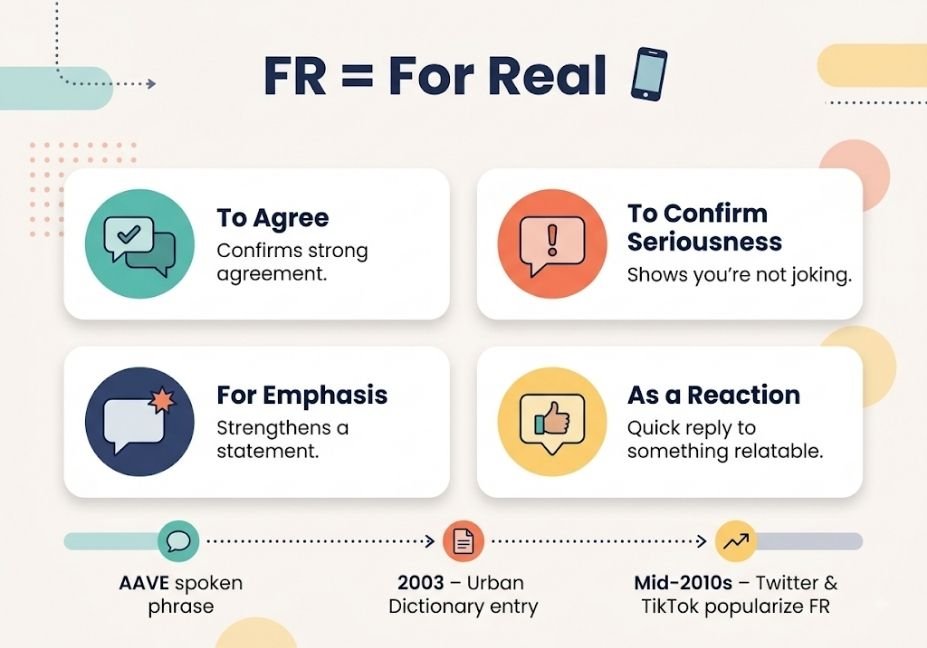
You’ll typically see it used in one of four ways:
- As agreement. Someone says something and you respond “fr” to signal that you feel exactly the same way, without needing to write out a full sentence.
- As a confirmation of seriousness. You’re clarifying that what you just said wasn’t a joke, even if it might sound like one out of context.
- As emphasis. Tacked onto the end of a sentence, it functions a lot like “seriously” or “genuinely” a way to strengthen a claim.
- As a reaction. In comment sections especially, “fr” pops up as a standalone reply to something funny, relatable, or surprising, almost like a shorter version of “same” or “this is so true.”
If a friend texts you “that movie was insane, fr,” they’re not adding new information to the sentence they’re adding conviction. It’s their way of saying “and I really mean that.”
Where FR Came From
The full phrase “for real” didn’t start on the internetIt has deep roots in African American Vernacular English (AAVE). The phrase has been used in everyday speech for decades. People often say “for real?” to confirm that something is true. They also use “for real” to stress that they are not exaggerating.
As texting and early internet forums grew in the early 2000s, people began shortening common phrases. This saved time, characters, and thumb movement. Slang trackers point to Urban Dictionary entries for the abbreviation “FR” as early as 2003. For years, however, it remained a niche form of internet shorthand. It did not become widely used until much later.
It didn’t become a true mainstream fixture until the mid-2010s. Twitter’s character limit pushed users toward shorter, punchier phrasing across the board, and abbreviations like “fr” fit that environment perfectly. From there, platforms like Instagram and especially TikTok picked it up and pushed it into daily use among younger internet users, cementing it as a staple of casual digital communication rather than a passing trend.
How FR Shows Up Differently Across Platforms
The underlying meaning of “fr” doesn’t really change from app to app but how often you encounter it, and in what form, shifts depending on where you’re scrolling.
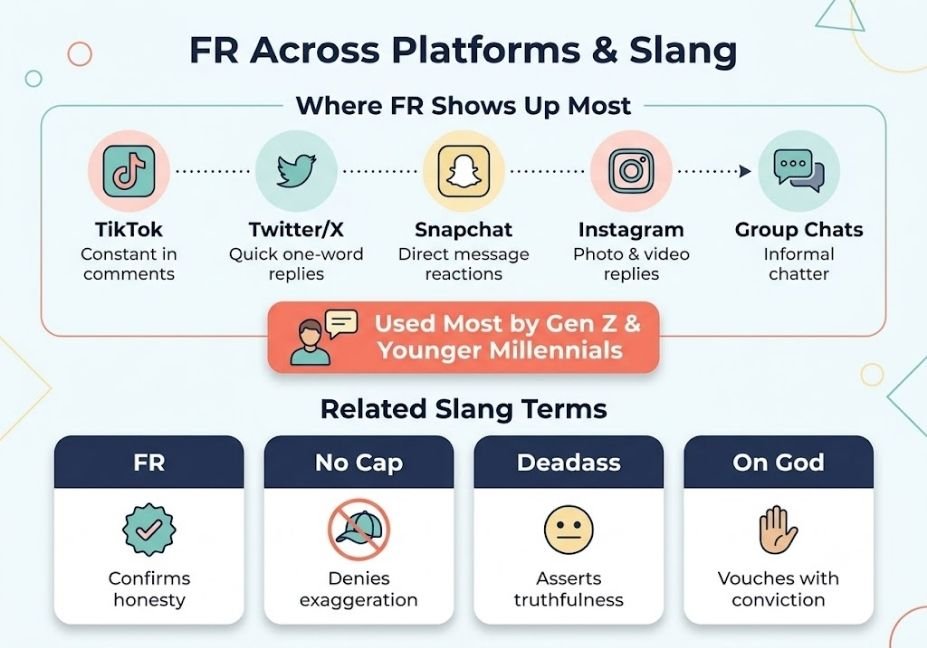
TikTok is probably where “fr” appears most densely. Comment sections under relatable, funny, or emotionally resonant videos are full of one-word “fr” replies, often stacked on top of each other as people pile on to agree with the original comment or the video itself.
Twitter/X still carries a lot of “fr” traffic, partly because of its historical role in popularizing short-form slang in the first place. The character constraint that shaped the platform for years trained users to reach for compact phrases, and “fr” fit right in.
Snapchat tends to use “fr” in a more conversational, one-on-one way confirming a statement between friends or asking whether something is genuinely true, closer to how the phrase functions in spoken conversation.
Instagram sees it mostly in captions and comments, usually as a way to add emphasis to a photo caption or agree with something in a comment thread.
Group chats, meanwhile, are where “fr” often shows up completely unadorned just the two letters on their own line, functioning as a quick reaction to something surprising, frustrating, or funny that someone else just said.
FRFR: The Intensified Version
Sometimes a single “fr” doesn’t feel like enough. That’s where “frfr” comes in literally “for real, for real.” It’s the linguistic equivalent of doubling down, used when someone wants to make absolutely sure the other person understands they mean what they’re saying.
You might see someone text “I’m not mad, frfr” after a tense exchange, specifically to reassure the other person that the reassurance itself is genuine not just something said to smooth things over. “Frfr” tends to show up most often among Gen Z and younger millennial texters, and it’s especially common as a response to disbelief. If someone doubts a claim (“wait, really?”), “frfr” is a natural way to double down without escalating into a longer explanation.
Is FR Rude or Disrespectful?
No — and this is one of the more common points of confusion for people encountering the term for the first time. “Fr” is entirely casual and isn’t considered rude or dismissive in any typical context. It functions the same way “seriously” or “I mean it” would in a spoken sentence, adding sincerity rather than sarcasm or attitude.
The one place it can feel out of place is formal or professional communication a work email, a message to someone you don’t know well, or any context where casual slang might read as unprofessional or unclear. In those settings, spelling out “genuinely” or “I’m being serious” communicates the same idea without the risk of the recipient not recognizing the abbreviation or reading it as too informal for the setting.
Does FR Mean Something Different From a Guy or a Girl?
Not really. The term carries the exact same meaning no matter who’s typing it there’s no gendered subtext or hidden interpretation layered onto it. If a guy texts “you’re funny, fr,” he means it sincerely. If a girl sends the identical message, the meaning is identical too.
What actually shapes the interpretation is the surrounding context, not the sender’s gender. A flirtatious conversation might use “fr” to underline genuine interest or attraction, while a casual conversation between friends might use the exact same word to agree about something completely unrelated to feelings a shared opinion about a TV show, a complaint about work, or a joke that landed. The word itself is neutral; the conversation around it does the heavy lifting.
FR in Real Conversations: Examples
Definitions only go so far — seeing the term in context is usually what makes it click. Here are a few common examples of how “fr” gets used in actual texts:
- “That test was so hard, fr” confirms genuine frustration rather than exaggeration for effect.
- “You’re actually really funny, fr” adds sincerity to what might otherwise read as a throwaway compliment.
- “I’m not mad, fr” reassures the other person that a statement is completely true, especially useful after a disagreement.
- “This song is stuck in my head, fr fr” uses the intensified double version purely for extra emphasis.
- “Wait, fr?” turns the term into a quick question, asking whether something is actually true.
Notice how flexible the word is. It can close out a statement, open a question, or stand entirely alone as a reaction. That flexibility is a big part of why it’s stuck around as long as it has.
Other Meanings of FR
Outside of texting slang, “fr” occasionally means something else entirely, and it’s worth knowing these alternate meanings so context doesn’t trip you up:
- In international contexts, FR is the standard country abbreviation for France.
- In gaming and tech spaces, FR can refer to frame rate how smoothly a game or video plays.
- In business and finance settings, FR sometimes stands for financial report.
In the context of a casual text message or social media comment, though, the slang meaning of “for real” is overwhelmingly the most likely interpretation, and it’s rarely confused with these other uses once you know the setting.
How to Reply to FR
Responding to “fr” is usually simple, since the term is more often a statement of sincerity than a direct question requiring an answer. If someone tacks “fr” onto something they said, a short agreement just texting “fr” back, or something like “I know right” keeps the exchange flowing naturally without overcomplicating it.
If “fr” shows up as a standalone question, like “wait, fr?”, you can answer honestly with something like “yeah, fr” if it’s true, or follow up with more detail if the situation calls for it. Because the term itself is so casual and low-stakes, there’s rarely a wrong way to respond it’s forgiving by nature.
FR Meaning by Generation
Usage of “FR” varies noticeably by age group. Gen Z and younger millennials use it the most naturally. For them, it is a normal part of everyday texting. They rarely see it as a new or trend-driven expression.
This group often uses “FR” instead of longer phrases. It appears in captions, comments, and casual conversations. They use it without giving much thought to the abbreviation. It has simply become part of how they communicate online.
Older millennials and Gen X usually recognize “FR” when they see it. However, they tend to use it less often themselves. Many understand its meaning from context rather than using it in their own messages.
This generational gap explains some of the confusion around “FR.” Someone who grew up writing full sentences may mistake it for a typo. They may also assume it is an unfamiliar acronym. In contrast, people who grew up texting during the TikTok era often recognize it instantly. For them, using “FR” can feel completely natural.
FR Versus Similar Slang Terms
“Fr” doesn’t exist in isolation it belongs to a small cluster of slang terms that all serve a similar emphasis-driven purpose in casual texting, and they often show up together in the same conversation.
- No cap pairs closely with “fr,” and both are used to confirm honesty though “no cap” specifically denies exaggeration or lying, while “fr” is more of a general sincerity marker.
- Deadass carries nearly identical meaning to “fr” and is often used interchangeably to stress that someone is being completely serious.
- Fr fr, the doubled version discussed earlier, simply adds stronger emphasis than a single “fr” on its own.
- On god functions similarly to “fr,” swearing to the truth of a statement in a casual, non-religious way that has nothing to do with actual religious meaning.
Recognizing these related terms makes it much easier to follow fast-moving conversations, especially ones where several of them get stacked together for extra emphasis something like “that’s crazy, fr fr, no cap” isn’t unusual in casual texting.
Common Mistakes People Make With FR
A handful of misunderstandings come up repeatedly when people first encounter “fr,” and they’re worth addressing directly:
- Assuming every “fr” needs a direct reply. Often it’s simply adding tone to a statement that already stands complete on its own no response is strictly required.
- Confusing “fr” with unrelated meanings like France or frame rate when the context is clearly casual texting.
- Using “fr” in formal emails or workplace messages, where it can come across as unclear to anyone unfamiliar with the term, or simply too casual for the setting.
- Overthinking the tone behind it. In the vast majority of cases, “fr” signals plain, uncomplicated sincerity rather than anything deeper or more layered.
Staying aware of these small mix-ups goes a long way toward keeping conversations clear and avoiding confusion over what is, at the end of the day, a fairly simple piece of slang.
When FR Shows Up in Flirting
“FR” also appears in flirty or romantic texting. It often adds extra sincerity to a compliment or expression of interest. For example, someone might say, “I actually really like talking to you, FR.” This shows they genuinely mean what they are saying. It suggests they are not simply being polite or making conversation.
The meaning of “FR” does not change in these situations. Instead, it shows how flexible the abbreviation can be. It works in casual conversations between friends and more personal, emotional exchanges.
Why FR Became So Popular
A few clear factors help explain why “fr” spread so widely and has stuck around rather than fading out like a lot of internet slang does.
Short abbreviations naturally fit the rhythm of digital conversation. Typing speed and character limits often matter more than complete sentences. “FR” also fills a gap in plain-text communication. Tone, facial expressions, and vocal inflection can get lost when people communicate through screens. Adding “FR” helps restore some of that missing sincerity. It can convey the emphasis that would come naturally through spoken conversation.
Its simplicity also helped it spread. Two letters are easy to remember and effortless to type. They are also instantly recognizable once people have seen them a few times. This gives “FR” an advantage over longer slang phrases. Longer expressions can fade from use because they take more effort to type.
Social media accelerated all of this. Twitter’s early character constraints rewarded short expressions across the board, and once “fr” caught on there, TikTok and Instagram carried it further, pushing it toward younger audiences worldwide. Unlike a lot of slang that burns out after a year or two of overuse, “fr” has stayed remarkably consistent in both meaning and popularity — likely because it serves such a simple, universal function that never really goes out of style.
Frequently Asked Questions
What does FR mean from a girl?
It means the same thing it means from anyone: “for real,” used to show sincerity, agreement, or emphasis in a message.
What does FR mean from a guy?
It carries the identical meaning of “for real,” confirming honesty or agreement, with no hidden or gendered interpretation behind it.
Is FR rude or disrespectful?
No. It’s casual slang meant to add sincerity to a message, and it isn’t considered rude in any normal conversational context.
Can I use FR in professional messages?
It’s best avoided in formal or professional communication. Spelling out “genuinely” or “I’m being serious” reads more clearly in those settings.
The Bottom Line
The meaning of “fr” in text comes down to one simple idea: sincerity.Whether someone is confirming a statement, agreeing completely, or asking if something is genuinely true, “FR” signals honesty in just two letters. It has remained popular because it fits naturally into fast, casual digital conversations. Once you understand it, you can easily recognize and respond to it in texts.