
Someone just texted you “hru” and you’re staring at your phone trying to figure out what does hru mean before you type back something that makes no sense. You’re not alone. This tiny four-letter combo shows up constantly in texts, Instagram DMs, TikTok comments, and gaming chats, and if you didn’t grow up texting in shorthand, it can feel like a small code you’re supposed to already know. This guide breaks down exactly what does hru mean, where it came from, and how to reply so you sound natural instead of confused.
By the end of this article, you’ll know the full meaning, how it’s used across different apps and age groups, when it’s fine to use, and when it might come across as a little too casual. You’ll also get quick, ready-to-use replies and a look at common mistakes, so the next time someone sends it your way, you won’t have to pause and Google it again.
Quick Answer: What Does Hru Mean?
Hru means “how are you.” It’s a texting and internet slang abbreviation used to casually check in on someone in a message, comment, or chat. It’s informal, common across almost every messaging app, and it’s simply a shortcut for a friendly greeting.
The Full Meaning Behind Hru
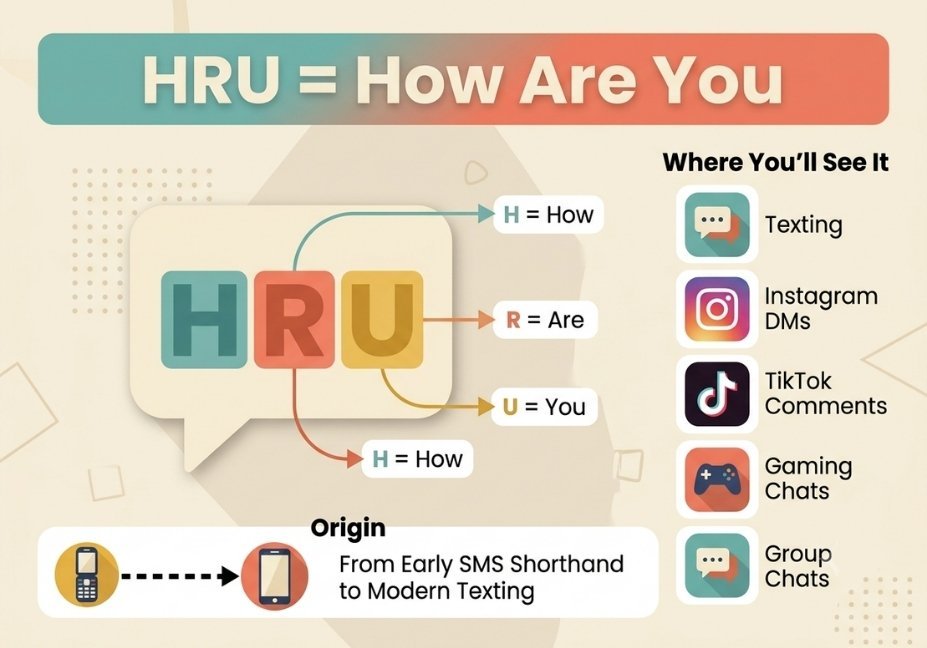
Hru is built from the first letters of a common phrase, using single letters to stand in for whole words. The “h” covers “how,” the “r” replaces “are,” and the “u” swaps in for “you.” Put together, it reads exactly like the sentence it’s shortening: how are you.
It’s part of a much bigger family of texting shorthand that swaps full words for single letters or numbers to save time and keystrokes. Think of it alongside terms like “u” for you, “r” for are, or “2” for to. None of these are complicated codes. They’re just faster ways to type things people already say every day.
So when someone sends you hru, they’re doing the digital version of a casual “hey, how’s it going.” It’s not usually a deep or serious question. It’s a light way to open a conversation or check in without typing a full sentence. Because it’s so short, it also works as a filler line, something people send when they want to keep a conversation alive without putting much thought into the message itself.
Where Did Hru Come From?
Letter-based shorthand like hru has roots in early text messaging and instant messenger culture, back when phones charged per character and typing on a numeric keypad was slow. People started dropping vowels and swapping single letters for whole words just to communicate faster, and terms like brb, ttyl, and hru became everyday habits.
That habit never really went away. Even though modern phones have full keyboards and autocorrect, the shorthand stuck around because it feels quick, casual, and familiar, especially among people who grew up texting this way. According to dictionary resources that track internet and slang terms, hru is now formally recognized as a piece of digital shorthand tied specifically to texting and messaging culture, not just a random abbreviation people made up on the spot.
What’s interesting is that this kind of shorthand didn’t disappear once technology improved. It became a style choice. Typing “how are you” in full can sometimes feel a little formal or distant in a fast-moving chat, while “hru” feels relaxed, friendly, and low-pressure. The shorthand survived because it fits the tone people actually want in casual conversations, not because typing got harder.
Hru Across Generations and Regions
Usage of hru isn’t identical across every age group. Younger texters, particularly teens and younger members of Gen Z, tend to use it constantly and casually, often without thinking twice about it. It blends in with a whole vocabulary of similar shorthand they grew up using.
Older texters and people newer to digital slang sometimes use it less often, or use it more deliberately, almost as a way to sound casual on purpose. It’s also worth noting that hru reads a little differently depending on the platform’s overall tone. On a fast-paced app like Snapchat or in a gaming chat, it feels completely normal. In a slightly more curated space like a professional-adjacent group chat, it can stand out as very casual.
Regionally, hru is widely understood across English-speaking countries and beyond, since so much of digital slang travels internationally through the same apps and platforms. It’s not a term tied to one specific country or dialect. It functions more like a universal piece of internet shorthand than a regional expression.
Where You’ll See Hru Used
Hru isn’t limited to one app or platform. You’ll run into it in a lot of everyday digital spaces, including:
- Text messages between friends or family
- Instagram or Snapchat direct messages
- TikTok comment sections
- Group chats checking in on everyone at once
- Gaming chats between teammates during or after a match
- Discord servers and other casual online communities
Because it’s so short, it works well anywhere speed matters more than formality. It’s the kind of message people send when they want to reconnect or check in without committing to a longer conversation right away. It also shows up frequently as an opening line, since it’s an easy, low-pressure way to start talking to someone without needing a specific reason.
Does Hru Mean Something Different From a Guy or a Girl?
The core meaning of hru doesn’t change based on who’s sending it. Whether it comes from a guy, a girl, a friend, or a stranger, it still just means “how are you.” What can shift is the context around it.
From a close friend, it usually means exactly what it says: a simple check-in. From someone you’re just getting to know or someone you matched with on a dating app, a plain “hru” without much else can sometimes feel low-effort, since it doesn’t reference anything specific about the conversation. That doesn’t mean the term itself has a hidden meaning. It just means tone and effort often matter more than the word choice.
If a guy or girl sends hru as an opening message with no other context, it’s usually just a simple, casual way of starting a conversation, not a sign of deeper interest or disinterest. Reading too much into four letters usually isn’t necessary. The bigger signals come from what happens after the initial message, not the abbreviation itself.
Is It Rude to Say Hru?
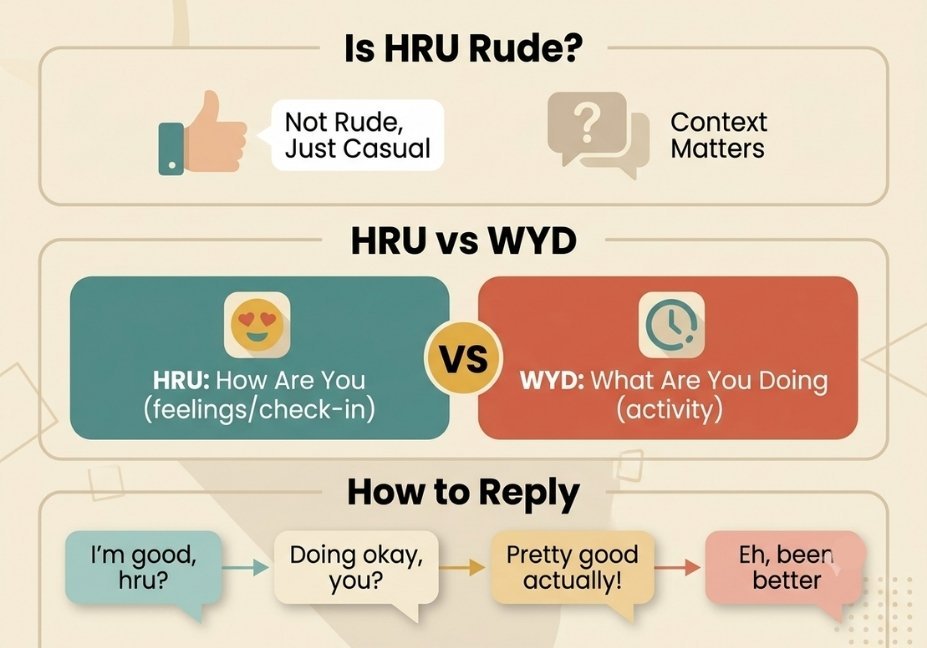
No, hru itself isn’t rude. It’s simply informal. The concern some people raise isn’t about the word, it’s about when and how it’s used. Sending “hru” as your very first message to someone you don’t know well, with nothing else attached, can come across as a little low-effort compared to a more personalized opener.
In casual settings like group chats, close friendships, or ongoing conversations, hru is completely normal and reads as friendly, not rude. The context matters more than the abbreviation itself. If you want a message to feel more thoughtful, adding a small detail, like referencing something from an earlier conversation, usually helps more than avoiding the shorthand altogether.
Hru vs Wyd: What’s the Difference?
These two often get grouped together, but they’re asking different things. Hru means “how are you” and is focused on someone’s mood, health, or general state. Wyd means “what are you doing” and is focused on someone’s current activity.
You might send hru to check in emotionally, and wyd to see if someone’s free or what they’re up to right now. Both are casual, both are common, and they’re sometimes used together in the same message, like “hru, wyd rn,” which combines a check-in with a question about availability.
Similar Texting Shorthand You Might See Alongside Hru
Hru rarely shows up alone. It’s part of a wider group of casual shorthand terms that appear in the same kinds of conversations. Recognizing a few of these makes the overall texting style easier to follow:
- brb means be right back
- ttyl means talk to you later
- idk means I don’t know
- wyd means what are you doing
- ngl means not going to lie
- ily means I love you
None of these are hard to learn once you see the pattern. They’re all built the same way hru is, using short letters to stand in for common phrases people already say constantly.
How to Respond to Hru
There’s no single “correct” reply, but a few options work well depending on the vibe of the conversation:
- “I’m good, hru?” – the standard, friendly default
- “Doing okay, just busy today” – adds a little context
- “Not bad, you?” – short and casual
- “Pretty good actually!” – upbeat and positive
- “Eh, been better” – honest if you’re not having a great day
The easiest approach is to answer briefly and then turn the question back around, since hru is often meant to open a conversation rather than end one. Matching the sender’s energy usually works well too. A short, casual message deserves a short, casual reply rather than a long paragraph.
Real Example Conversations With Hru
Seeing hru used in context makes the meaning even clearer. Here are a few realistic examples of how it plays out in everyday chats.
Example 1: Between close friends Friend 1: “hru today” Friend 2: “pretty tired honestly, you?” Friend 1: “same, work was rough lol”
Example 2: Reconnecting after a while Person 1: “hey! hru, been a minute” Person 2: “good good! hru, how’s everything been”
Example 3: In a gaming chat Player 1: “gg that was close” Player 2: “hru feeling after that match lol” Player 1: “honestly relieved we won”
Example 4: In a group chat Group member: “hru all doing today” Reply 1: “doing well!” Reply 2: “same here, just busy”
Notice how none of these examples treat hru as a big, serious question. It’s almost always used to open or continue a light, ongoing conversation, not to dig into something emotionally heavy. The short length keeps the tone easy and low-pressure, which is exactly why it’s stuck around as a texting habit for so long.
Common Mistakes People Make With Hru
A few small mix-ups happen often enough to be worth mentioning. Some people confuse hru with similar-looking abbreviations and misread the intent behind the message. Others assume it always signals romantic interest when it’s frequently just a neutral greeting. It’s also common for people to overthink a plain hru message instead of just replying naturally.
Another mistake is using hru in a clearly formal setting, like a work email or a message to someone significantly older in a professional context, where it can feel out of place. Saving it for casual, personal conversations keeps it doing what it does best.
Other Meanings of Hru
In a small number of contexts outside texting, “hru” or “HRU” can appear as an acronym in completely unrelated fields, such as an abbreviation used in certain organizations, usernames, or gaming tags. These uses are rare compared to the texting meaning and depend entirely on context. If you’re seeing hru inside a casual message or comment, the “how are you” meaning is almost certainly the right one.
Frequently Asked Questions
What does hru mean in text? Hru means “how are you.” It’s a casual texting abbreviation used to check in on someone quickly.
Is hru the same on every app? Yes, the meaning stays the same across texting, Instagram, Snapchat, TikTok, and gaming chats.
Is it rude to say hru instead of a full sentence? Not usually. It’s informal, but it only feels low-effort in certain contexts, like a first message to a stranger.
What’s a good response when someone texts hru? A short, honest answer works well, like “I’m good, hru?” or “Doing okay, you?”
What’s the difference between hru and wyd? Hru asks how you’re doing. Wyd asks what you’re currently doing.
Final Takeaway
So, what does hru mean in the end? It’s a small, friendly piece of texting shorthand for “how are you,” used everywhere from group chats to gaming lobbies to keep conversations quick and casual. It’s not rude, it’s not complicated, and it’s not hiding some deeper meaning. Understanding a little of its history, how it shifts across age groups, and how to reply naturally makes it even easier to use with confidence. The next time it lands in your inbox, you’ll know exactly what’s being asked, and exactly how to answer.
Pingback: What Does LYK Mean? A Simple Guide to This Texting Term - Celebrity Auraa