
You’re texting a friend about weekend plans and they reply “lyk when you’re free.” Or maybe someone comments “this song is lyk so good” on a video. Same three letters, two completely different meanings. If you’re wondering what does lyk mean, you’ve landed in exactly the right spot, because this tiny abbreviation actually stands for two separate things depending on how it’s used.
This guide breaks down both meanings, shows you how to tell them apart in seconds, and explains how the term compares to similar texting shorthand like LMK. By the end, you’ll never have to guess again when it shows up in your messages.
Also Read This:[What Does STSU Mean in Text? The Full Meaning Explained]
What Does LYK Mean?
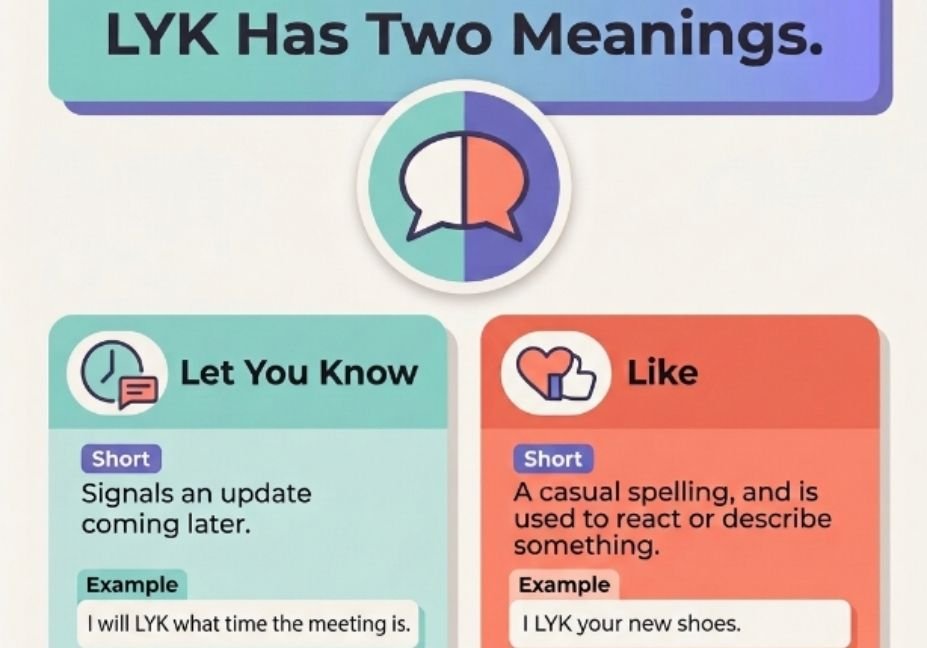
LYK most commonly means “let you know.” It’s used when someone plans to share information later, as in “I’ll LYK once I hear back.” A second, less common use is a shortened spelling of the word “like,” as in “this is lyk really good.”
What Does LYK Mean in Text, Exactly?
There are two real meanings here, and context is what separates them. Getting this right just takes a quick look at where the word sits in the sentence.
Meaning 1: “Let you know”
This is the more established and widely recognized use. It works as a promise to share an update once the sender has more information.
- “I don’t have a time yet, but I’ll LYK soon.”
- “Still checking my schedule. LYK by tonight.”
- “She said she’ll LYK if the plan changes.”
Meaning 2: “Like”
This use is simply a stylized, shortened spelling of the word “like.” People drop the “i” to type faster or to match casual texting trends, similar to how “u” replaces “you.”
- “This song is lyk so catchy.”
- “I lyk really want to go to that concert.”
- “That outfit is lyk perfect for the party.”
Both are genuine internet slang, and most dictionary sites that track texting abbreviations, including sources like NoSlang’s slang dictionary, list “let you know” as the primary definition. The “like” spelling shows up more often on social media captions and comments than in one-on-one texting.
How to Tell the Two Meanings Apart
You don’t need to guess. A quick pattern check makes the meaning obvious almost every time.
- A future action or update usually signals “let you know.”
- A word sitting mid-sentence and describing a feeling usually signals “like.”
- If the sentence still makes sense with “let you know” swapped in, that’s the meaning.
- If swapping in “like” keeps the sentence natural, that’s the meaning instead.
Try the swap test yourself. “I’ll LYK when I land” only makes sense as “let you know.” “This is lyk amazing” only makes sense as “like.” This abbreviation rarely leaves real room for confusion once you check the sentence structure.
Where Did LYK Come From?
This shorthand has been part of digital slang since the early days of texting and instant messaging, alongside other classics like BRB, LOL, and TTYL. Back when SMS messages were often charged per text, shortening common phrases like “let you know” helped people save characters and time.
The “like” spelling version came later and grew mostly through social media, especially platforms where fast, casual typing became the norm. Instagram comments, TikTok captions, and Snapchat chats all helped spread this stylized spelling, even though it isn’t tied to any specific origin story the way the older meaning is.
Over time, both uses settled into everyday digital communication without ever fully replacing each other, which is exactly why the term still causes mix-ups today.
LYK Across Different Apps and Platforms
This abbreviation behaves a little differently depending on where you see it, even though the underlying meanings never change.
In text messages and iMessage threads, it almost always means “let you know.” These conversations tend to be practical, focused on plans, schedules, or waiting on a decision, which naturally favors the “update coming later” meaning. In Slack or Teams messages between coworkers, the same pattern holds, since these are usually short, task-focused exchanges.
On Instagram and TikTok, it leans more toward the “like” spelling, especially in comments reacting to a photo, video, or song. Snapchat captions follow a similar pattern, often pairing the word with emojis to react to something in the moment. On Reddit and other forums, it usually reverts back to “let you know,” since forum replies tend to involve people promising to follow up with more detail in a later comment.
Knowing the platform alone won’t always settle the meaning, but it narrows things down quickly before you even check the sentence itself.
Does the Meaning Change by Generation?
This shorthand has been around long enough to cross several generations of internet users, and the “let you know” meaning has stayed fairly consistent the whole time. What has shifted is the newer “like” spelling, which is much more common among younger texters raised on fast-paced social media commenting.
Older texters who learned shorthand during the early SMS era are far more likely to use it strictly as “let you know,” since that was the original and more widely documented meaning. Younger users, especially those active on TikTok and Instagram, often use the “like” spelling without ever picking up the promise-to-update meaning at all. Neither generation is using it incorrectly. They’re simply drawing from two different, equally valid slang traditions that happen to share the same three letters.
How People Use LYK in Texts and Social Media
This abbreviation shows up constantly in casual digital spaces, and the setting often hints at which meaning is intended.
As “Let You Know”
This version is common in one-on-one texts and small group chats, especially when someone is waiting on details.
- “Not sure about dinner yet, I’ll LYK.”
- “Boss hasn’t confirmed the meeting time. LYK when she does.”
As “Like”
This version leans more social media, showing up in comments, captions, and quick reactions.
- “That view is lyk unreal 😍”
- “I lyk cannot believe this happened.”
What Does LYK Mean From a Guy or a Girl?
A common search variation asks what this term means “from a guy” or “from a girl,” as if gender changes the definition. It doesn’t. Both meanings stay exactly the same no matter who sends the message.
What can shift is the emotional read. If a guy texts “I’ll LYK after practice,” it’s a simple, practical update, nothing more. If a girl comments “this photo is lyk so cute,” she’s using the casual spelling of “like” to react warmly. The abbreviation itself is neutral. Tone comes from the rest of the message and the relationship between the people texting, not from the letters themselves.
People searching for a gendered meaning are usually really asking about intent, not definition. A guy adding “I’ll LYK” after being asked about weekend plans is simply managing expectations, not being evasive. A girl using “lyk” in a caption isn’t sending a hidden message either, she’s just following a common commenting style. Reading the full sentence, not the sender, is always the better way to figure out what’s actually being said.
LYK vs LMK: What’s the Difference?
These two look nearly identical, but people mix them up constantly because they mean opposite things in terms of who’s doing the informing.
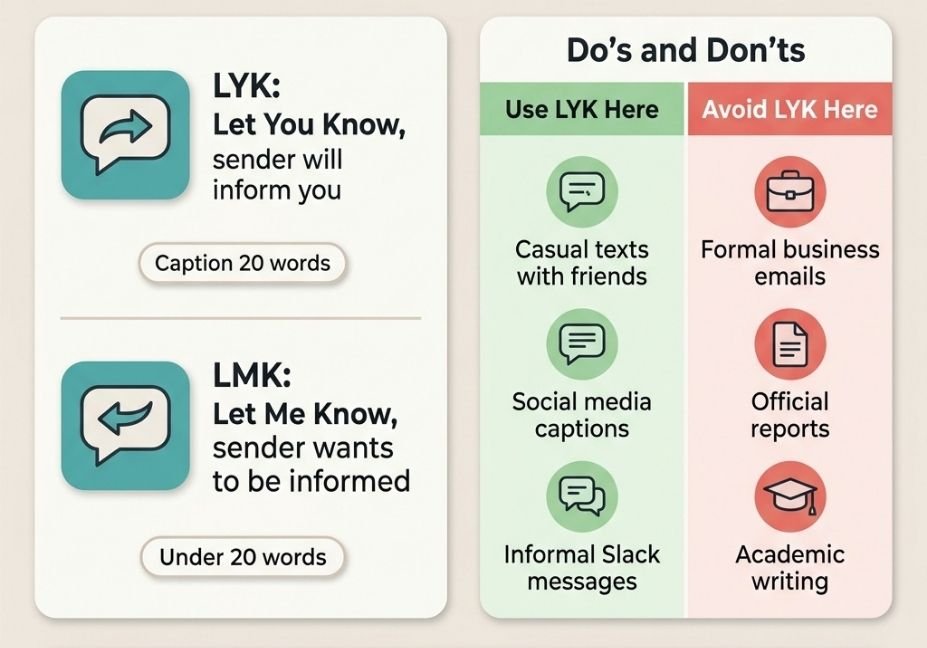
“LYK” stands for “let you know,” used when the sender plans to share information later. Meanwhile, “LMK” means “let me know,” a request for the other person to provide that information instead.
- “I’ll LYK once I confirm the time” means the sender will update you.
- “LMK once you confirm the time” means the sender wants you to update them.
| Abbreviation | Full Meaning | Who Shares Info |
|---|---|---|
| LYK | Let you know | The sender will inform you |
| LMK | Let me know | The other person should inform the sender |
Mixing these two up is one of the most common texting slang mistakes, so it’s worth double checking which direction the information is supposed to flow.
When to Use LYK and When to Avoid It
This abbreviation fits naturally into casual conversations with friends, family, and close coworkers over informal channels like texting or Slack. It’s short, familiar, and gets the point across quickly without sounding cold.
It doesn’t belong in formal writing. Business emails, official reports, and professional documents should use the full phrase, “I will let you know” or “I’ll keep you updated.” Shorthand like this can come across as too casual in those settings, even when the underlying message is professional.
A simple rule of thumb: match the tone of the conversation. If a coworker’s messages are formal and complete, spell things out. If a friend texts in constant shorthand, it will fit right in without any issue.
There’s also a middle ground worth knowing. Some workplaces use casual chat tools like Slack for quick, informal exchanges, even though they’re technically professional platforms. In that setting, this shorthand can work fine for something like confirming lunch plans, but still feels out of place in a message about a client deadline or a budget approval. Reading the room, even a digital one, still matters more than the abbreviation itself.
Similar Abbreviations You’ll See Alongside LYK
This term often appears near other short texting expressions, so knowing a few neighbors makes conversations easier to follow.
- LMK: let me know, used when asking someone else for an update.
- DYK: did you know, often used before sharing a fun fact.
- IIRC: if I remember correctly, used when someone isn’t fully certain.
- ICYMI: in case you missed it, used to highlight something already shared.
- HMU: hit me up, used to invite someone to reach out later.
Recognizing these related abbreviations helps group chats and social captions make sense at a glance, especially when several show up in the same message.
Common Mistakes People Make With This Abbreviation
A few small habits cause confusion here.
- Assuming it only ever means one thing, ignoring the “like” spelling entirely.
- Confusing it with LMK, which reverses who’s supposed to share the update.
- Using it in professional emails, where it can look unpolished.
- Overusing the “like” spelling in serious messages, which can feel careless.
Reading the surrounding sentence almost always clears up which meaning is intended, so a quick pause before replying can prevent an awkward mix-up.
Frequently Asked Questions
Does LYK mean “let you know” or “like”? Both are real. “Let you know” is more common overall, while “like” shows up mostly as a casual spelling on social media.
What does it mean from a girl? The same as it means from anyone. Context, not gender, decides whether it means “let you know” or “like.”
What’s the difference between LYK and LMK? The first means the sender will update you. The second means the sender wants you to update them.
Is it rude to say? No. It’s a neutral, casual abbreviation. Tone depends on the rest of the message, not the letters themselves.
How do you use LYK in a sentence? Use it to promise an update, like “I’ll LYK tonight,” or as slang for “like,” such as “this is lyk great.”
Conclusion
LYK carries two genuine meanings, and knowing both is the real key to understanding it. Most of the time it stands for “let you know,” a quick promise to share details later. Sometimes it’s just a casual, shortened spelling of “like,” especially in comments and captions.
Once you check the sentence around it, the correct meaning becomes obvious almost instantly. Use it freely in casual chats, keep an eye out for its close cousin LMK, and skip it entirely in formal writing. That’s really all there is to it.
Texting shorthand changes fast, but the habit of checking context before replying will always serve you well, no matter which new abbreviation shows up next in your messages.