
Getting a notification that someone “Emphasized” your message can be confusing if you have never seen it before. It is not a like, it is not a reply, and it is not something you typed by accident. Understanding what does emphasize mean in text will save you from overthinking that little double exclamation mark the next time it shows up on your screen.
In this guide, you will learn exactly what the emphasize reaction is, how it works on iPhone and Android, and what it usually signals depending on who sent it. By the end, you will know how to use it yourself and how to read it when someone uses it on you.
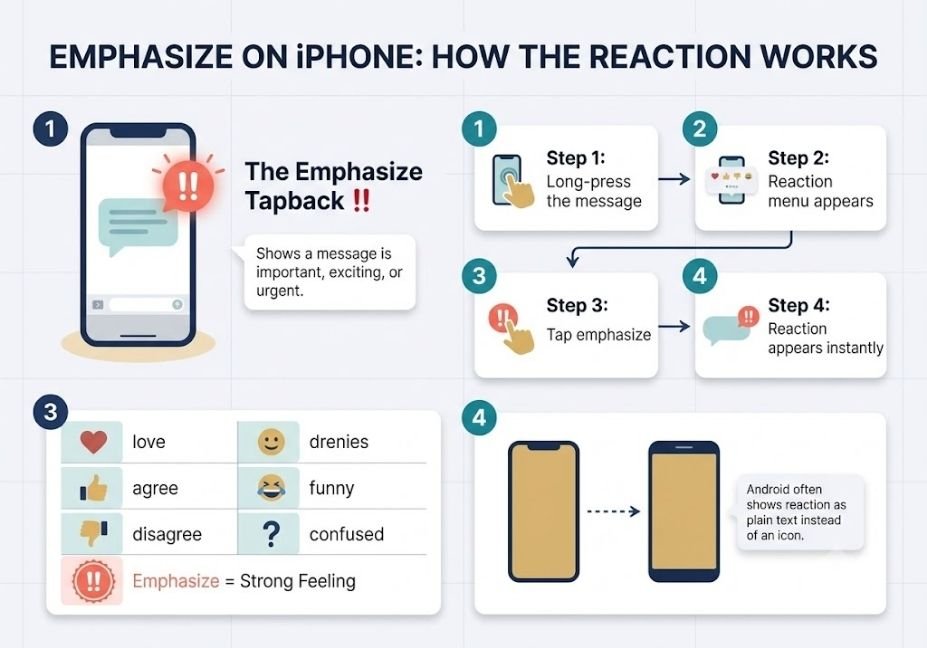
To emphasize a text means to react to a message with a double exclamation mark (‼️), a built-in iMessage Tapback that shows the sender feels the message is important, exciting, or worth stressing, without needing to type a full reply.
What Does Emphasize Mean In Text On iPhone
On iPhone, emphasize is one of the six built-in Tapback reactions inside iMessage. When you hold down on a message, a small menu pops up with options like heart, thumbs up, thumbs down, ha-ha, question mark, and the double exclamation mark. Tapping that double exclamation mark is what triggers the “Emphasized” label under the message.
Apple designed Tapbacks to add quick emotional context to a conversation without forcing anyone to type anything. Emphasize specifically is meant to say “this matters” or “I feel strongly about this,” whether that feeling is excitement, urgency, agreement, or shock. It sits apart from the other reactions because it does not clearly mean positive or negative. A thumbs up is obviously good and a thumbs down is obviously bad, but emphasize just says the message hit hard in some way, and the reader has to use context to figure out exactly how.
The label itself shows up as a small line of gray text above or below the original bubble, something like “Emphasized ‘see you at 7′” so both people in the chat can see exactly which message got the reaction. Unlike a heart or a thumbs up, which feel instantly readable at a glance, emphasize tends to make people pause for a second the first time they see it, since the visual icon alone does not spell out a clear emotion the way the others do.
Tapbacks were introduced with iOS 10 and have remained largely unchanged ever since. They have become one of the most recognizable features of the iMessage experience. Over the years, the Emphasize reaction has taken on a specific role. It goes beyond simple agreement and highlights that a message carries real importance. That importance may reflect excitement, urgency, or simply a strong emotional reaction.
|Also read this article Br meaning in text: what it actually stands for, explained
How To Emphasize A Message
Using the feature is simple, whether you are reacting on your own phone or trying to understand what someone else did.
- Long-press or double-tap the message bubble you want to react to
- Wait for the small reaction menu to appear above or below the text
- Tap the icon with two exclamation marks
- The reaction appears attached to that message for both people in the chat
- Long-press again and tap the same icon to remove it
The whole thing takes about two seconds, which is exactly the point. It lets someone react strongly to what you said without stopping to write out a full response. This matters most in fast-moving conversations, like a group chat juggling several topics at once, where typing a full sentence for every reaction would slow everything down.
It is also worth knowing that Tapbacks, including Emphasize, can be added to messages sent by either person in a conversation. They are not limited to incoming messages. You can even emphasize your own message after sending it. Some people do this for comedic effect. Others use it to add extra weight to what they just said. It works like adding a stamp of importance to your own message.
What It Means When Someone Emphasizes Your Text
Context is everything here, since the same reaction can carry different weight depending on who sent it and what the original message said.
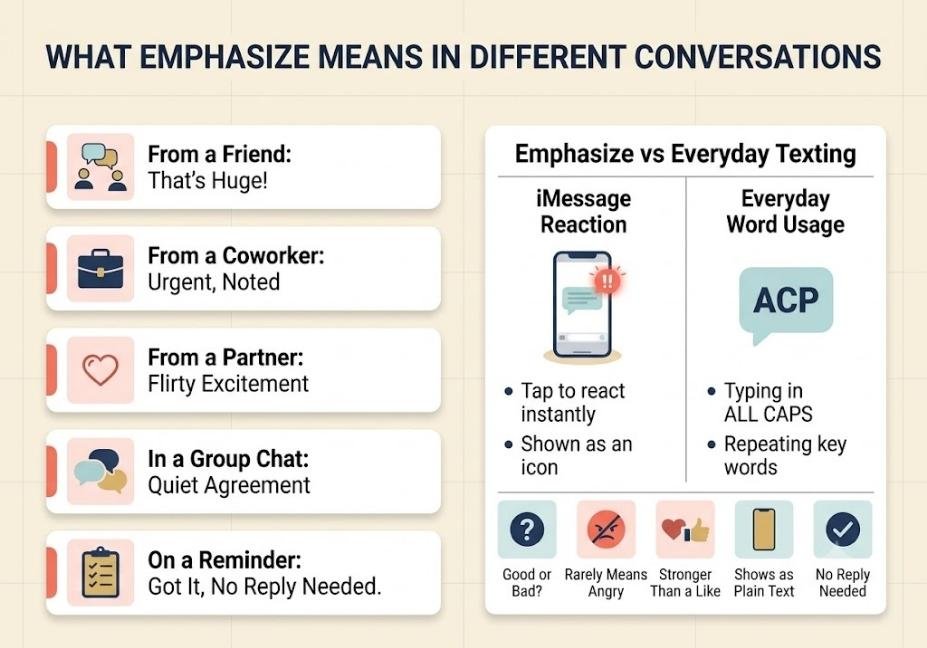
- From a friend: usually means “that’s huge” or “I’m hyped for you”
- From a coworker or boss: often signals urgency or “noted, this is important”
- From someone you are dating: can lean flirty or show genuine excitement about your message
- In a group chat: frequently used to back up or agree with a point without adding to the noise
- On a reminder or instruction: works as a quick “got it, I heard you” without a full reply
- On a joke or funny comment: can add extra emphasis to show something really landed
If someone emphasizes your good news, it almost always signals celebration. If someone emphasizes your deadline or warning, they are usually highlighting how seriously they take it. People rarely use the Emphasize reaction to express anger. However, poor timing can make it sound sarcastic, depending on the earlier tone of the conversation.
What does emphasize mean from a guy versus what does emphasize mean from a girl usually comes down to the same underlying signal, strong interest or strong agreement, since the Tapback itself carries no gendered meaning at all. Any difference in how it feels comes from the existing tone of the conversation rather than anything built into the reaction. A flirty exchange stays flirty when emphasize shows up, while a work-related thread stays work-related, the reaction simply amplifies whatever tone was already there.
Emphasize Meaning On Android
Android phones do not use the same built-in Tapback system as iMessage. Because of this, reactions can look different depending on the device.
If an iPhone user emphasizes a message sent over standard SMS, the Android user usually sees a text notification instead. It typically says, “Emphasized [message content]” rather than showing a visual reaction icon. The notification appears as a separate message instead of attaching to the original text bubble. As a result, the conversation can look confusing or cluttered to Android users.
Google has been improving this experience through RCS updates. Many Android devices now convert iPhone reactions into proper emoji reactions instead of displaying a written-out message. If both people use RCS-enabled messaging apps, such as Google Messages, reactions usually appear much more naturally. The experience is also closer to what iPhone users see in iMessage.
Android users cannot send the exact same “emphasize” Tapback back, since that specific feature belongs to iMessage. Instead, Android messaging apps typically offer their own emoji reaction sets, which cover similar emotional ground even though the icon and label are different.
This cross-platform gap is part of a larger, well-known friction point between iPhone and Android messaging, often nicknamed the “green bubble” issue since Android texts show up in green instead of blue inside iMessage. As RCS adoption spreads further across carriers and devices, reactions like emphasize are expected to display more consistently no matter which phone either person is using, gradually smoothing out one of the more noticeable quirks of mixed-platform group chats.
The Everyday Meaning: Emphasizing In Regular Conversation
Outside of the iMessage feature, “emphasize” is also just a normal English word people use constantly in texting and everyday speech, and this sense matters just as much for anyone searching the phrase. According to Merriam-Webster’s tracking of everyday usage, to emphasize something simply means to give it special importance or stress within a larger point.
In a text conversation, this shows up in a few common ways:
- Typing in ALL CAPS to stress a word or phrase
- Repeating a word for effect, like “I need this NOW, now, now”
- Using extra punctuation such as multiple exclamation points or question marks
- Bolding or underlining text in apps that support formatting
- Literally writing “I want to emphasize that…” before a key point
Example: “I want to emphasize that the meeting is TOMORROW, not today.” Here, the sender is using the word directly to make sure the listener does not miss the most important detail. This everyday sense and the iMessage Tapback sense both point back to the same core idea, drawing attention to what matters most in a message.
This dual meaning is exactly why the phrase “emphasize meaning in text” pulls in two slightly different audiences. Some people want to know about the tap-to-react feature, while others are trying to understand or use the plain English word correctly inside a message they are writing themselves. Both senses share the same root idea of stressing importance, just expressed through different tools, one through a tap gesture and one through wording choices.
Common Mistakes People Make With Emphasize
A few small mix-ups come up often enough to be worth clearing up. Some people assume the emphasize Tapback must always mean something negative, since the double exclamation mark can look intense at first glance, when in reality it leans positive or neutral far more often than not. Others assume it is the same as a heart reaction, when it actually carries a different, less clearly defined emotional signal.
Another common confusion happens in mixed iPhone and Android group chats, where someone might not realize a plain text starting with “Emphasized” is actually a reaction rather than a new message someone typed. Recognizing that pattern makes it much easier to follow group conversations without getting thrown off by what looks like an odd, out-of-place text.
Emphasize Vs Other Reactions
It helps to see emphasize next to the other Tapback options to understand why it stands out.
- Heart: clear positive reaction, usually love or strong approval
- Thumbs up: agreement or acknowledgment, low emotional intensity
- Thumbs down: disagreement or a negative reaction
- Ha-ha: something was funny
- Question mark: confusion, asking for clarification
- Emphasize: strong feeling or importance, direction unclear without context
That last point is exactly why so many people search for what it means. Every other reaction tells you the sentiment instantly. Emphasize tells you the intensity but leaves the sentiment for you to interpret from the conversation around it.
This is also why emphasize tends to generate more overthinking than any of the other five Tapbacks. A heart never leaves anyone wondering what it meant, and a thumbs down rarely does either. Emphasize sits in a gray area by design, which makes it flexible enough to fit almost any strong reaction, but it also means the responsibility for figuring out the tone falls entirely on the person reading it rather than the reaction itself.
Why Emphasize Feels More Ambiguous Than Other Reactions
Part of the reason emphasize causes more second-guessing than a heart or a laugh comes down to how humans naturally read tone in text. Most reactions map cleanly onto a single, obvious emotion, so there is nothing left to interpret. Emphasize breaks that pattern on purpose, since Apple built it to cover a wider range of strong feelings rather than one specific one.
This ambiguity is not a flaw, it is closer to a feature. It gives people a fast way to react strongly to almost anything, a big announcement, a stressful update, an exciting plan, or a firm instruction, without needing six different reaction icons to cover every possible strong emotion. The tradeoff is that the reader has to do a little more work connecting the reaction back to the message and the relationship behind it, which is exactly the kind of context this guide has walked through section by section.
Frequently Asked Questions
Is emphasizing a text a good or bad thing?
Usually good. It typically signals excitement, importance, or strong agreement rather than a negative reaction.
Does emphasizing a message mean they’re mad?
Not usually. Anger is more commonly shown with a thumbs down, though tone can shift the meaning slightly.
What’s the difference between emphasize and like on iMessage?
A heart or thumbs up shows simple approval, while emphasize signals stronger feeling or urgency about the message.
Why does emphasize show up as a text on Android?
Standard SMS cannot carry iMessage’s Tapback icons, so it falls back to a plain text description instead.
Can Android users send the emphasize reaction?
Not the exact same one, but RCS-enabled apps offer similar emoji reactions that carry a comparable meaning.
Final Takeaway
The emphasize reaction is a small feature with an outsized amount of confusion attached to it, mostly because it does not spell out exactly how someone feels the way a heart or thumbs down does. On iPhone, it is a quick Tapback that says “this matters,” while in everyday texting the word simply means stressing an important point. Android users experience it a little differently, but the underlying intent stays the same no matter which phone either person is using.
Read it alongside the message it is attached to and who sent it, and the meaning almost always becomes obvious. Next time someone emphasizes your text, you will know exactly what they are trying to say.