
You got a text with “MYF” in it and now you are stuck trying to figure out what your friend actually meant. Myf meaning in text is not a single, simple definition. It genuinely shifts depending on who sent it, where you saw it, and what the conversation was about before it showed up.
In this guide, you will learn every real meaning behind MYF, how to tell them apart using context, where each version came from, and exactly how to reply once you know which one you are dealing with.
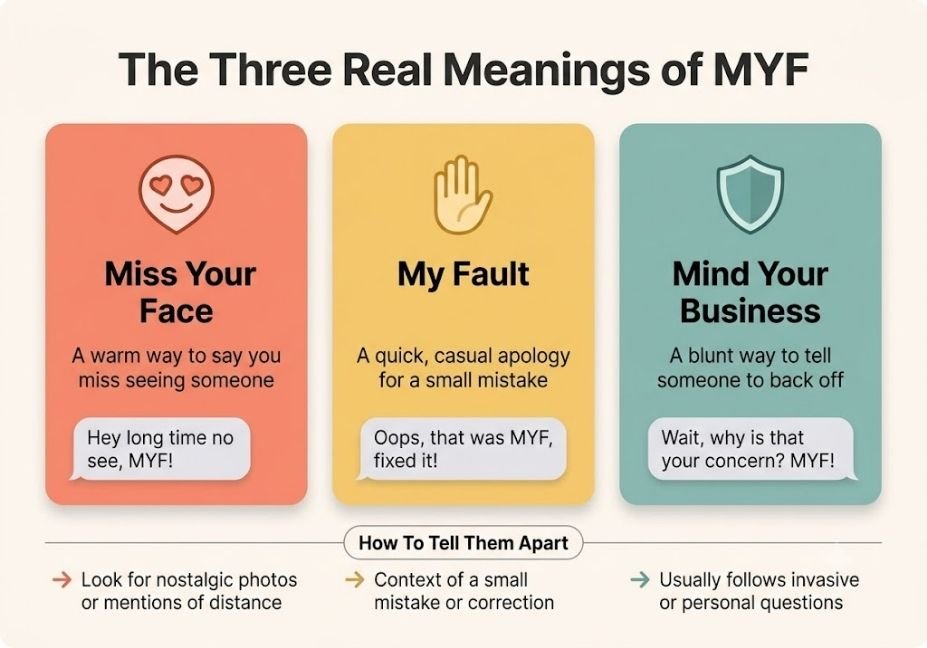
MYF most commonly means “Miss Your Face,” a casual way of saying you miss seeing someone. It can also mean “My Fault,” used as a quick apology, or “Mind Your Business,” used to tell someone to back off.
The Three Real Meanings Of MYF
Unlike most texting slang, MYF does not have one single agreed-upon meaning. Three definitions show up regularly enough that all of them matter.
Miss Your Face, a warm phrase used when someone misses seeing you. My Fault, a quick, casual way of apologizing for a small mistake. Mind Your Business, a blunt way of telling someone to stop prying.
A less common fourth version, Miss You Friend, also appears occasionally, functioning almost identically to Miss Your Face but aimed specifically at platonic friendships rather than romantic ones. None of these meanings is more official than another, since MYF never came from a single source or platform, it simply grew organically across different friend groups, regions, and platforms until multiple versions stuck around at once.
Miss Your Face: The Most Common Meaning
Most of the time, especially in personal texts, captions, and DMs, MYF means Miss Your Face. It is a sweet, casual way of telling someone you miss seeing them, whether that is in person, on video, or just in old photos. This meaning traces back to early text and instant messaging slang from the 2000s, and it still shows up today on Snapchat, Instagram, and TikTok, often attached to old photos or nostalgic captions.
This version tends to feel warm rather than clingy. Someone might text “throwback to last summer, myf” under an old picture, or simply drop “myf” out of nowhere as a small, casual way of saying they have been thinking about you.
My Fault: The Quick Apology
MYF also works as shorthand for “my fault,” functioning the same way people use “my bad.” According to Urban Dictionary’s crowd-sourced slang entries, this version is especially common among texters from Philadelphia, where “my fault” is a well-known regional way of apologizing quickly and casually.
This meaning usually shows up right after a small mistake.
Someone bumps into you and says “myf, wasn’t looking.” A friend cancels last minute and follows up with “myf, something came up.” Someone sends the wrong photo or link and adds “myf” to own the mistake.
The tone here is casual and low-stakes, closer to a shrug than a real apology.
Mind Your Business: The Blunt Version
The third common meaning is far more direct. In this version, MYF stands for a blunt phrase telling someone to stop prying or stay out of a situation that is not theirs. It shows up most often in response to a nosy question or unsolicited comment.
Examples make this version easiest to spot.
“Why are you hanging out with them?” gets answered with “myf.” “You shouldn’t wear that” gets shut down with a quick “myf.” “Why didn’t you invite me?” gets brushed off with “myf, lol.”
This meaning usually appears paired with a laughing or smirking emoji, which softens the bluntness and signals the person is being playful rather than genuinely angry.
How To Tell Which Meaning Someone Means
Context almost always makes the intended meaning clear once you know what to look for.
If the message follows a nostalgic photo or a “thinking of you” moment, it likely means Miss Your Face and If it follows a mistake, mix-up, or minor inconvenience, it likely means My Fault , If it follows a nosy question or unwanted opinion, it likely means Mind Your Business. If it comes from someone in a close friend group with no romantic undertone, Miss You Friend is possible too.
The sender’s tone, the emojis attached, and what was said right before MYF appeared will almost always point to the right meaning within a few seconds of reading the full conversation.
Where MYF Came From
Miss Your Face is the oldest of the common meanings, showing up in early text and web slang dating back to the mid-2000s, well before smartphones made abbreviations even more common. My Fault as MYF grew out of regional slang, most associated with Philadelphia, where “my fault” has long been a normal, casual way to apologize in everyday speech, not just in texting.
The Mind Your Business version is newer and spread mostly through social media comment sections, where blunt, short replies work better than full sentences. As platforms like TikTok and Instagram pushed shorter, punchier language, this more dismissive version of MYF picked up steam alongside similar blunt acronyms.
MYF On Different Platforms
The meaning of MYF can shift slightly depending on where you see it.
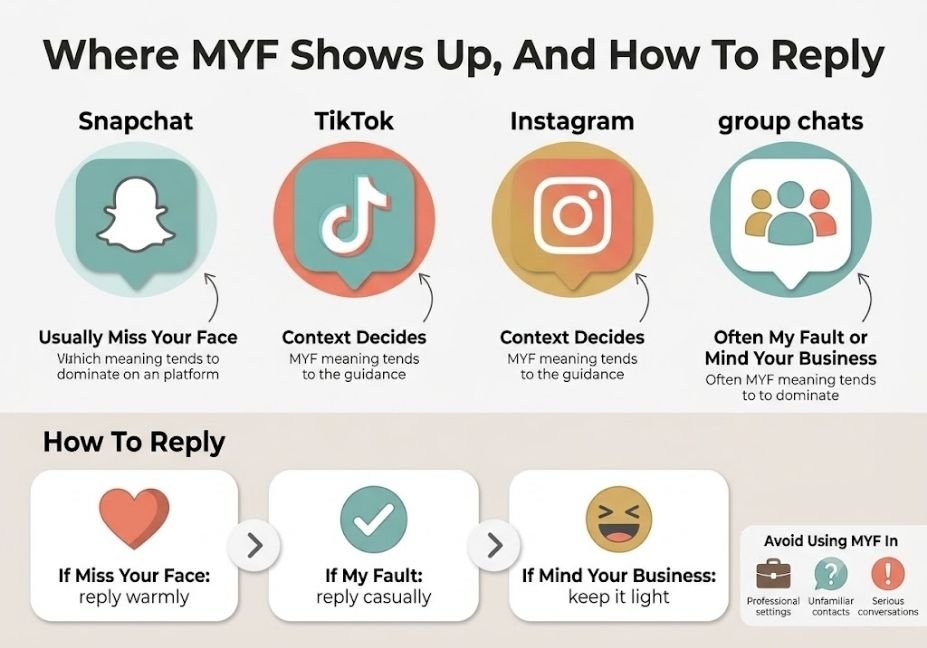
On Snapchat, MYF usually leans toward Miss Your Face, often tied to a selfie or a memory resurfacing. On TikTok comments, MYF frequently appears under old or throwback videos with the same missing-someone meaning. In Instagram DMs between friends, MYF can go either way, so checking the last few messages matters. In comment sections responding to a nosy or judgmental comment, MYF almost always means Mind Your Business.
Group chats tend to be the trickiest spot, since close friends may bounce between all three meanings depending on the moment.
How To Reply To MYF
The right reply depends entirely on which meaning fits the context.
If it means Miss Your Face, replying with “miss you too” or a simple heart keeps the warmth going but If it means My Fault, a casual “it’s fine” or “no worries” wraps things up naturally. If it means Mind Your Business, playing along with a laugh or dropping the topic usually keeps things light.
Getting the tone wrong is rarely a big deal here, since MYF is casual slang and most people will simply clarify if a reply feels off.
MYF Versus Similar Acronyms
A few other short texting terms get mixed up with MYF, so it helps to see them side by side.
MYB, short for “my bad,” overlaps closely with the My Fault meaning of MYF. IDC, meaning “I don’t care,” sometimes gets confused with the dismissive tone of the Mind Your Business version. MYF and MYA (Miss You Always) look similar but carry slightly different emotional weight, with MYA leaning more permanent. YF alone, without the M, usually just means “your face” and lacks the same emotional context.
Knowing these differences helps avoid mixing up MYF with a similarly short but distinct piece of slang mid-conversation.
Real Examples Of MYF In Full Conversations
Seeing the term inside a full exchange makes the meaning click faster than definitions alone.
“Found this old photo of us at the beach. myf” clearly points to Miss Your Face, tied to nostalgia. “Sorry I’m late, myf, traffic was insane” reads as My Fault, a quick casual apology. “Why do you always hang out with them instead of us?” followed by “myf 😏” signals Mind Your Business. “It’s been way too long, myf, we need to catch up soon” leans warm and friendly, another Miss Your Face example. “I broke the remote, myf, I’ll replace it” is a straightforward My Fault apology over a small mistake.
Reading the line right before MYF appears is almost always enough to land on the correct meaning without needing to ask.
Common Mistakes People Make With MYF
A few misunderstandings come up often enough to be worth flagging directly.
Assuming MYF always means the rude version, when it is usually friendly or apologetic instead. Reading too much into a lack of emoji, since plenty of genuine Miss Your Face texts show up completely plain. Confusing MYF with unrelated acronyms that only share one or two letters in common. Treating MYF as formal enough for work messages or professional emails, where it should be avoided entirely.
Staying aware of these mix-ups keeps conversations from turning confusing over what is really a small, casual abbreviation.
MYF Meaning By Generation And Region
Older millennials tend to associate MYF almost entirely with its early Miss Your Face roots, since that version predates most other uses and was common on early messaging platforms like AIM and early text messaging. Gen Z texters use MYF more flexibly, comfortably switching between all three meanings depending on the conversation, since shorter, multi-purpose slang fits the pace of platforms like TikTok and Snapchat.
Regionally, the My Fault meaning stays strongest in and around Philadelphia and nearby East Coast cities, where “my fault” as a spoken apology was common long before texting existed. Outside that region, Miss Your Face remains the default assumption for most readers seeing MYF for the first time, which is part of why confusion pops up so often when the blunter Mind Your Business version shows up unexpectedly.
When To Avoid Using MYF
MYF works well in casual settings, but a few situations call for skipping it entirely.
Professional emails and workplace chats, where slang can come across as unclear or unprofessional. Conversations with someone unfamiliar with texting slang, where it may just cause confusion. Serious or sensitive conversations, where a real apology or explanation works better than shorthand. First-time conversations with someone new, since tone is harder to read without shared context.
Sticking to full sentences in these situations avoids any unnecessary mixed signals.
Conclusion
Myf meaning in text depends entirely on context, and that is the one thing worth remembering above all else. It can mean Miss Your Face, My Fault, or Mind Your Business, and sometimes even Miss You Friend, depending on who sent it and what led up to it. Once you read the message before it and notice the tone, the right meaning becomes obvious almost every time. There is no need to guess blindly, the conversation itself usually hands you the answer.
FAQs
What does MYF mean from a guy?
It depends on context, but it most often means Miss Your Face, a casual way of saying he misses seeing you.
Is MYF rude or friendly?
It can be either. Miss Your Face and My Fault are friendly, while Mind Your Business can sound blunt, though usually playful.
What does MYF mean on Snapchat?
On Snapchat, MYF almost always means Miss Your Face, often attached to an old photo or memory.
Does MYF always mean the same thing?
No, it has multiple common meanings, and the surrounding conversation determines which one the sender intended.
How do you reply to MYF?
Match the meaning, respond warmly if it means Miss Your Face, casually if it means My Fault, and lightly if it means Mind Your Business.
Where did MYF as My Fault come from?
It grew out of Philadelphia slang, where “my fault” has long been a common, casual spoken apology outside of texting too.