
If you just got a text or comment with “GTFO” in it and you’re not sure whether to laugh or worry, you’re not alone. It’s one of the most common internet acronyms out there, and it shows up everywhere from group chats to gaming lobbies to Instagram comments.
This guide breaks down exactly what GTFO means in text, where it came from, and how to tell the difference between a joke and a real reaction. By the end, you’ll know exactly how to read it and how to reply.
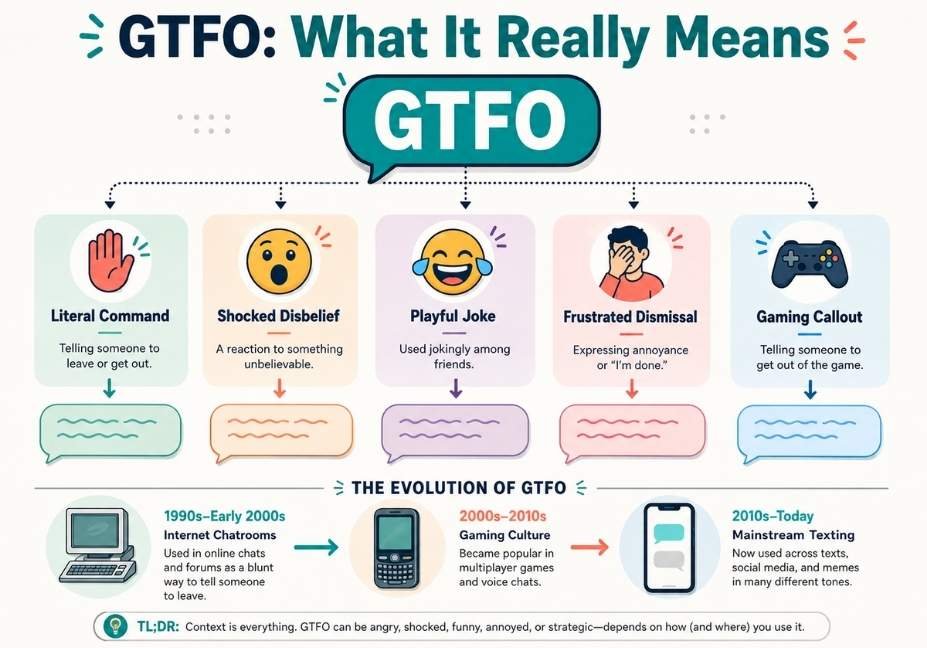
GTFO stands for “Get The F*** Out.” In texting, it’s used two main ways: as a literal command telling someone to leave, or as a slang reaction to something shocking, unbelievable, or annoying. The tone almost always depends on context.
Also read article : What Does ATM Mean? Bank Machine or Text Slang Explained
What Does GTFO Stand For, Exactly?
Breaking the acronym down letter by letter helps explain why it carries so much punch in just four characters.
- G: “Get,” the action word that starts the command.
- T: “The,” a small connector word.
- F: the profanity that gives the phrase its blunt, forceful tone.
- O: “Out,” the direction or outcome being demanded.
Compressed together, those four letters carry the full weight of a much longer, harsher sentence. That’s part of why it works so well as a reaction. It delivers a strong emotional punch without anyone having to type out the whole phrase.
GTFO Meaning in Text: The Basics
GTFO is a four-letter acronym built from a much blunter phrase. On its own, it looks aggressive. In practice, most people who type it aren’t actually angry.
Think of it like “shut up” in casual conversation. Said one way, it’s an insult. Said another way, between friends, it just means “no way, really?” GTFO works the same way. The letters don’t change, but the meaning shifts completely depending on who’s typing it and why.
That’s why context matters more than the definition itself. Reading GTFO without checking the conversation around it is like reading one word out of a sentence and guessing the whole meaning.
Also read the article :What Does LYK Mean? A Simple Guide to This Texting Term
letters carry the full weight of a much longer, harsher sentence. That’s part of why it works so well as a reaction. It delivers a strong emotional punch without anyone having to type out the whole phrase.
Where GTFO Came From
The full phrase behind GTFO has been part of casual spoken English for a long time, mostly as a rough way to tell someone to leave. The acronym version is newer and grew alongside internet chatrooms, early gaming forums, and text messaging, where short forms saved time and added punch.
As gaming culture and social platforms grew through the 2000s and 2010s, GTFO spread fast. It became a go-to reaction in multiplayer games, comment sections, and group texts, eventually crossing over into everyday texting slang used by teens and adults alike.
Some dictionaries that track internet and slang usage note that acronyms like GTFO tend to soften over time, shifting from purely aggressive commands into flexible reactions used across a wide range of moods.
The Different Ways GTFO Is Used
Here’s where most guides stop at one definition. In reality, GTFO shows up in a few distinct situations, and each one reads differently.
- Literal command: telling someone to physically leave, often in anger.
- Shocked disbelief: reacting to surprising or unbelievable news.
- Playful exaggeration: joking around with a friend, no real emotion behind it.
- Frustrated dismissal: telling someone to stop talking or stop being annoying.
- Gaming callout: telling a teammate to leave a match or stop trolling.
Example Texts by Tone
Shock/disbelief: “You met your favorite artist backstage?” “GTFO, seriously?”
Playful joke between friends: “I ate the entire pizza by myself.” “GTFO 😂 no you didn’t.”
Frustrated or annoyed: “Stop trolling the match, GTFO.”
Literal, serious command: “GTFO of my room right now.”
Notice how the punctuation, emoji, and surrounding words change the read completely, even though the four letters stay the same.
Also read article : What Does DND Mean in Text? Full Meaning and Examples
GTFO in Memes and Pop Culture
Beyond one-on-one texting, GTFO has become a recurring character in meme culture. It regularly shows up as reaction text stamped over screenshots of shocking sports plays, plot twists, or celebrity news, functioning almost like a caption rather than a message to a specific person.
On platforms like TikTok and Instagram, GTFO often appears in comment sections under videos showing unbelievable talent, dramatic reveals, or unexpected coincidences. In that setting, it works as a compliment of sorts, a way of saying a video was impressive enough to provoke a strong reaction.
Sports commentary accounts and highlight pages also use it frequently, pairing GTFO with clips of incredible catches, buzzer-beaters, or bloopers. In that context, it has almost nothing to do with anger and everything to do with disbelief at what just happened on screen.
Regional and Platform Differences
While GTFO started in English-speaking online spaces, particularly in North American gaming and forum culture, its use has spread well beyond those roots. International users on global platforms often adopt it even when English isn’t their first language, largely because the tone reads clearly through emoji and context even if the literal words don’t translate perfectly.
Different platforms also shape how it gets used. On gaming voice chats and text overlays, it tends to stay closer to its literal, functional meaning, telling someone to leave a match or stop a specific behavior. On visual platforms like TikTok or Instagram, it leans more toward reaction and commentary, detached from any real command at all.
Recognizing which platform a message came from can be just as useful as reading the words themselves when it comes to figuring out the intended tone.
Also read the article :What Does NP Mean In Text? Meaning, Origin, And Examples
Common Mistakes People Make With GTFO
Even though GTFO feels simple, a few common mix-ups trip people up regularly.
- Assuming it always means anger, when it’s usually just surprise.
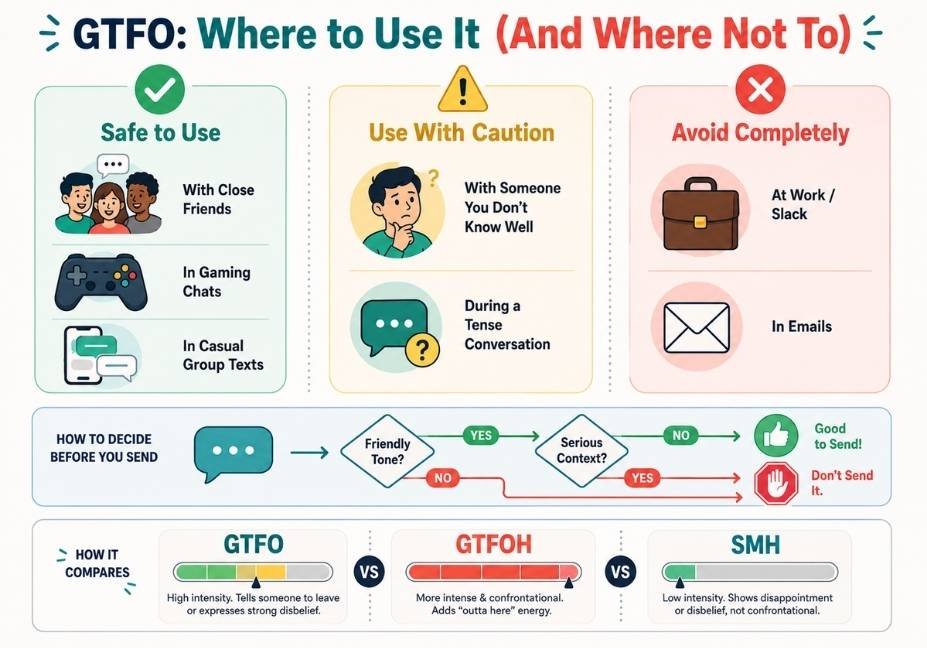
- Using it with someone new before knowing how they’ll take it.
- Sending it in a work chat because a coworker used it casually once.
- Missing sarcasm because the message has no emoji or extra context.
- Confusing it with harsher acronyms like STFU, which carry a different tone.
Avoiding these mistakes mostly comes down to slowing down for a second and reading the full conversation instead of reacting to the acronym alone.
Is GTFO Rude?
It depends entirely on who’s saying it and the relationship behind the message. Between close friends, GTFO is usually harmless and even friendly, more of a verbal shrug than an insult.
Sent by a stranger, an angry coworker, or in a serious argument, it reads very differently and can come across as hostile or disrespectful. The profanity built into the acronym means it’s never fully “safe” or formal, even when the intent is playful.
GTFO in Gaming and Group Chats
Gaming communities helped push GTFO into mainstream slang. In multiplayer games, it often gets used to call out a teammate who’s underperforming, trolling, or intentionally sabotaging a match.
In Discord servers and group chats, the tone tends to be lighter. It’s frequently used as a quick, low-effort reaction to news, memes, or plot twists in a show everyone’s watching together. The shared context of the group usually makes the intent obvious to everyone inside it.
How Punctuation and Emoji Change the Meaning
The letters GTFO never change, but everything around them does most of the work. A single emoji or extra letter can flip the entire tone of a message.
- Adding “😂” or “lol” almost always signals a joke.
- All caps with an exclamation point often signals real shock or anger.
- No punctuation at all in a tense chat usually means it’s serious.
- Extra letters, like “GTFOOOO,” usually signal excitement rather than anger.
- A single period after it, like “GTFO.,” tends to read as cold or annoyed.
Reading these small signals is often more useful than the definition itself, since the acronym’s core meaning barely shifts while its emotional temperature changes constantly.
GTFO at Work or in Formal Settings
This is one thing a lot of guides skip entirely: GTFO does not belong in professional communication, even in casual workplace chat tools. Because the acronym is built on profanity, using it in Slack, email, or any work-adjacent channel risks coming across as unprofessional, regardless of how “chill” the environment feels.
If you want to express the same idea at work, safer alternatives include “no way,” “I don’t believe it,” or “that’s wild.” They carry the same energy without the risk.
Also check out :Blood Pick Up Lines That Are Surprisingly Irresistible
Who Uses GTFO the Most
GTFO isn’t tied to one single age group anymore, but usage patterns still differ a bit depending on who’s typing.
- Teens and young adults tend to use it casually and often, mostly for jokes.
- Gamers of all ages use it functionally, calling out teammates during matches.
- Older millennials and Gen X texters tend to use it more sparingly and more literally.
- Content creators and streamers often use it as shorthand for audience reactions.
None of these groups use it exclusively, and plenty of overlap exists. Still, noticing who sent it can help you guess the intended tone before you even read the rest of the message.
How to Respond to GTFO
If someone sends you GTFO, check three things before reacting: the relationship, the conversation before it, and any punctuation or emoji attached.
- Followed by a laughing emoji or exclamation point, it’s almost always playful.
- Sent with no punctuation in the middle of an argument, take it seriously.
- From someone you don’t know well, treat it cautiously until the tone is clear.
A safe reply in most casual situations is simply matching the energy back, like “I know, right?” or “for real.” If it feels serious or hostile, it’s fine to ask directly what they meant.
GTFO vs. Similar Acronyms
GTFO often gets grouped with a few related short forms that carry a similar spirit but slightly different weight:
- GTFOH: a more emphatic version, often read as more dismissive or sarcastic.
- STFU: a harsher command focused on silence rather than leaving.
- SMH: a milder reaction expressing disappointment or disbelief without profanity.
Knowing the difference helps you gauge just how strong a reaction someone is actually expressing.
Also read article :Voice Pick Up Lines That Work Better Than Texting
Conclusion
GTFO stands for “Get The F*** Out,” but in real texting life it rarely means someone wants you gone. Most of the time, it’s a fast way to express shock, disbelief, or a bit of playful frustration, and the real meaning comes from the context around it rather than the letters themselves.
Before reacting to a GTFO text, take a second to check who sent it, what led up to it, and how it’s punctuated. Do that, and you’ll almost always read the tone correctly, whether it’s a joke between friends or something that needs a more serious response.
FAQs
Is GTFO rude to say to a friend? Usually not. Between friends it’s typically playful, though tone and context still matter.
What’s the difference between GTFO and GTFOH? GTFOH is a stronger, more emphatic version, often used sarcastically or dismissively.
Can GTFO be used in a nice way? Yes, it’s commonly used as a lighthearted reaction to surprising or funny news.
Where did GTFO come from? It grew from internet chatrooms and gaming culture, shortening a longer spoken phrase for fast typing.
Does an emoji change what GTFO means? Yes. A laughing emoji usually signals a joke, while no punctuation in a tense chat often signals it’s serious.