
Omw meaning in text is “on my way.” It tells someone you are currently heading to a location or about to leave for one.
If you have ever gotten a text that just says “omw” and wondered what it meant, you are not alone. This tiny three-letter abbreviation shows up constantly in texts, group chats, and social media comments, and understanding omw meaning in text takes about ten seconds once someone breaks it down for you. It is one of the most common pieces of texting shorthand out there, right alongside terms like TBH and NVM.
In this guide, you will learn exactly what OMW stands for, where it came from, how people actually use it across different apps and relationships, and how it compares to similar phrases like OTW and ETA. By the end, you will know exactly how to use it yourself and how to reply when someone sends it to you.
What Does OMW Stand For?
OMW stands for “on my way.” It is one of the simplest and most widely recognized pieces of text abbreviation in casual digital communication today. When someone texts you “omw,” they are letting you know they have already started heading toward you or a specific location, or that they are about to leave any minute.
You will see it written in both uppercase and lowercase. According to Dictionary.com’s culture and acronyms section, the lowercase version has become far more common in recent years, especially in casual texting between friends. Both versions mean the exact same thing, so capitalization does not change anything here.
A typical exchange looks like this:
Friend: “Are you coming to the party?” You: “Omw, be there in ten minutes.”
That single word answers the question completely. No extra explanation needed, which is exactly why it caught on in the first place.
The phrase works so well in texting because it hits the sweet spot between clarity and speed. A full sentence like “I have left my house and I am currently traveling toward the location we agreed on” takes real effort to type out on a phone. Three letters carry the same information, land in a fraction of a second, and still feel warm and personal instead of robotic. That balance is a big part of why omw meaning in text has stayed consistent for years instead of drifting into something more complicated.
Where Did OMW Come From?
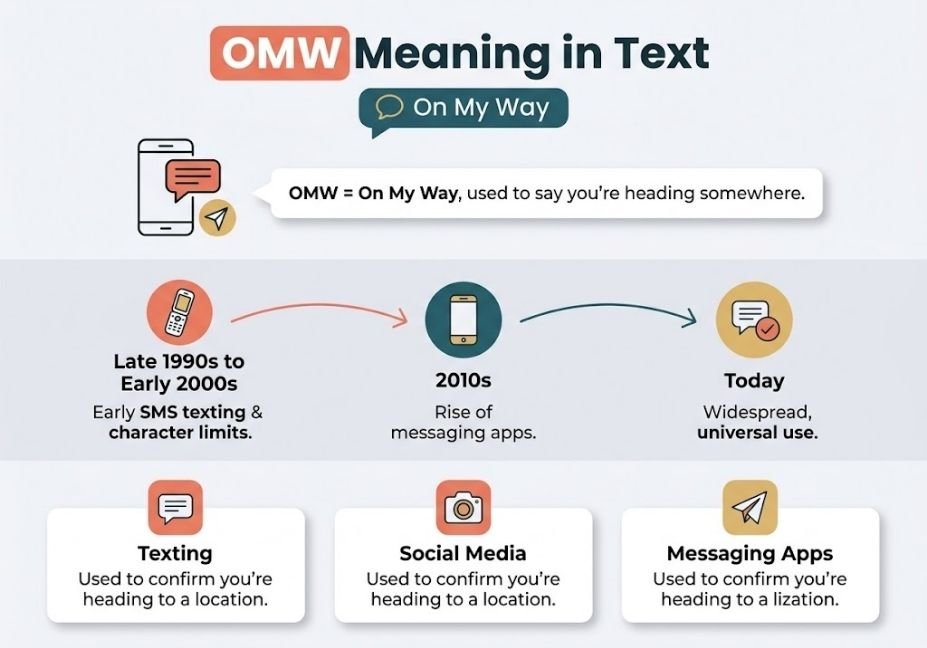
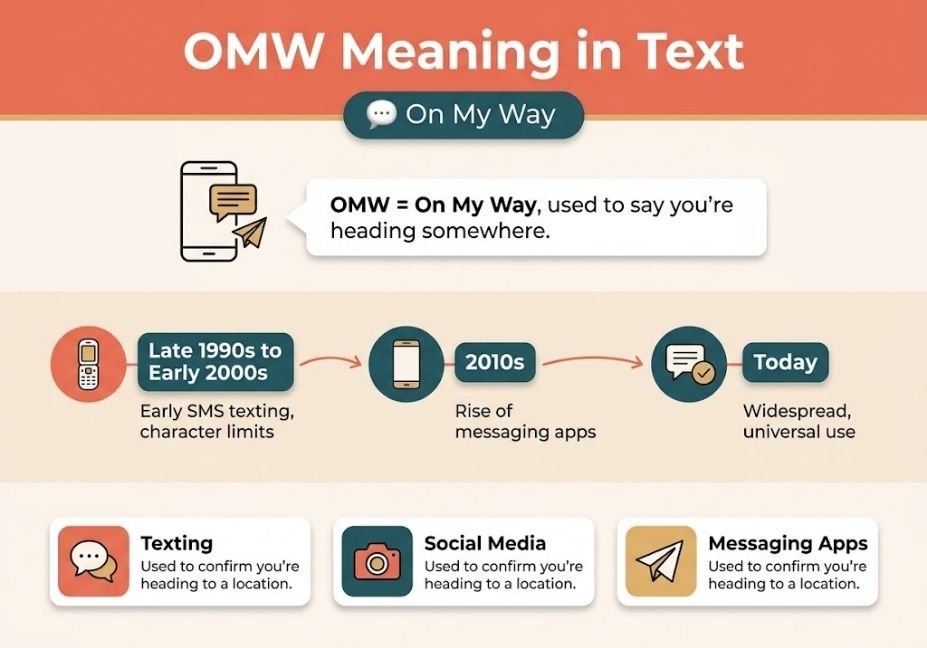
The phrase “on my way” has been part of everyday English for a very long time. The shortened version, OMW, traces back to early SMS text messaging, when phones limited messages to 160 characters and every letter counted. According to How-To Geek’s breakdown of internet acronyms, people needed fast ways to communicate short updates, and abbreviations like OMW filled that gap perfectly.
The abbreviation existed quietly for years, but it exploded in popularity during the 2010s alongside the rise of smartphone messaging apps. As texting became the primary way people coordinated plans, OMW became one of the fastest and most reliable ways to confirm you were heading somewhere without typing out a full sentence.
Today, predictive text and quick-reply features on many phones and apps even suggest “omw” automatically, which has helped cement it as one of the most universally understood pieces of texting slang across age groups.
This kind of shortening is not unique to OMW. Texting culture has always compressed common phrases whenever people needed to save time or characters, and OMW simply joined a much larger family of shorthand that includes terms like BRB, TTYL, and NVM. What makes OMW stand out is how often it gets used. Coordinating plans is one of the single most common reasons people text each other, and OMW answers that exact need in the shortest way possible.
How People Use OMW in Texting and Social Media
OMW shows up constantly across nearly every messaging platform, and the meaning stays the same no matter where you see it.
- Texting friends or family to confirm you are heading their way
- WhatsApp and Snapchat messages when coordinating meetups
- Instagram DMs and comments, often paired with an emoji
- Group chats when multiple people are gathering somewhere
- Quick workplace messages in casual, informal teams
Sometimes people use OMW a little loosely. Someone might text it while they are still getting dressed, simply meaning they are about to leave rather than already in motion. This flexible, intention-based usage is common and generally understood by most people who text regularly.
OMW can also be used in a slightly playful or metaphorical way. Someone finishing up a work task might joke “omw to being done,” meaning they are close to finishing rather than physically traveling anywhere.
Here are a few more examples of how the abbreviation shows up in real conversations:
Person A: “The movie starts in twenty minutes.” Person B: “Omw, just grabbing my coffee first.”
Coworker: “Meeting starts in five, don’t be late.” You: “On it, omw to the conference room now.”
Friend: “You said six, it’s already six thirty.” You: “Sorry, omw now, traffic was bad.”
These small exchanges show why the term feels so natural in everyday digital communication. It reassures the other person without requiring a phone call or a longer explanation, which keeps conversations moving smoothly even when someone is busy, driving, or multitasking.
Generational habits play a role here too. Younger texters, especially teenagers and young adults, tend to use OMW constantly and often pair it with emojis or extra punctuation for emphasis, like “omw!!” or “omw 🚗”. Older texters or more formal contexts tend to use it more sparingly, sometimes preferring to spell out “on my way” in full even in casual settings. Neither approach is wrong, but recognizing this pattern helps explain why the tone around OMW can feel slightly different depending on who is sending it.
What Does OMW Mean From a Girl or a Guy?
This is one of the most searched follow-up questions, and the honest answer is simple: the meaning does not change based on who sends it. When a girl texts OMW, it means the same thing as when a guy texts it, which is that they are heading your way or about to leave.
What can shift is the tone. A girl or guy might send “omw!!” with extra punctuation or an emoji to show excitement about seeing you, especially in a dating context or with someone they are close to. In a plain, professional, or casual group setting, “omw” without any extra flair usually just signals a quick, practical update.
The words themselves stay consistent. Context, punctuation, and relationship history are what change the emotional tone behind the message, not the gender of the sender.
OMW vs OTW vs ETA: What’s the Difference?
People often mix up OMW with a few similar abbreviations, so here is a quick, clear breakdown of how they differ.
- OMW means “on my way,” confirming you have started heading somewhere or are about to.
- OTW means “on the way,” which is essentially interchangeable with OMW in casual texting.
- ETA means “estimated time of arrival,” and it tells someone when you expect to arrive, not just that you are moving.
- BRT means “be right there,” used for very short distances or quick tasks before you leave.
These terms often get combined in real conversations. Someone might text “omw, eta 15 minutes,” which confirms both that they are traveling and roughly when they will show up. Understanding this small difference helps avoid confusion when coordinating plans with friends, coworkers, or family.
None of these abbreviations compete with each other. They actually work well together, since each one answers a slightly different question. OMW answers “have you started moving,” OTW answers the same question with slightly different phrasing, ETA answers “when will you arrive,” and BRT answers “how soon before you leave.” Once you know the small difference between them, you can mix and match them naturally depending on exactly what information the other person needs.
Is OMW Formal or Informal?
OMW is informal language, and that matters when deciding where to use it. It fits perfectly in texts, DMs, group chats, and casual conversations with friends, family, or coworkers you have a relaxed relationship with.
It is generally best to avoid OMW in formal emails, official business communication, or professional documents. In casual workplace chat apps like Slack, it is usually fine among team members who already communicate informally, but it is not something you would use in a client-facing email or a formal report.
The rule of thumb is simple: if the conversation already feels casual, OMW fits right in. If the setting calls for more formal language, spell out “on my way” instead.
Common Misunderstandings About OMW
A few small misconceptions come up often enough to be worth clearing up.
- Some people confuse OMW with “oh my word,” a phrase used similarly to “oh my god” in British English. Context almost always makes the correct meaning obvious.
- Typing ONW instead of OMW is usually just a simple typo, not a different abbreviation with its own meaning.
- OMW does not guarantee an exact arrival time. It signals movement or intention, not a precise schedule.
- Sending OMW does not always mean someone has physically left yet. Sometimes it just means they are getting ready to.
Knowing these small distinctions helps prevent unnecessary confusion, especially when you are coordinating time-sensitive plans with someone.
How to Reply When Someone Sends You OMW
Knowing what to text back after receiving an OMW is just as useful as knowing what it means. Your reply usually depends on the relationship and the situation, but a few responses work in almost any context.
- “Okay, see you soon” works as a simple, friendly acknowledgment
- “Take your time” signals there is no rush at all
- “How long will you take?” is useful if timing genuinely matters
- “Drive safe” adds a caring touch for anyone traveling by car
None of these replies require overthinking. The whole point of OMW is to keep communication light and efficient, and matching that same energy in your response keeps the conversation feeling natural instead of formal or stiff.
It also helps to remember that OMW is meant to reduce back and forth, not start a longer conversation. If timing genuinely matters, like meeting a flight or catching the start of an event, it is completely reasonable to ask a quick follow up question. Outside of those situations, a short, warm reply is usually all the moment calls for.
Conclusion
Omw meaning in text comes down to one simple phrase: on my way. It is a fast, friendly, and widely understood way to tell someone you are heading toward them or about to leave for a destination. Whether you see it from a friend, a date, a family member, or a coworker, the core meaning never changes, even if the tone around it does.
The real takeaway here is that OMW works because it is simple. It replaces a full sentence with three letters, keeps conversations moving quickly, and fits naturally into nearly every casual messaging platform people use today. Now that you know exactly what it means and how to use it, you can send or reply to it with total confidence.
FAQs
What does OMW mean from a girl?
It means the same thing as always, “on my way.” Tone or emojis might add warmth, but the core meaning stays identical.
What does OMW mean from a guy?
It simply means he is heading your way or about to leave soon. The meaning does not change by gender.
Is OMW formal or informal to use?
OMW is informal. It works well in casual texts and chats but should be avoided in formal emails or documents.
What is the difference between OMW and ETA?
OMW confirms you are moving toward a destination. ETA tells the other person roughly when you will actually arrive.
Where did the abbreviation OMW come from?
It started in early SMS texting when character limits were strict, then became mainstream with the rise of smartphone messaging apps.