
If you’ve ever read a passage that felt like a string of gunshots, short, sharp, and fast. You’ve already encountered a staccato sentence. The meaning of staccato sentences begins with music, but the term has since become a powerful tool in a writer’s toolbox. Whether you came across it in an English class, a writing guide, or a novel review, you may still wonder what it means and, more importantly, how to use it effectively.
In this guide, you’ll learn where the term comes from, what makes a sentence “staccato,” how it differs from other short-sentence styles, and how to use it in your own writing without overdoing it. By the end, you’ll be able to spot staccato sentences instantly and build a few of your own.
What Does Staccato Sentences Meaning Refer To?
A staccato sentence is a short, abrupt sentence, usually just a few words, used back-to-back with others for emphasis, speed, or dramatic effect. The word borrows its meaning from music, where staccato notes are played sharply and separately rather than smoothly connected. In writing, staccato sentences meaning carries the same idea: short bursts of language that hit hard and move fast.
Where the Term Staccato Comes From
The word staccato didn’t start in literature. It came from music. Staccato is the past form of the Italian verb staccare, which means “to detach.” In music, musicians use the term to describe notes played briefly and distinctly, with a clear gap between each one. In contrast, legato notes flow smoothly together, like a long, gentle bow stroke on a violin. Think of staccato as a quick pluck followed by silence. That contrast is the heart of staccato.
In sheet music, a staccato note is marked with a small dot placed above or below the note head. That dot tells the performer to cut the note short, allowing silence to follow instead of letting it blend into the next sound. Meanwhile, legato takes the opposite approach, with notes flowing smoothly into one another without an audible break. As a result, staccato creates a sharper, more separated sound. The contrast between staccato and legato is really a contrast between separation and connection, and that same contrast is exactly what carries over into writing.
Over time, writers and critics borrowed the word to describe anything abrupt, choppy, or made of short, disconnected bursts. A staccato cough. Staccato gunfire. Staccato footsteps on tile. And, most relevant here, staccato sentences.By the early twentieth century, however, literary critics were already using the term to describe a distinct prose style. This style relied on clipped, rapid-fire sentences rather than long, winding ones.
What Makes a Sentence “Staccato”?
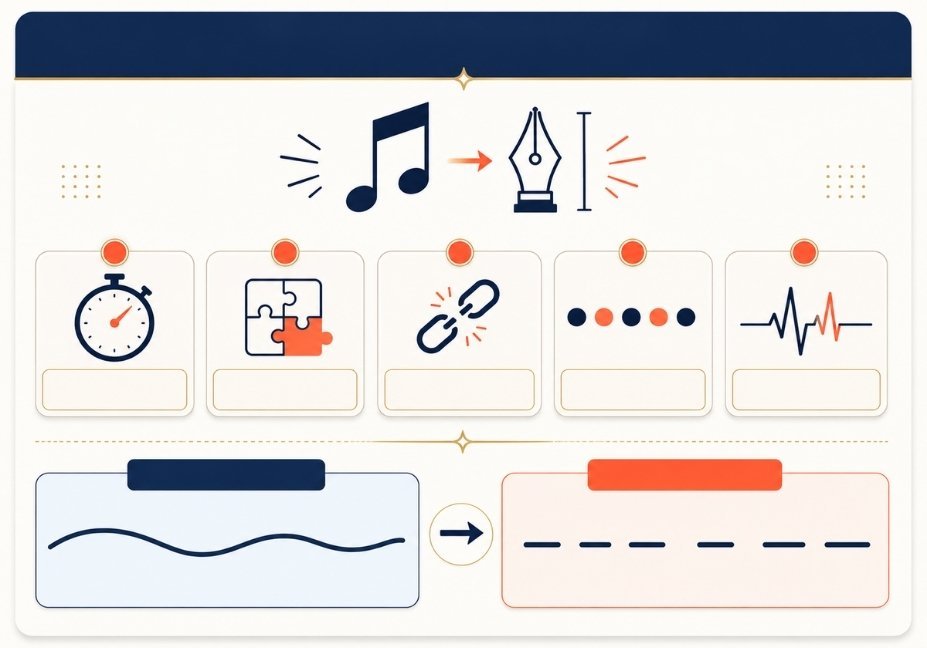
A staccato sentence isn’t just any short sentence. It’s a deliberately short one, placed next to other short sentences, to create a specific rhythm. A few defining traits show up again and again:
- Brevity. Most staccato sentences run one to eight words.
- Simplicity. They favor plain, common words over complex vocabulary.
- Fragmentation. Many are technically sentence fragments, not full grammatical sentences.
- Repetition in pattern. They’re rarely used alone; they appear in clusters.
- Emotional or dramatic weight. Each one is built to land with impact.
Here’s a simple example:
He stopped. Silence. Then chaos.
Notice how each fragment stands alone. There’s no smooth transition, no connecting word linking one idea to the next. That gap between each phrase is exactly what staccato means in a musical sense, translated into prose.
Staccato Sentences in Action: Examples
Seeing staccato sentences in context makes the concept click faster than any definition. Here’s a fishing scene built almost entirely from short, punchy fragments:
The reel clicked once. Matt lowered his beer. It clicked again. Two more. Three. Faster now. The rod bowed. Fish on!
Notice the acceleration. The sentences get shorter and closer together as the tension rises, mimicking the quickening pace of the moment itself. That’s the technique at work: sentence length mirrors emotional intensity.
Compare that to a suspense scene:
Footsteps. Closer now. A shadow crossed the wall. She froze. Waited. Nothing.
Again, short bursts create tension. Long, flowing sentences would slow the pace and dull the suspense. Staccato writing forces the reader’s eyes, and pulse, to move quickly.
Staccato Sentences Across Genres
The technique shows up differently depending on the type of writing. Recognizing these patterns makes it easier to spot, and use, staccato sentences meaning in your own work.
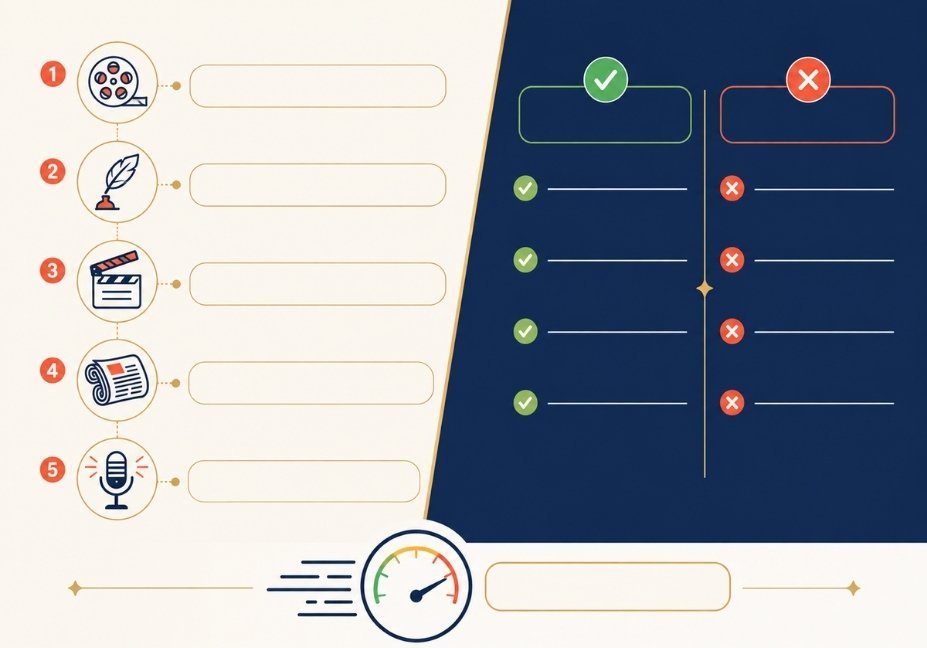
Fiction and thrillers. Action and suspense writers rely on staccato sentences to keep readers on edge. A car chase, a fight scene, or a jump scare almost always slows down for setup, then switches to short bursts the moment the action hits.
Poetry. Poets use staccato lines to control breath and rhythm. A short line forces a pause, mimicking the effect of a staccato note cutting off before the next begins.
Screenwriting. Scripts often use staccato dialogue or stage directions to convey urgency without wasting page space. A character barking single-word commands during a crisis is a classic staccato pattern.
Journalism. News writers use short, punchy sentences in leads and breaking news coverage to convey urgency and keep readers moving quickly through developing stories.
Speeches. Public speakers use staccato phrasing for rallying lines and memorable closers, because short, rhythmic phrases are easier for an audience to absorb and repeat.
Staccato Sentences vs. Other Short-Sentence Styles
It’s easy to confuse staccato sentences with other short or fragmented writing techniques. Here’s how they differ:
- Simple sentences are grammatically complete but not necessarily rhythmic or clustered.
- Sentence fragments are incomplete but may appear alone, not in a rapid sequence.
- Minimalist prose uses short sentences throughout a whole piece, not just for emphasis.
- Staccato sentences are specifically short, clustered, and used for rhythm or drama.
The key difference is intent and pattern. A single short sentence isn’t staccato. A deliberate sequence of short, punchy sentences designed to speed up the reader’s pace is.
Why Writers Use Staccato Sentences
Writers reach for staccato sentences meaning as a technique when they want to control pacing and emotional intensity. A few common reasons show up across fiction, journalism, and even marketing copy:
- To build tension or urgency in an action scene.
- To mimic panic, fear, or a racing heartbeat.
- To create a punchy, memorable closing line.
- To speed up the reading pace during a climax.
- To add rhythm and musicality to otherwise flat prose.
- To make a single idea stand out by isolating it.
This technique is especially common in thrillers, war novels, and hard-boiled crime fiction, where fast pacing mirrors physical danger. For example, Ernest Hemingway is often credited with popularizing short, clipped sentences in modern American fiction. Later, journalists and advertisers adopted similar techniques because brevity quickly grabs attention.
Staccato Sentences in Business and Everyday Writing
Staccato sentences aren’t limited to novels. Used sparingly, they show up in business writing, marketing copy, and speeches too. A short, punchy line can close a pitch, highlight a key benefit, or make a headline unforgettable. Consider a product tagline built from staccato fragments: fast. Simple. Done.
That kind of phrasing works because it’s memorable and confident. It sounds decisive. But context matters. In a formal report or a technical document, too many staccato sentences can come across as choppy, unprofessional, or even flippant. Save the technique for moments that genuinely call for punch and pace.
How to Use Staccato Sentences Without Overusing Them
Like most stylistic tools, staccato sentences lose their power when overused. If every sentence in a piece is short and abrupt, none of them stand out. The contrast is what creates the effect, so staccato sentences work best when placed against a backdrop of longer, more flowing sentences.
A useful way to think about it: use staccato sentences the way you’d use a strong spice. A pinch transforms a dish. Too much overwhelms it. The same logic applies here. Save the technique for pivotal moments, a plot twist, a moment of realization, a climactic action beat, rather than spreading it evenly across an entire piece.
Here are a few practical tips for using the technique effectively:
- Reserve staccato sentences for high-emotion or high-stakes moments.
- Surround them with longer sentences for contrast and rhythm.
- Keep each fragment under eight words when possible.
- Read the passage aloud to check the pacing feels natural.
- Avoid using the technique in formal or technical writing.
Staccato Sentences and Reading Rhythm
One reason this technique works so well is that sentence length physically affects reading speed. Long, complex sentences slow readers down because there’s more to process. Short sentences do the opposite. Your eyes move faster, and your brain processes the information in quick, digestible chunks.
This is part of why staccato sentences meaning is so closely tied to pacing. A string of short sentences literally speeds up how fast a reader moves through the text, which is exactly why writers use the technique during action sequences, arguments, or emotional confrontations. According to Merriam-Webster’s notes on the word’s musical origin, staccato describes tones that are short and disconnected rather than smoothly flowing, and that same “start-stop” quality is what gives staccato prose its distinctive rhythm on the page.
Staccato Sentences and Sentence Variety
Good prose rarely relies on just one sentence length throughout. Skilled writers move between long, medium, and short sentences to keep readers engaged, and staccato sentences are simply the shortest end of that range, used at the moments that matter most.
Think of a paragraph as a piece of music. A steady stream of medium-length sentences is like a melody played at a constant tempo, pleasant, but not especially memorable. Drop in a few staccato sentences at the right moment, and suddenly there’s a beat, an accent, a moment the reader’s brain flags as important. That’s the real power of the technique: it isn’t just about being short, it’s about creating contrast against everything around it.
Writers who master sentence variety often describe their process as listening to the rhythm of a paragraph as much as reading its meaning. If a passage feels flat, adding one or two staccato sentences at a key turning point can often fix the pacing without changing a single fact in the story.
Common Mistakes Writers Make With Staccato Sentences
Even once you understand the definition, it’s easy to misuse the technique. A few frequent missteps include:
- Overusing it until every sentence feels short and choppy.
- Using it in scenes that call for a slower, reflective pace.
- Stringing together fragments that don’t build toward anything.
- Losing clarity by cutting too much context from each sentence.
- Relying on it as a crutch instead of varying sentence structure naturally.
The goal isn’t just brevity for its own sake. Every staccato sentence should earn its place by adding tension, clarity, or emotional weight. If a short sentence doesn’t do one of those things, it’s probably better combined with the sentence around it.
Frequently Asked Questions
What is the simple definition of a staccato sentence?
A staccato sentence is a very short, abrupt sentence used alongside other short sentences to create speed, tension, or emphasis in writing.
Does staccato sentence mean the same as a fragment?
Not exactly. Many staccato sentences are fragments, but the term specifically refers to short sentences used in a rhythmic, clustered pattern for effect.
Where does the word staccato come from?
It comes from the Italian verb staccare, meaning “to detach,” originally used as a musical direction for short, separated notes.
Are staccato sentences good or bad in writing?
Neither on their own. Used sparingly for emphasis, they’re powerful. Overused, they make prose feel choppy and disjointed.
Can staccato sentences be used outside of fiction?
Yes. Journalists, speechwriters, and marketers use them for punchy headlines, taglines, and moments that need impact.
Final Thoughts on Staccato Sentences Meaning
At its core, staccato sentences meaning comes down to one idea borrowed from music: short, detached bursts that create rhythm and impact. In writing, that translates into brief, punchy sentences placed together to speed up pacing, heighten emotion, or make a single line unforgettable.
The technique works best in small doses, placed carefully against longer, flowing prose for contrast. Whether you’re writing a thriller, a speech, or a piece of marketing copy, a well-timed staccato sentence can do what paragraphs of explanation can’t: it can make a reader feel something instantly. Use it deliberately, and it will always leave a mark.