
To reconnoiter means to explore or survey an area to gather information, usually before taking action. The word most often shows up in military contexts, but people also use it in everyday writing when they mean “scout out” or “check out ahead of time.” It’s a word that sounds formal and a little old-fashioned, yet it still earns its place in modern writing because there’s no single word that captures the same idea quite as precisely.
If you’ve seen this word in a novel, a history book, a news article, or a spelling quiz and wondered exactly what it means, you’re not alone. It’s one of those words that looks harder to pronounce than it actually is, and one that people often recognize but rarely use themselves. This guide breaks down the reconnoiter meaning in plain English, shows you how to pronounce and spell it correctly, walks through its grammar and word forms, and gives you real examples of how it’s used today, both on and off the battlefield.
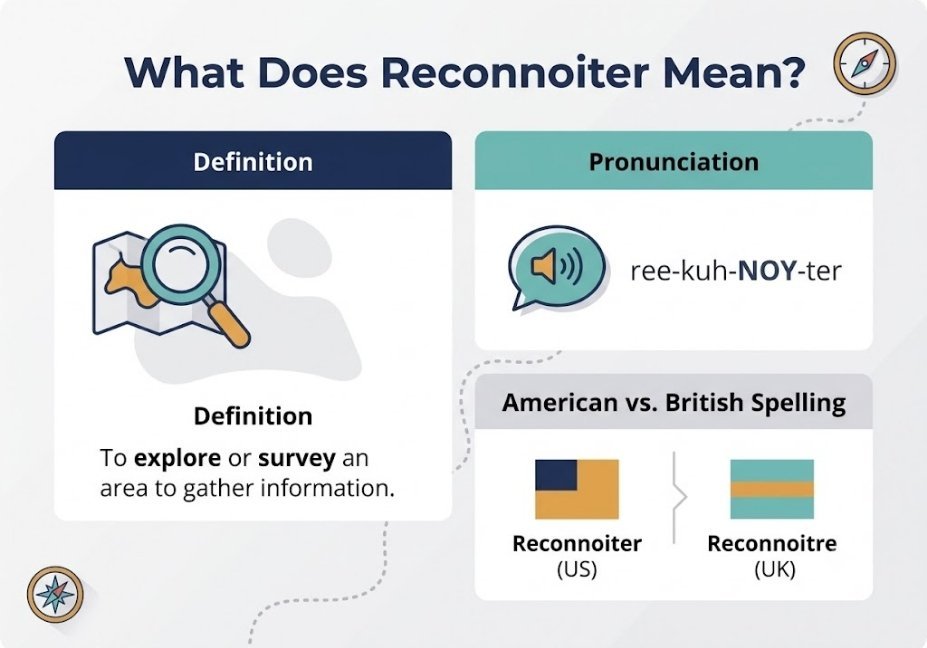
Reconnoiter (verb): to inspect or explore an area in order to gather information, often before making a decision or taking action. Example: “The team reconnoitered the trail before the group hike.”
|Also read this article GFN Meaning in Text: What It Really Means Today
What Does Reconnoiter Mean?
At its core, reconnoiter means to look something over carefully to learn about it. Merriam-Webster defines it simply as to make a reconnaissance of something. Britannica’s dictionary puts it more concretely: it means to go to a place or area to find out information, often about a military enemy, or to do a reconnaissance of that place.
Notice the pattern in both definitions: the word always implies purpose. You don’t reconnoiter something out of idle curiosity. You reconnoiter because you’re about to make a decision, and you want information first. That’s really the heart of the word. It’s not just “looking around,” it’s looking around with intent, usually so you can act more safely or more effectively afterward.
The word can be used with or without an object. You can reconnoiter a location (“They reconnoitered the coast”), or you can simply reconnoiter, as in scouting ahead without naming the target directly (“They were sent ahead to reconnoiter”). Both forms are grammatically correct, and which one you use depends on whether you want to specify exactly what’s being surveyed.
|Also read this article What Does GTFO Mean in Text? Full Guide (2026)
Reconnoiter vs. Reconnoitre (Spelling)
This is one of the most common points of confusion, right up there with how to actually say the word out loud. Both spellings mean the same thing:
- Reconnoiter – American English spelling
- Reconnoitre – British English spelling
Cambridge Dictionary uses the same core definition for both, describing it as what soldiers or aircraft do to get information about an area or the size and position of a force. The spelling difference follows the same pattern as other American-versus-British word pairs, like “center” and “centre” or “theater” and “theatre.” If you’re writing for a US audience, use “reconnoiter.” For UK, Australian, Canadian, or Indian English audiences, “reconnoitre” is the standard form. Neither spelling is “more correct” than the other; they’re regional conventions, not competing definitions.
|Also read this article What Does CF Mean in Text? Every Meaning Explained
How to Pronounce Reconnoiter
It’s pronounced ree-kuh-NOY-ter. The stress falls on the third syllable, and the tricky part for most people is the “oi” sound in the middle, which rhymes with “boy.” A useful trick is to break it into three chunks: “re,” like the musical note, “kuh,” a short unstressed syllable, and “NOY-ter,” where almost all the emphasis lands. Say those three pieces quickly in a row and the full word comes out naturally.
Because it’s a less common word in everyday speech, a lot of people only ever encounter it in writing, which is exactly why so many searches are about pronunciation rather than definition alone. If you’ve been silently mispronouncing it in your head, you’re in good company.
|Also read this article What Does ICL Mean In Text? The Full Meaning Explained
Where Does Reconnoiter Come From?
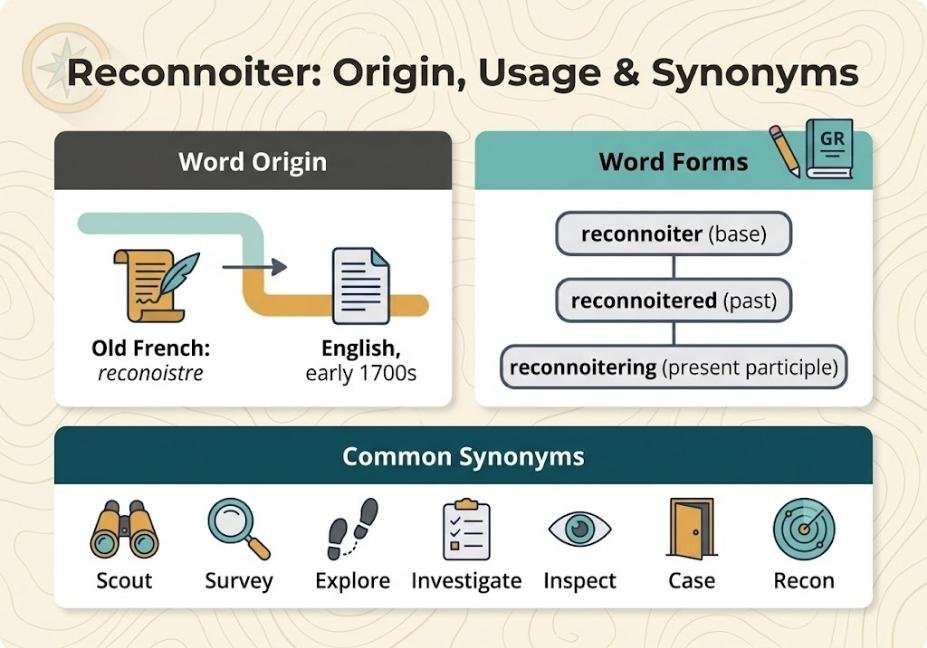
The word has French roots. It comes from the obsolete French word reconnoître, which traces back to the Old French reconoistre, related to the modern word “recognize.” Dictionary.com and Collins both trace the term to this French origin, noting it entered English use in the early 1700s, originally as a military scouting term.
That connection to “recognize” makes sense once you think about it: reconnoitering is essentially trying to recognize what you’re dealing with before you commit to a plan. Military commanders in the 18th century needed a word for the specific act of sending scouts ahead to identify enemy positions, terrain features, and potential obstacles before committing troops. English borrowed the French term wholesale, adapted the spelling over time, and it stuck around as standard military vocabulary for the next three centuries.
This etymology also explains why reconnoiter is closely related to the noun “reconnaissance,” which shares the same French root. Both words describe the same basic concept: gathering information about an area or situation before acting on it. Over time, “reconnaissance” became the more common noun in general use, especially in phrases like “reconnaissance mission” or “reconnaissance flight,” while “reconnoiter” stayed firmly a verb describing the act itself.
Word Forms and Grammar
Like most English verbs, reconnoiter changes form depending on tense and usage. Knowing these forms helps if you’re writing dialogue, historical fiction, or formal reports where the word might appear more than once:
- Base form: reconnoiter (or reconnoitre)
- Past tense: reconnoitered (or reconnoitred)
- Present participle: reconnoitering (or reconnoitring)
- Noun form (related): reconnaissance
- Person who reconnoiters: reconnoiterer
Notice that the British spelling drops the “e” before adding “-ing” or “-ed,” which is a common pattern in British English word formation. American English keeps the double vowel intact throughout all its conjugations. This is the same rule that governs words like “travelling” versus “traveling,” so if that distinction is already familiar to you, reconnoiter follows the exact same logic.
Reconnoiter in a Sentence: Real Examples
Reconnoiter still appears most often in military and historical writing, but it shows up in modern journalism, science reporting, and everyday speech too. A few real-world uses:
- Military/defense: news coverage has described drones that reconnoiter vast stretches of territory using sensors to perform surveillance.
- Space and science writing: coverage of NASA and ESA missions has described spacecraft set to reconnoiter both Dimorphos and Didymos to take measurements of the rocks after the DART mission.
- Historical and exploration writing: older texts describe explorers who reconnoitered coastlines and rivers, traveling upstream to map unfamiliar territory before settlements were built.
- Everyday, non-military use: Vocabulary.com points out you don’t need a battlefield to use the word, you could just as easily reconnoiter the breakroom on the lookout for doughnuts.
That last example is a good reminder: reconnoiter simply means to scope something out before you act, whether that’s an enemy coastline, a new neighborhood, a hiking trail, or a snack table. Writers often reach for it specifically because it sounds more deliberate and purposeful than plain alternatives like “look around” or “check out.”
Reconnoiter in Literature and Film
Because of its military weight, reconnoiter shows up frequently in war novels, historical fiction, and screenplays set during conflict. Characters “reconnoiter” enemy camps, unfamiliar towns, or dangerous terrain before deciding how to proceed. This usage isn’t just decorative; it signals to the reader that a character is being cautious and strategic rather than reckless. A soldier who reconnoiters before advancing is written as competent and careful, which is part of why the word carries a certain gravitas even outside strict military nonfiction.
You’ll also spot it occasionally in espionage fiction and heist stories, where a character might reconnoiter a building or a psychiatrist’s office before a covert operation, echoing its original sense of scouting a target from a safe distance first.
Common Synonyms for Reconnoiter
- Scout
- Survey
- Explore
- Investigate
- Inspect
- Case (informal)
- Recon (informal shorthand)
Each of these carries a slightly different flavor. “Scout” feels casual and is common in everyday speech. “Survey” leans more formal and technical, often used in engineering or land contexts. “Case,” as in “case the joint,” is slang with a slightly criminal connotation. “Reconnoiter” sits above all of these in formality, which is exactly why it tends to show up in military reports, science journalism, and literary fiction rather than casual conversation. If you’re writing something conversational, “scout” or “check out” will usually sound more natural; save “reconnoiter” for moments where you want that extra weight and precision.
Is Reconnoiter Only a Military Word?
No. While its roots and most common usage are military, dictionary sources confirm it applies anytime someone explores an area to gather information first, whether that’s a person checking out a new city neighborhood before deciding where to live, a hiking group scouting a trail before committing to a route, or a business scouting a new market before launching a product there.
In fact, using the word outside a military context can add a bit of wit or elevated tone to writing. Describing someone who “reconnoiters the buffet table” before filling their plate, for example, borrows the word’s serious military weight and applies it playfully to something mundane, which is part of why writers enjoy using it.
Common Mistakes People Make With Reconnoiter
A few small errors come up often enough to be worth flagging:
- Confusing it with “reconnaissance” and using them interchangeably as the same part of speech. Remember: reconnoiter is the verb, reconnaissance is the noun.
- Misspelling it as “reconnoitor” or “reconoiter,” dropping or misplacing the double “n” or the “oi.”
- Assuming British “reconnoitre” is a typo. It’s a legitimate, standard spelling, not an error.
- Overusing it in casual writing where a simpler word like “scout” or “check out” would read more naturally.
Why This Word Still Matters Today
Even though reconnoiter isn’t part of everyday casual speech, it hasn’t faded from use. It regularly appears in defense journalism describing drone surveillance, in science writing about space missions gathering data before a landing, and in historical fiction set during wartime. Its precision is exactly what keeps it alive: no other single word captures the specific idea of “purposefully exploring to gather information before acting” quite as cleanly.
FAQs
Is reconnoiter a real word?
Yes. It’s a standard English verb listed in major dictionaries, meaning to explore an area to gather information.
What is the difference between reconnoiter and reconnaissance?
Reconnoiter is the verb (the action). Reconnaissance is the noun describing the act or mission itself.
How do you pronounce reconnoiter?
It’s pronounced ree-kuh-NOY-ter, with stress on the third syllable.
What is a synonym for reconnoiter?
Common synonyms include scout, survey, explore, and investigate.
Is reconnoiter only used in a military context?
No. It originated as a military term but is now used for any careful, exploratory look at an area or situation before acting.
Final Thoughts
Reconnoiter means to explore or survey something, usually to gather information before making a move. It has military and French origins, but its modern use stretches well beyond the battlefield into travel, hiking, journalism, science writing, literature, and everyday conversation. Whether you’re writing fiction, prepping for a vocabulary test, studying word origins, or just curious after seeing it in an article, you now know exactly what it means, how to pronounce it, how it changes across tenses, and how to use it correctly in a sentence.