
Seeing “PFP” in a text or comment section can be confusing. You might wonder if you missed something. The truth is, PFP meaning in text is much simpler than it looks. Once you know what it means, you’ll notice it everywhere. It appears in group chats, social media, gaming servers, and online communities every day.
In this guide, you’ll learn exactly what PFP stands for, where the term originated, how people use it across different apps, and what someone means when they mention your PFP. By the end, you will be able to read and use the term like a regular on any platform.
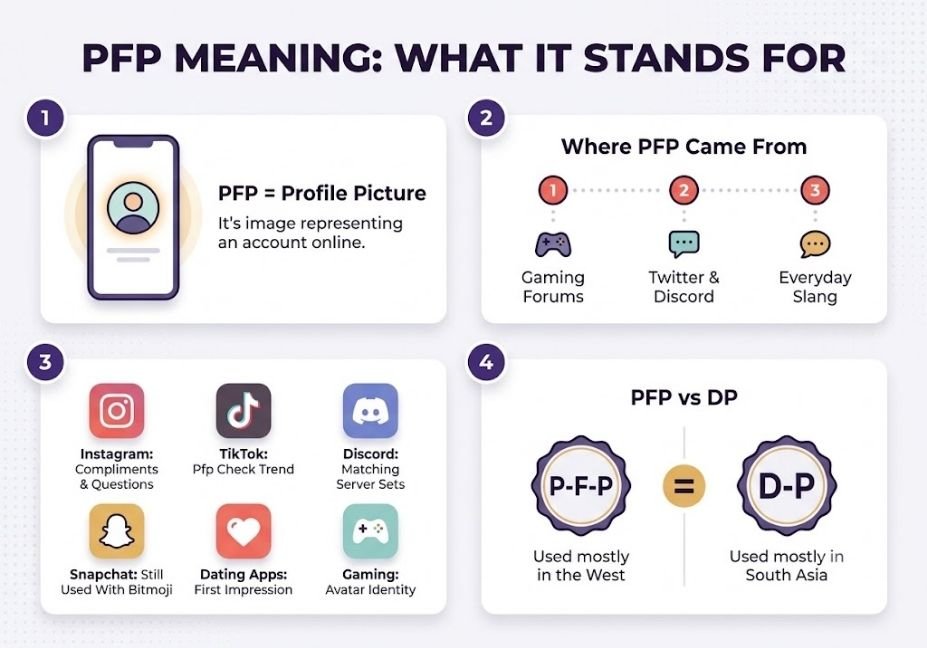
PFP stands for “profile picture.” It refers to the image or avatar that represents someone’s account on social media, messaging apps, or gaming platforms. In casual texting, PFP almost always means that profile photo or avatar.
What Does PFP Stand For
PFP is short for “profile picture.” It is the small image attached to a username on almost every app with user accounts. You’ll see it on Instagram, TikTok, Discord, and even in group texts. People use PFP because typing “profile picture” every time takes longer. The shorter term matches the fast, casual style of texting and online conversations.
The term is neutral by itself. It simply names the photo, not whether that photo is good, bad, or worth commenting on. How someone reacts to a PFP depends on the image and the tone of the conversation. Some reactions are positive, while others may be negative.
Where PFP Came From
PFP first became popular on early internet forums and gaming communities. People used short abbreviations to save time while typing. As platforms like Twitter, Discord, and Instagram grew during the 2010s, the term spread quickly. It matched the way people already communicated online. Most users preferred quick, clipped phrases instead of full sentences.
Gaming communities adopted PFP early because avatars helped players recognize each other. This was especially useful before platforms offered fully searchable usernames. Forum culture in the early 2000s already leaned on small profile images next to usernames, so when texting slang caught up, the abbreviation simply carried over. From there, the term spread across social media. Today, PFP is one of the most common abbreviations linked to online identity, and it shows no sign of fading, since every new platform still needs some kind of profile image to identify accounts.
PFP Meaning By Generation
Not everyone uses the term the same way, and age plays a role here.
Younger users, especially teens on TikTok and Discord, treat pfp as an everyday word, using it constantly without a second thought. Millennials tend to use pfp mainly on Instagram and Twitter, often tied to specific eras of profile photo trends. Older users sometimes still say “profile picture” in full and only recognize pfp once someone explains it. Gamers across age groups use pfp almost interchangeably with avatar, since many gaming platforms never required a real photo.
This gap explains why some people search “pfp meaning in text” in the first place. It is common enough that most young internet users assume everyone already knows it, but that is not always true across different age groups or platforms.
How PFP Is Used On Different Platforms
The meaning of pfp stays the same everywhere, but the way people bring it up shifts slightly depending on the app.
On Instagram, PFP usually comes up as a compliment or a question about who is in the photo. TikTok users often comment “PFP check” to encourage others to share or react to their profile picture. Within Discord servers, PFPs often become part of matching themes among friends or communities. Even on Snapchat, people still use the term, although Bitmojis are more common. Dating apps rely heavily on a PFP because it creates a strong first impression and can influence whether someone swipes or replies. In gaming chats, pfp usually points to an avatar rather than a real photo. On X, formerly Twitter, pfp often gets discussed around big cultural moments or trending topics. On LinkedIn, the same image is usually just called a profile photo instead of pfp, since the platform leans more professional.
What It Means When Someone Comments On Your PFP
A pfp comment is rarely random. It usually falls into one of a few categories depending on tone and context.
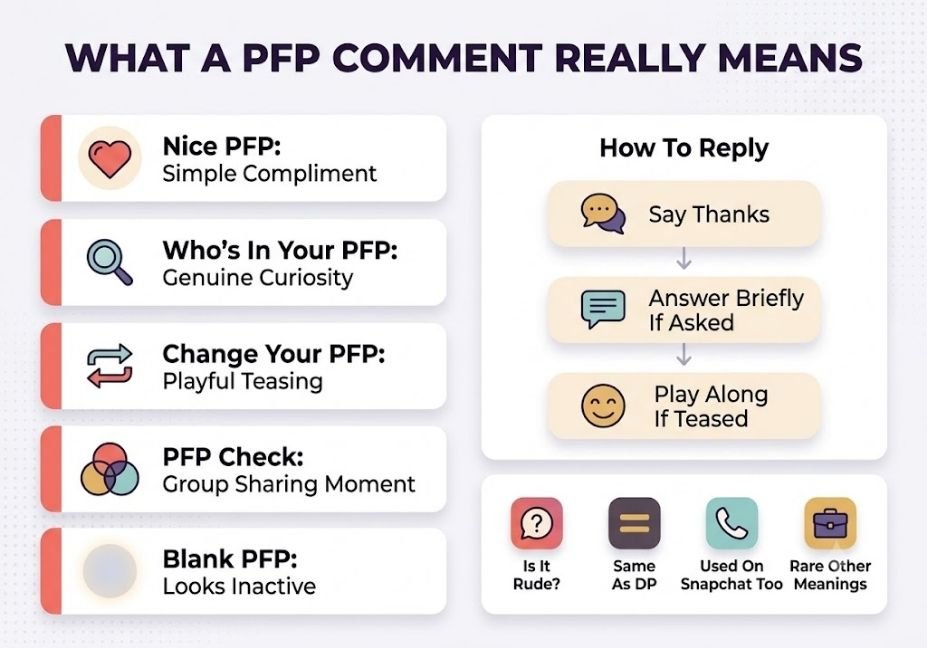
“Nice pfp” is a simple compliment about your current photo. “Who’s in your pfp” is genuine curiosity about the image. “Change your pfp” can be a joke, a request, or mild teasing depending on the friendship. “Pfp check” invites people to share or react to their current picture together. A blank or default pfp sometimes reads as inactive or unfamiliar to others.
Context and tone matter more than the words themselves. The exact same message can be playful between close friends and slightly awkward from someone you barely know, so it helps to read the rest of the conversation before deciding how to respond.
PFP Vs DP: What’s The Difference
DP, short for “display picture,” means the same thing as pfp in almost every situation.The two terms are often used interchangeably. DP is more common in South Asia, while PFP dominates in the United States and most Western platforms. Neither term is more correct than the other. They simply reflect regional language habits. If someone asks, “What’s your DP?” instead of “What’s your PFP?”, they likely use apps that are more popular outside the United States. Once you know both terms, the meaning is the same.
PFP In Gaming Versus Real-Life Photos
Gaming platforms treat pfp a little differently than social apps built around real photos. On sites like Discord, Xbox, or PlayStation networks, a pfp is almost always an avatar, a character, or a piece of fan art rather than an actual picture of the user. This happens partly for privacy, since many gamers prefer not to share their real face online, and partly for fun, since a cool or funny avatar becomes part of someone’s online identity within a community.
On platforms built around real connections, like Instagram or LinkedIn, a pfp usually is an actual photo of the person, since the whole point is recognizing a real face. Understanding this difference helps explain why asking “who’s in your pfp” makes sense on Instagram but sounds a little odd on a gaming server, where the honest answer is often “nobody, it’s just a drawing I liked.”
Other Meanings Of PFP
Outside of texting and social media, PFP occasionally stands for something else entirely, and it helps to know these exist so you are not thrown off in the wrong context. In medical settings, PFP can refer to patellofemoral pain, a common knee condition, while in military and workplace contexts it can mean private first class or pay for performance. According to Merriam-Webster’s tracking of common abbreviations, acronyms like this frequently carry multiple meanings depending entirely on the field they appear in. In a text message or on social media, though, the internet slang meaning of profile picture is by far the most common, and it is almost never confused with these other definitions in casual conversation.
Why Your PFP Matters Online
A profile picture works like a digital face for an account, so the image someone picks tends to send a quiet signal before a single word gets typed. A clear photo can read as confident or approachable, an anime or cartoon avatar often signals playfulness or fandom involvement, and a blank default image can come across as inactive or unfamiliar to people who do not know the account yet. For creators, freelancers, and anyone building an online presence, a consistent pfp across platforms also makes an account easier to recognize at a glance.
Some people even change their pfp deliberately to mark a moment, like a birthday, a new relationship, a favorite show finale, or support for a cause. Reading too much into every pfp change is unnecessary most of the time, but a sudden switch during an emotional period can occasionally be a small, quiet signal worth noticing from someone you care about. Brands and public figures treat this even more seriously, often testing different profile images to see which one gets more engagement or feels more approachable to their audience, since a pfp can quietly shape first impressions before anyone reads a single caption.
PFP Etiquette: What To Do And What To Avoid
A few simple habits keep pfp-related conversations easy and drama-free.
Do compliment a pfp genuinely if you actually like it, since a small comment often makes someone’s day. Do ask who is in a pfp if you are curious, since this is one of the most normal, low-stakes questions online. Avoid mocking someone’s PFP choice, even as a joke, unless you know the friendship can handle that kind of teasing. Don’t assume a PFP change signals something dramatic. Most people simply prefer a newer or better photo. Respect someone’s privacy if they intentionally use an avatar or drawing as their PFP. Never pressure them to reveal their identity.
How To Reply When Someone Mentions Your PFP
When someone compliments your PFP, a simple “thanks” or a brief explanation of the photo is usually enough. If they ask who is in the picture, answer honestly and keep your reply short. A friend who jokingly suggests changing your PFP is usually teasing. You can play along or explain why you like your current picture. The main thing to avoid is overthinking a pfp comment, since most of the time it is just casual conversation, not a hidden message.
Frequently Asked Questions
Is pfp a rude word?
No, pfp is neutral slang for profile picture. Any rudeness comes from tone or context, not the word itself.
Does pfp mean the same thing as dp?
Yes, DP and pfp both mean profile picture, with DP more common in South Asia and pfp more common in the West.
What does pfp mean on Snapchat?
It still refers to a profile picture, even though many Snapchat users rely on Bitmojis instead of real photos.
Can pfp mean something other than profile picture?
Rarely in texting. Outside casual chat, PFP can refer to a medical condition or military rank, but not in normal messages.
Why do people change their pfp so often?
Usually just personal preference or a new favorite photo, though sometimes it marks a birthday, event, or mood.
Is it okay to ask who is in someone’s pfp?
Yes, it is a common and low-stakes question, though it can feel odd on gaming platforms where the pfp is often just an avatar.
Common PFP Trends Worth Knowing
Profile picture trends shift constantly, and recognizing a few common patterns makes online conversations easier to follow.
Matching pfps, where two friends or a couple use paired images, are popular in group chats and Discord servers. No-face pfps, showing the back of someone’s head or a partial view, are common among people who want privacy without going fully anonymous. Fandom pfps, featuring a favorite show, game, or celebrity, signal shared interests instantly to other fans. Meme pfps change frequently and often reflect whatever joke or trend is popular that week. Professional headshot pfps are common on LinkedIn and business accounts, where a real, clear photo builds trust.
Spotting these patterns helps explain why someone’s pfp looks a certain way, and it also makes casual pfp comments easier to understand at a glance.
Final Takeaway
PFP is a small abbreviation with a simple meaning, standing for profile picture across nearly every platform where accounts exist. Whether someone is complimenting your photo, asking who is in it, or jokingly telling you to switch it up, the term itself is casual and harmless, with tone doing all the heavy lifting. Now that you know exactly what pfp meaning in text looks like across different apps, generations, and communities, you can read and reply to it without a second of confusion.