
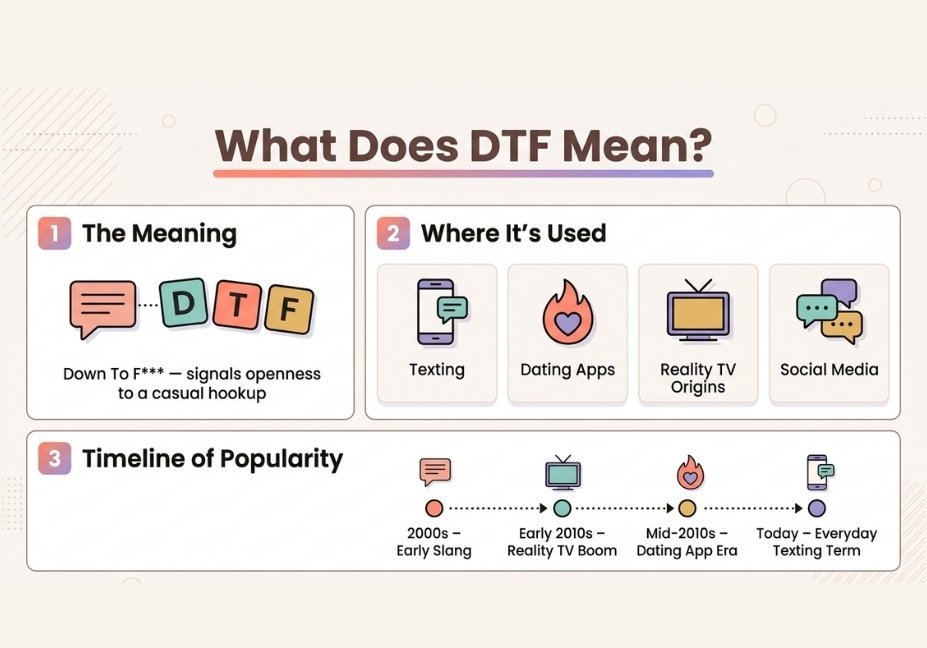
DTF is an abbreviation for “Down To F***,” a blunt way of signaling openness to a casual, no-commitment sexual hookup. It shows up mostly in texts, dating app conversations, and social media captions, and it’s used almost exclusively among adults.
If someone just sent you a text with “DTF” in it and you’re scrambling to figure out what it means, you’re far from the only one. Slang like this tends to spread through group chats and comment sections long before it ever gets explained anywhere, so plenty of people end up staring at three letters wondering what exactly they’re being asked. This guide breaks down what DTF actually means, how the term developed, the different ways it shows up in everyday conversation, and how to think about responding to it.
What DTF Actually Stands For
DTF is shorthand for “Down To F***.” Stripped of the slang, it’s a direct statement (or question) about willingness to have casual sex, typically without any expectation that it leads to dating, a relationship, or anything beyond that single encounter. It’s blunt by design — there’s no polite dance around the point, which is part of why it caught on in fast-moving text conversations.
Compared to a lot of flirty slang that can be read multiple ways depending on delivery, DTF is fairly unambiguous once you know what the letters mean. It’s rare for someone to type it and mean something entirely different. That said, it isn’t used with 100% sexual intent 100% of the time. Some people use it as a meme reference, a joke about how casually people talk about hookups now, or — in a much smaller and more novelty-driven usage — as a stand-in for “down to food” before a group grabs dinner. Those alternate uses exist, but they’re the exception rather than the norm, and they’re usually easy to spot from the surrounding conversation.
Where the Term Came From
DTF is newer as an acronym, but the underlying phrase isn’t.“Down to” has long served as a casual synonym for “willing to” or “up for,” even before texting existed. People used phrases like “I’m down to grab food” or “down to hang out.” Texting and early-2000s internet chatrooms changed how people used DTF. Both favored short, easy-to-type phrases over complete sentences. An acronym like DTF was a natural fit for that environment.
By the mid-2010s, DTF had settled into its current status: widely recognized slang that most adults have encountered at least once, regardless The term moved from niche slang into mainstream pop culture in the early 2010s. Reality television played a major role in that shift. Shows about nightlife, partying, and hookup culture exposed the phrase to huge audiences. They also helped normalize it as something people said aloud, not just typed privately.
The rise of swipe-based dating apps gave DTF an even bigger platform. These apps rely on fast, low-effort messaging. That made them ideal for three-letter shorthand. DTF could communicate a lot with very few characters.of whether they’ve ever typed it themselves.
It’s worth noting that DTF followed a pattern common to a lot of internet and dating slang. A phrase often starts within a small community, such as nightlife and party culture. People repeat it until it becomes familiar shorthand. Then, a piece of media can spread it to a much wider audience almost overnight. Once that happens, the term stops belonging to any one subculture and just becomes part of general vocabulary. That’s roughly the arc DTF followed between the late 2000s and mid-2010s.
Smartphones accelerated things furtherBefore texting became the main way people flirted, slang spread mostly through word of mouth and early instant messaging platforms. As texting became the default, short acronyms gained an obvious advantage. Typing three letters takes less time than writing a full sentence. This mattered even more when people felt awkward spelling out what they meant. That convenience helped DTF survive while much of the era’s slang gradually faded away.
How DTF Shows Up in Real Conversations
Knowing the definition is one thing; understanding how people actually use the term is more useful in practice.. A few common patterns:
- A direct question — something like “you free tonight? DTF?” — where the intent is straightforwardly about a hookup.
- A dating profile line — some users include it in their bio specifically to filter for people looking for something casual, saving everyone time.
- A joke between friends — teasing someone after they mention a date went unexpectedly well.
- A meme caption — attached to an unrelated, often funny image, with little to no real sexual meaning behind it.
- A sarcastic reply — someone who clearly isn’t interested may use it ironically as a joke.
- A food-related pun — “down to food” repurposing the acronym before a group meal.
Context and platform matter more than the letters themselves. On a dating app, DTF is rarely a joke — it tends to mean exactly what it says. In a text from a close friend or a social media caption, the term is more likely to sound playful or ironic. It may also reference pop culture rather than express a sincere proposition. Look at the surrounding conversation instead of focusing only on the acronym. This approach usually helps you understand the intended meaning faster.
Slang trackers and dictionary sites that follow internet and dating vocabulary have noticed a similar pattern with many hookup-culture abbreviations. These terms often spread quickly through dating apps and pop culture. Over time, they become part of everyday internet language. DTF followed a similar path, moving from niche party slang to a widely recognized term.
Has the Meaning Changed Across Generations?
The core meaning has stayed consistent, but the tone varies depending on who uses the term. People who came of age during DTF’s early-2010s rise often associate it with reality TV and the first major wave of dating apps. For many in that group, the term carries a faint, nostalgic “of its time” quality. It became one of the defining slang terms of that era of internet culture.
Younger users often see the term as a permanent part of texting vocabulary rather than a passing trend. They treat it much like acronyms such as LOL or BRB. Because they grew up with the term, they may also use it more casually or ironically. Repeated use has reduced much of its original shock value. The definition hasn’t really changed. Each generation simply uses the term more casually because they already know what it means.
There’s also some variation depending on social circle rather than strictly age. In settings with a heavy nightlife or party culture, the term shows up more casually and more often. In more conservative circles, workplaces, or family group chats, it’s rare to see it used sincerely at all outside of the occasional joke referencing pop culture. None of this changes what the term technically means — it just explains why some people run into it constantly while others barely ever see it.
Is DTF Always Sexual?
For the most part, yes. If DTF shows up in a message with no other context clues, the safest assumption is that it’s about sex or a hookup — that’s the term’s primary and most common meaning across texting, dating apps, and social platforms.
There are exceptions, and they’re usually pretty obvious once you look at what’s around them: a friend making a food joke, a meme with a clearly unrelated caption, or a sarcastic one-liner in a group chat where a hookup clearly isn’t on the table. The confusion tends to happen specifically when a message is ambiguous on its own — a single-word text with zero other context. In those cases, there’s nothing wrong with just asking what someone means rather than guessing. Slang shifts fast enough that clarifying takes a lot less effort than assuming and getting it wrong.
How People Tend to Respond to a DTF Text
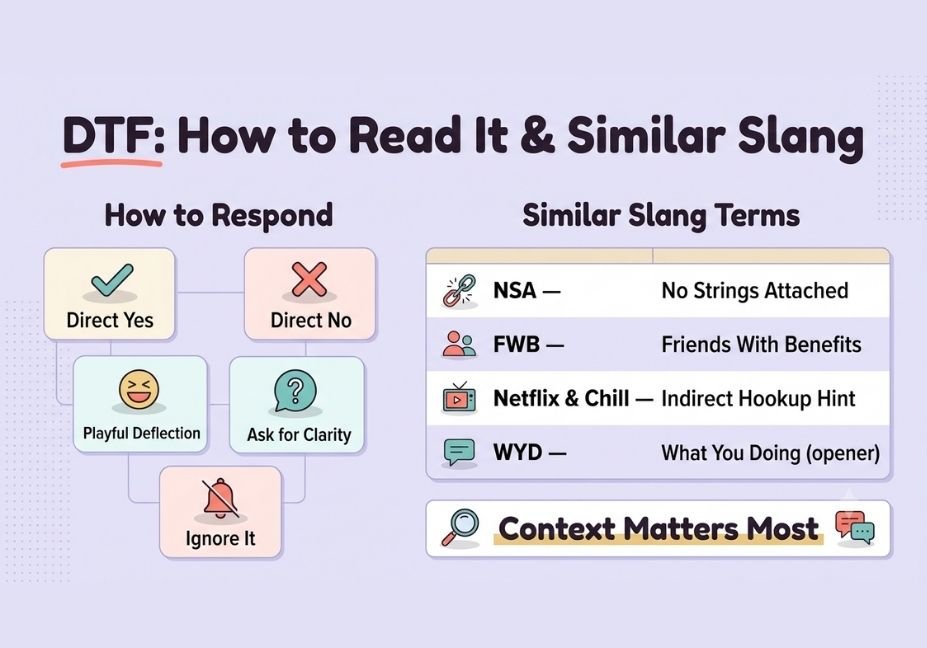
There’s no universally “correct” way to respond — it depends entirely on personal interest, comfort, and the relationship with the person sending it. Some common approaches:
- A direct yes — matching the tone and confirming interest plainly, without over-explaining.
- A direct no — a short, clear decline that doesn’t require justification.
- A playful deflection — turning it into a joke for someone who wants to keep things light without shutting the conversation down entirely.
- Asking for clarification — a reasonable move if the message feels out of nowhere or ambiguous.
- Not responding at all — the recipient can simply choose not to respond, especially when they don’t know the sender well.
Whichever route someone chooses, being clear tends to work out better than being vague. Since the term itself is already about as direct as slang gets, a mixed-signal or cryptic reply usually just creates more confusion rather than less.
Setting matters as much as wording here. A DTF text from someone matched on a dating app carries very different weight than the same three letters showing up unprompted from a coworker or an old acquaintance. In the first case, it’s often an expected part of how that platform functions. In the second situation, you may feel that someone has crossed a line, and you can say so plainly instead of feeling obligated to respond politely.
Common Mix-Ups and Mistakes
A handful of misunderstandings come up repeatedly with this particular term:
- Assuming it’s always a joke, when in most real conversations it isn’t.
- Missing sarcasm because the term already sounds so blunt and direct on its own.
- Using it with someone unfamiliar with internet or dating-app slang, leading to genuine confusion.
- Sending it into the wrong chat entirely — a professional setting or unrelated group thread.
- People often overanalyze a single ambiguous message instead of simply asking what the sender meant.
Almost all of these come down to skipping context. The three letters alone rarely tell the whole story, but the conversation surrounding them almost always does.
DTF and Similar Slang Terms
People often group a handful of other acronyms with DTF because they appear in similar dating and texting situations, even though they have slightly different meanings:
- NSA — “no strings attached.” Similar spirit, but framed more around avoiding emotional attachment than describing a single act.
- FWB — “friends with benefits.” Implies an ongoing, repeated arrangement rather than a one-time thing.
- Netflix and chill — a softer, more indirect way of implying roughly the same idea without spelling it out.
- WYD — “what you doing.” Often used as an opener before someone eventually brings up DTF later in the conversation.
Recognizing these related terms helps you understand the bigger picture of a conversation instead of interpreting one acronym in isolation.
Is It Appropriate to Use DTF Yourself?
That really comes down to who’s on the other end of the conversation and the setting it’s happening in. Among adults who are comfortable with blunt, casual language — particularly in dating-app contexts where that kind of directness is the norm — it’s a fairly ordinary, if crude, part of the culture. Avoid using it in professional settings, with people you don’t know well, or around anyone underage, as it’s inappropriate in all of these contexts.
Because the term is explicitly sexual, it’s also worth thinking through how it might land with the specific person receiving it before sending it. What feels playful and low-stakes to one person can come across as presumptuous, off-putting, or even alarming to someone else, especially without an established rapport.
Frequently Asked Questions
Does the meaning change depending on who’s sending it?
No — the definition stays the same regardless of gender. It signals openness to a casual hookup either way.
Is DTF always about sex?
Almost always. Jokes and non-sexual uses like “down to food” do exist, but they’re far less common than the literal meaning.
Where did the term originate?
It grew out of older, more general hookup slang and became mainstream in the early 2010s through reality television and the early wave of dating apps.
Yes — here’s the active-voice version:
Is it rude to send someone “DTF” out of nowhere?
It can come across as blunt or presumptuous, particularly without any established rapport, so context and familiarity with the person matter a lot.
Does it mean something different on platforms like Snapchat or TikTok?
The core meaning stays the same, though on platforms like TikTok it shows up more often in captions and jokes than as a sincere, direct message.
Can it ever mean something completely non-sexual?
Occasionally — a joking “down to food” is the most common example — but it’s rare and usually obvious from the surrounding conversation.
The Bottom Line
DTF is blunt slang with a simple core meaning: someone signaling they’re open to a casual hookup. It moved from older, more general “down to” phrasing into a fixed acronym, broke into the mainstream through reality TV, and found a lasting home on dating apps and in group chats, where short, low-effort abbreviations tend to stick around longest.
Most of the time, if the term shows up with no other context attached, it’s safe to take it at face value.You can usually spot the exceptions—jokes, memes, and food puns—once you consider the surrounding conversation. Now that you understand the meaning and background, you won’t need to feel caught off guard the next time someone uses it in a message.