
You’re mid-conversation, someone sends “bffr,” and the chat just stops making sense. Was that a joke? An insult? A compliment, somehow? If you’ve landed here searching bffr meaning in text, you’re one of thousands of people who see this four-letter reply every day and need a straight answer, fast.
This guide gives you the full meaning, where the phrase actually came from, and how to tell whether someone’s teasing you or genuinely annoyed. You’ll also see real example texts, learn how bffr compares to similar slang like fr and istg, and find out how to reply so you never sound out of the loop again. By the end, bffr meaning in text won’t be a mystery anymore.
What does bffr mean in a text?
Bffr stands for “be f***ing for real.” People send it when they think you’re exaggerating, joking, lying, or reacting way too big over something small. It usually means “stop playing” or “wait, are you serious right now.” Tone decides whether it lands as playful or harsh, but the core meaning stays the same across texts, comments, and DMs.
Where did bffr come from?
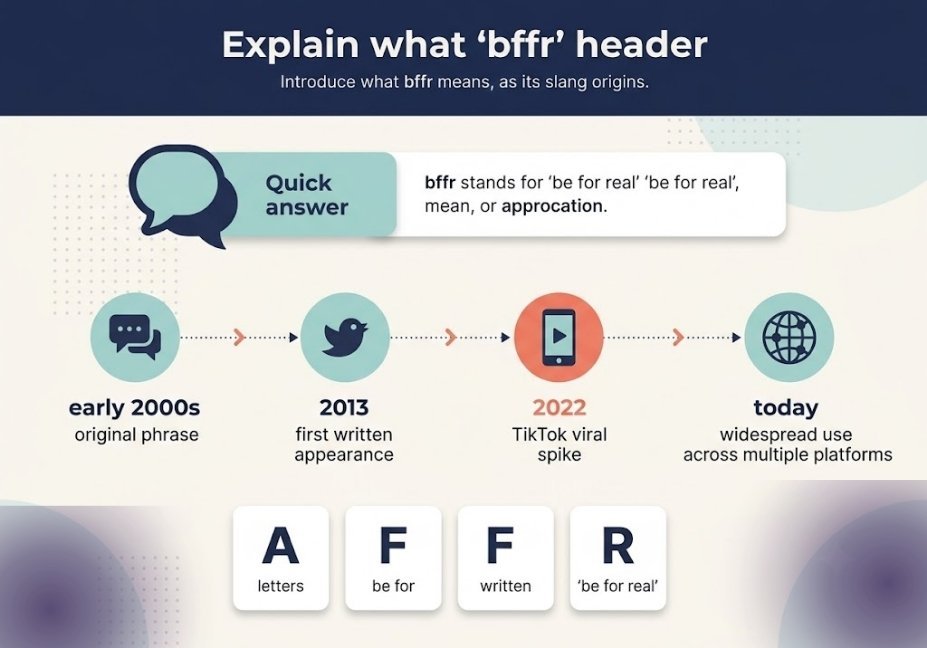
The phrase behind bffr didn’t start on TikTok, even though that’s where most people first saw it. The root phrase, “be for real,” has roots in African American Vernacular English and shows up in casual speech going back decades as a way to call out something unbelievable.
The internet-slang version tightened up years before it went mainstream. Dictionary.com’s slang tracking notes that a more intense, sweary version of “be for real” started appearing on social media in the late 2000s, well before people adopted the abbreviation itself. Records of the phrase in writing go back even further. Meme-archive site Know Your Meme traces a written “be f***ing for real” post to a 2013 tweet, showing the phrase was already circulating in text form nearly a decade before it became a trending acronym.
The shortened bffr spelling took off around 2022, boosted by a viral TikTok audio clip and a wave of reaction comments under dramatic or hard-to-believe posts. Once it caught on there, it spread fast to Instagram, Snapchat, X, and regular group chats, where it now lives as a normal part of casual texting.
Interestingly, bffr wasn’t always tied to this meaning. Before the 2022 spike, the same four letters sometimes floated around as a loose, informal riff on “bff,” used casually in usernames or captions with no real connection to the phrase it means today. That older usage faded fast once the “be for real” meaning took over completely, which is part of why the term can still feel confusing to anyone catching up on slang after a long break from social media.
Language reference sites now treat bffr as an established entry rather than a fleeting trend. Wiktionary lists it plainly as an internet slang initialism, a sign that the term has moved past meme-of-the-month status and settled into everyday digital vocabulary the way “lol” or “smh” did years earlier.
How people actually use bffr in texts and comments
FFR doesn’t express just one fixed reaction. It flexes depending on what triggered it. Here’s what it typically signals.
When someone thinks you’re lying or exaggerating
This is the most common use. A friend claims something wild, like running a marathon with zero training, and you fire back “bffr” to call it out. The message isn’t necessarily accusing you of full-on lying, just stretching the truth further than anyone believes.
When something feels shocking or hard to believe
Sometimes bffr isn’t accusing anyone of lying. It’s just a reaction to news, gossip, or a video that feels too extreme to process calmly. Think of a friend forwarding a screenshot of a wild breakup story and you replying with nothing but “bffr” because words fail you.
As a sarcastic or playful jab
Between close friends, bffr often has zero real anger behind it. It’s banter, similar to saying “come on, stop it” with a laugh. People usually pair this version with a laughing emoji or write it in all lowercase letters, both of which show that the sender isn’t upset at all.
As a sharper, more serious callout
In arguments or when someone’s genuinely frustrated, bffr can carry real irritation. Context and prior messages usually make this version obvious, especially if it follows a longer, more heated back and forth rather than showing up out of nowhere.
Is bffr the same as bff? A quick disambiguation
This mix-up trips up a lot of parents, teachers, and anyone who hasn’t been active on social media recently. Seeing four familiar-looking letters, it’s natural to assume bffr is just a longer version of bff. It almost never is anymore. If a teenager or younger sibling sends bffr today, they mean “be f***ing for real,” not “best friends forever.” Reading it the wrong way can genuinely flip the entire meaning of a message, so when the letters show up unexpectedly, default to the newer slang meaning first.
Real examples of bffr in the wild
Seeing bffr used in context makes the meaning click faster than any definition alone. Here’s what it typically looks like across different apps and situations.
In a group chat, someone might write “he said he ran a 6 minute mile, bffr,” poking fun at a friend’s unbelievable claim about their run. On a TikTok comment thread, you’ll often see something like “bffr, there’s no way that’s a real apartment for that price,” reacting to a shocking or too-good-to-be-true video. In a one-on-one text, a simple “wait bffr??” often shows up alone, standing in for genuine shock rather than any kind of accusation.
Notice how none of these examples spell out a full sentence. Bffr almost always shows up as a standalone reaction rather than a word built into a longer sentence, which is part of what makes it feel so punchy in a fast-moving conversation.
BFFR vs similar slang: fr, istg, ong
These terms overlap in tone but aren’t identical. Knowing the difference helps you read a conversation correctly.
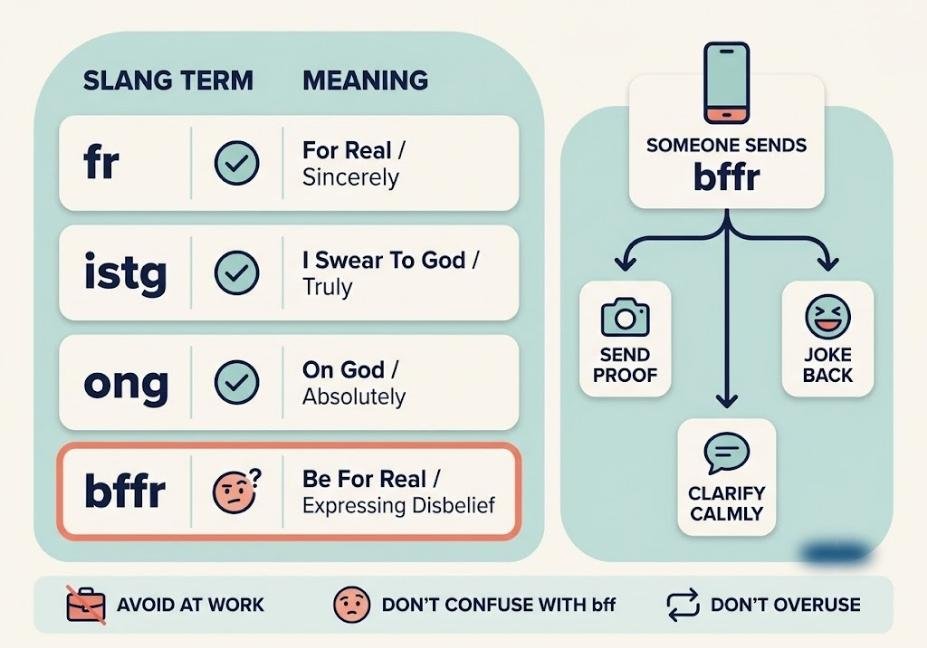
- Fr means “for real,” a milder agreement or confirmation, not a challenge.
- Istg means “I swear to God,” used to insist you’re being honest.
- Ong means “on god,” another way to swear something is true.
- Bffr is the only one of the four built to challenge someone else’s claim.
So while people usually use fr, istg, and ong to back themselves up, they usually direct bffr at someone else’s story. Knowing this difference matters because mixing them up can flip a message’s meaning entirely. Replying “fr” to someone’s wild claim reads as agreement, while replying “bffr” reads as doubt, even though the two look similar at a glance.
How to respond when someone sends you bffr
Getting hit with a bare “bffr” can feel confusing over text, since you lose tone of voice completely. A few reliable ways to reply:
- Send proof if you actually have it, like a photo or screenshot.
- Reply “bffr” back if you’re both joking around.
- Add context calmly if you were serious and got misread.
- Use an emoji to signal you’re not offended, like 😭 or 💀.
- Ask directly, “wait are you mad or joking,” if tone is genuinely unclear.
The safest move is matching their energy. If the conversation has been light so far, treat bffr as a joke unless something else in the message says otherwise.
When you should (and shouldn’t) use bffr
Bffr fits naturally in texts, DMs, comment sections, and casual group chats. It does not belong in work emails, school assignments, customer service messages, or anywhere formality matters, mostly because of the profanity baked into the full phrase.
Even in casual settings, think about who’s on the other end. Sending bffr to a close friend reads very differently than sending it to someone you just met or a coworker you’re texting for the first time. When in doubt, spell out “be for real” instead, since it carries the same meaning without the edge.
It also helps to think about the platform, not just the person. A comment left publicly under a stranger’s post carries more weight than a private message to someone who already knows your sense of humor. Public bffr comments are more likely to be read at face value by people who don’t know your tone, so save the sharper, more sarcastic version for private chats where context is already established.
Common mistakes people make with bffr
Even once you know what bffr means, it’s easy to misjudge it in the moment. A few misunderstandings come up again and again when people first learn this slang.
- Assuming it always means anger, when most uses are actually lighthearted.
- Confusing it with bff instead of recognizing it as a separate phrase.
- Using it in professional messages without realizing it includes profanity.
- Missing sarcasm and replying defensively when a friend was only joking.
- Overusing it until it loses its punch in every single reply.
Avoiding these mistakes mostly comes down to reading the relationship and the message thread as a whole, rather than reacting to the four letters in isolation.
Regional and generational differences
Bffr skews heavily toward Gen Z and younger millennial texting culture, and it’s most common on platforms built around short-form video and quick reactions, like TikTok, Instagram, and Snapchat. Older generations and more formal digital spaces rarely use it, and plenty of people outside terminally online circles have simply never encountered it, which is exactly why so many searches for this term exist in the first place.
Given its roots in African American Vernacular English, the phrase also carries cultural history worth acknowledging rather than treating as a random internet acronym that appeared out of nowhere. Slang like this tends to travel from close, specific communities into broader mainstream use once it catches on in viral videos and trending sounds, and bffr followed that exact path from spoken AAVE phrase to written shorthand to a term used by teenagers across very different backgrounds and locations.
Outside English-speaking online spaces, bffr hasn’t really been translated or adapted into other languages the way some slang eventually is. It tends to get used as-is, dropped straight into comments and captions in other languages the same way words like “lol” or “ok” have been absorbed worldwide without needing a local equivalent.
Frequently Asked Questions
What does bffr mean in a text from a girl?
The same as it does from anyone: “be f***ing for real.” Gender doesn’t change the meaning, only the relationship and tone might shift how sharp it feels.
Is bffr rude to say?
It can be. Among friends it’s usually playful. Sent to a stranger or in anger, it reads as blunt and confrontational.
What is the full form of bffr?
“Be f***ing for real.” Some milder versions drop the swear word and just mean “be for real.”
Is bffr the same as bff?
No. Bff means best friends forever. Bffr is unrelated slang meaning “stop exaggerating” or “are you serious.”
How do you reply when someone says bffr?
Match their tone. Send proof, joke back, or calmly clarify if you were being genuine and got misread.
Final thoughts
Bffr boils down to one simple demand dressed up in internet shorthand: stop exaggerating and tell the truth. Where it lands on the spectrum from playful tease to genuine frustration depends entirely on who’s texting you and what came before it in the conversation. Once you know the full phrase behind the letters and can read the context around it, bffr stops being confusing and just becomes one more piece of everyday texting shorthand you understand on sight.
Slang like this moves fast, and by next year a new acronym will probably take its place as the term everyone’s Googling. For now, though, you know exactly what bffr means, where it came from, and how to use it or respond to it without any second guessing.