
Idm Meaning In Text points to the abbreviation “IDM.” It almost always stands for “I Don’t Mind.” People send it when they’re okay with a choice, a plan, or a suggestion. They just don’t have a strong opinion either way.
You’ve probably seen a friend text back “idm” when you asked what they wanted for dinner. Or maybe you spotted it in an Instagram DM and wondered if you missed some new slang.
You didn’t. People search Idm Meaning In Text because they’re decoding a short, lowercase reply that showed up mid-conversation. It came with zero explanation. That’s the problem with texting slang. It moves fast. Nobody defines it. You’re left guessing whether your friend is being chill or brushing you off.
This guide breaks down what IDM means and where it came from. You’ll see how it shows up across WhatsApp, Snapchat, Instagram, Discord, and gaming chats. You’ll also learn how to reply when you get one. By the end, you’ll know the difference between a relaxed “idm” and one that might mean something more.
What Does IDM Mean in Text?
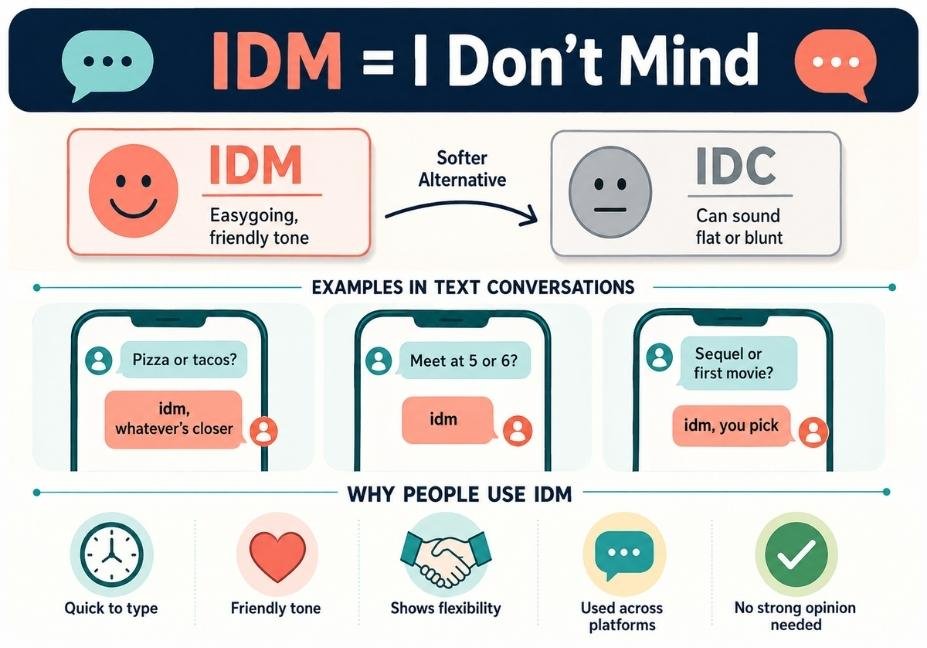
IDM stands for “I Don’t Mind.” People use this texting shortcut to show they’re fine with something. They don’t need to explain why. Think of it as a cousin to “idc” (I don’t care), but softer and friendlier.
The difference matters here. “Idc” can sound flat or even dismissive, depending on tone. “Idm” carries more warmth.
It says “either option works for me” instead of “I have no opinion and don’t care to form one.” That small shift in tone explains why IDM became such a common go-to in casual chats. People reach for it when they want to sound easygoing, not indifferent.
Here’s how it plays out in a normal exchange:
For example, a friend might ask, “Pizza or tacos tonight?” You could reply, “Whatever’s closer works for me, idm.”
When someone asks, “Can we push the call to 4pm?” a simple “Sure, idm” shows that you’re flexible.
If the question is, “Should we watch the sequel or start from the first movie?” you can say, “You pick; idm either way.”
In every one of these, IDM signals flexibility. The sender hands the decision back to the other person. They still sound cooperative, not indifferent.
Where Did IDM Come From?
Text abbreviations like IDM grew out of the same shorthand culture that gave us “lol,” “brb,” and “idk.” Early SMS plans charged by the character. Typing on a numeric keypad was slow too.
So people shortened common phrases out of habit. Smartphones later brought faster keyboards. But the abbreviating habit stuck around, especially for phrases people type constantly, like agreement or indifference.
IDM specifically gained traction as a softer alternative to “idc.” Online conversations grew more casual and emoji-driven over time. People started looking for ways to sound agreeable without sounding bored or checked out.
“Idm” filled that gap perfectly. You’ll now find it across nearly every messaging platform, from group chats to comment sections. Teens use it to coordinate weekend plans. Adults use it to schedule a work call over text.
You won’t find IDM listed as an official word in a standard dictionary. That’s normal for slang like this. These terms spread through group chats and shared culture long before any dictionary catches up.
Linguists who track internet language note something useful here. Abbreviations survive when they fill a real gap in tone, not just a gap in typing speed. IDM fits that pattern well. It didn’t just save keystrokes. It gave people a way to sound relaxed and cooperative in a format that can otherwise feel abrupt.
That’s also why IDM outlasted a lot of short-lived slang. Plenty of abbreviations fade out within a year or two once a trend moves on. IDM stayed relevant because it solves an ongoing problem. Texting strips out tone of voice. People constantly need a fast way to signal “I’m easygoing about this” without typing a full sentence every time.
How IDM Is Used Across Different Platforms
The core meaning of IDM stays consistent. But the vibe can shift a little depending on where you see it.
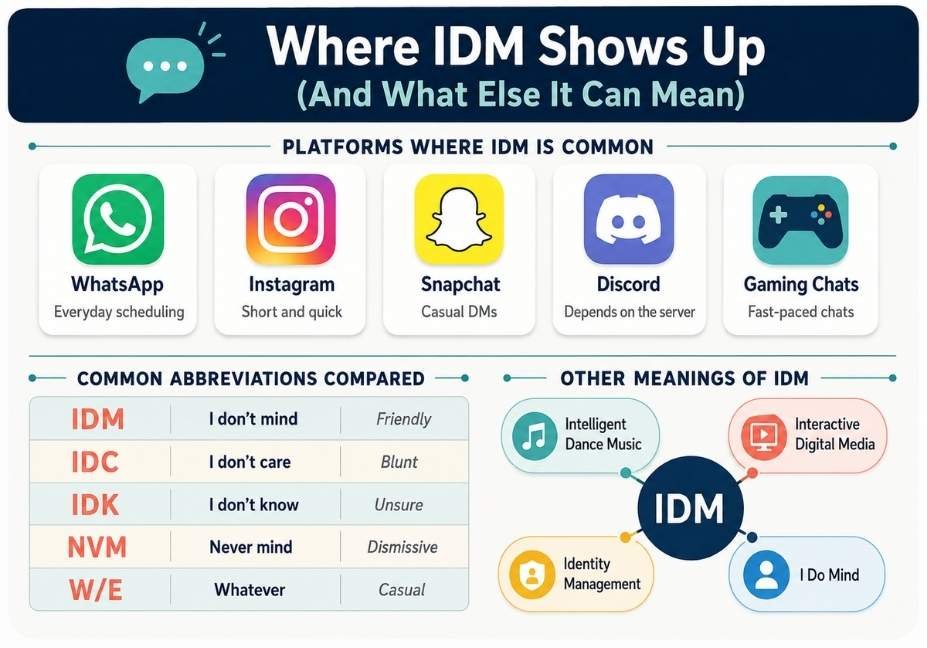
On WhatsApp:This is where IDM shows up most for everyday scheduling. “Are we meeting at 5 or 6? Idm, both work for me” reads as a completely normal message between friends, family, or coworkers. It comes across as cooperative, not lazy.
On Instagram and Snapchat:Conversations here move faster and shorter. “Idm” often appears on its own, with no extra context. A DM that just says “idm” usually means the sender is fine with whatever was just proposed. It can still feel a little clipped compared to a full sentence.
On Discord:Server culture varies a lot from group to group. IDM usually means “I don’t mind” here too. But some communities build their own inside jokes and niche shorthand. If IDM shows up in a highly specific server and the usual meaning doesn’t fit, just ask what the group means by it.
In gaming chats:Fast-paced games leave little room for full sentences. “Idm” comes up often when players pick roles, maps, or game modes. “Support or tank? idm, you choose” is a typical example. It keeps the match moving without slowing anyone down.
On dating apps:IDM still generally means “I don’t mind” here. But tone gets harder to read without facial expressions or vocal cues. A flat “idm” reply might signal genuine flexibility. It could also hint at mild disinterest. Context matters more here than almost anywhere else.
In family or mixed-age group chats:Not everyone reads texting slang the same way, especially across generations. Spell out “I don’t mind” in full when clarity matters, like when confirming plans with a parent or a teacher. Slang like IDM works best when everyone in the conversation already speaks the same shorthand.
One thing stays constant across all these platforms. IDM almost never shows up in formal writing. It belongs to fast, casual back-and-forth conversations. Drop it into an email or a work memo and it would look out of place. That’s part of why it’s stayed so tied to texting and social apps specifically.
Does IDM Ever Mean Something Else?
Yes, though this happens far less often in everyday texting. Context tells you which meaning applies.
- Intelligent Dance Music, a term music forums and fan communities use
- Interactive Digital Media, a formal term academic and industry settings use
- Instant Download Manager, an older tech term tied to software tools
- Identity Management, a term business and IT teams use
- I Do Mind, a sarcastic flip of the usual meaning, used playfully among close friends
Picture someone texting “idm” in the middle of a conversation about weekend plans or dinner choices. That almost certainly means “I don’t mind.” Now picture it showing up in a thread about music production software or a company’s IT systems. That’s a different meaning entirely.
When you’re not sure, read the sentence around it. Don’t assume one fixed meaning applies everywhere.
Is IDM Positive, Negative, or Neutral?
IDM usually reads as neutral to positive. But tone depends on what came before it and how the rest of the message looks.
A relaxed “idm, both sound good” reads as genuinely flexible and easygoing. A bare, one-word “idm” with no punctuation can come across as a little distant. That’s especially true if the conversation felt more expressive up to that point.
This doesn’t necessarily mean something’s wrong. Texting strips out tone of voice by nature. Short replies can read colder than the sender intended.
Here’s a useful way to judge it. Look at what usually happens before and after that person’s “idm” texts. Some people text short across the board. For them, a plain “idm” is just their normal style.
Other people usually text with more detail. If one of those people suddenly replies with just “idm,” it might be worth a quick check-in. Not because something’s definitely wrong. A sudden style change often signals more than the abbreviation itself does.
How to Reply When Someone Texts You IDM
IDM hands the decision back to you. So the easiest way to respond is simple. Just make the call.
- Pick an option yourself instead of asking “are you sure?” repeatedly
- Add a quick reason so the choice feels natural, not random
- Keep it casual, matching the tone they used
- Ask directly if the context feels off, instead of guessing
Say a friend replies “idm” when you ask about movie night. You can just answer, “cool, let’s do the 7pm showing then.” That keeps things moving without overthinking a short reply.
Remember something important here. IDM exists to make decisions easier, not harder. Some people freeze up when they get one.
They worry about picking the “wrong” option, even though the whole point of the message was to hand that choice over freely. Treat it as genuine permission to decide, not a hidden test. Replying gets a lot simpler once you do. The person who sent “idm” trusts your judgment on this one. There’s no need to keep bouncing the decision back and forth.
IDM vs Similar Texting Abbreviations
It helps to see IDM next to the abbreviations people often confuse it with.
- IDM – I don’t mind, shows flexibility and mild agreement
- IDC – I don’t care, can sound more indifferent or blunt
- IDK – I don’t know, used when someone is genuinely unsure
- NVM – Never mind, used to drop a topic or cancel a thought
- W/E – Whatever, often used casually but can sound dismissive
Choosing between these comes down to tone. Pick IDM when you want to sound open to options. It’s the friendlier choice. Pick IDC when you genuinely have no opinion and don’t care either way. It gets that across more directly.
Does Everyone Use IDM the Same Way?
Not quite. Usage shifts depending on age group and how someone learned to text.
Younger texters grew up messaging on smartphones rather than old flip phones. They tend to use IDM freely and often, sometimes several times in one conversation. It comes as naturally to them as typing “lol” without thinking twice.
Older texters, or people newer to a platform, often use it more sparingly. Some spell out “I don’t mind” in full to avoid confusion. This shows up especially in group chats that mix generations, like a family thread or a school parent group.
Neither approach is wrong here. It just reflects how comfortable someone feels with shorthand, and how well they know the people they’re texting.
Regional differences play a role too. English-speaking texting culture uses IDM broadly across the board. Some countries’ casual chat styles lean on it more than others. You’ll often see it paired with other short agreement phrases, like “sure thing” or “either way.”
Why Slang Like IDM Keeps Spreading
Texting slang spreads fast because platforms reward speed. People type on small screens, often with one thumb. They want to keep conversations moving without losing meaning. IDM checks both boxes. It’s quick to type, and it still communicates a clear, friendly stance.
Group chats accelerate this even further. Once one person in a friend group starts using IDM, others tend to pick it up within a few conversations. Kids and teens especially absorb slang this way. Repeated exposure inside their own social circles does more work than any formal source. That’s also why definitions can vary slightly from group to group, even when the core meaning stays close to “I don’t mind” almost everywhere.
Social media speeds this process up even more. A single popular post or comment thread can expose millions of people to a term in a matter of days. IDM likely spread this way too. It moved from small group chats into broader use as more people encountered it in DMs and comment sections and started using it themselves.
Common Mistakes People Make With IDM
A few small mix-ups happen a lot with this abbreviation. Knowing them helps you avoid awkward moments.
Using it in formal messages. IDM belongs in casual chats, not emails or work reports. Swap it for “I’m fine with either option” in anything formal.
Assuming it always means full agreement. IDM signals flexibility, not enthusiasm. Someone might not feel thrilled about a plan but still text “idm” because they don’t want to make a fuss.
Reading too much into a single word. One short “idm” text doesn’t reveal someone’s whole mood. Look at the pattern across several messages before drawing conclusions.
Mixing it up with IDM’s rarer meanings. Outside music or tech chats, don’t assume someone means Intelligent Dance Music or Identity Management. Stick with “I don’t mind” as the default unless the topic clearly points elsewhere.
Avoiding these mix-ups makes texting smoother for everyone involved, especially in group chats where tone already gets lost easily.
Frequently Asked Questions
What does IDM mean from a girl?
It usually means she’s fine with a suggestion or has no strong preference. The exact tone depends on the rest of the conversation and any emojis used.
What does IDM mean from a guy?
It carries the same core meaning. He’s okay with the plan or choice. Guys often use it as a quick, low-effort way to agree without overthinking the reply.
Is IDM rude?
Not inherently. It can read as short without other context. On its own, though, it simply signals flexibility, not annoyance.
What’s the difference between IDM and IDC?
IDM sounds more agreeable and open. IDC can come across as more indifferent or blunt, depending on tone.
Does IDM always mean I don’t mind?
In casual texting, yes, almost always. In music, tech, or business contexts, it can stand for something else entirely.
The Bottom Line
IDM is one of those small texting abbreviations that says more than its three letters suggest. In nearly every everyday chat, from WhatsApp scheduling to gaming lobbies, it means “I don’t mind.” It’s a quick way to show you’re flexible and happy to go along with whatever gets decided.
The tone behind it depends less on the letters themselves and more on the conversation surrounding them. If a reply ever feels unclear, the fastest fix is still just asking directly. Now that you know what Idm Meaning In Text actually refers to, you won’t have to guess the next time it lands in your inbox.