
If you’ve ever paused mid sentence wondering whether to write “full proof” or “foolproof,” you’re not alone. This mix up shows up in emails, blog posts, and everyday conversation all the time. Quick answer: “foolproof” is the correct spelling for something that cannot fail. “Full proof” is a common misspelling, though it does have a few narrow, correct uses in legal writing and the alcohol industry.
In this guide, you’ll learn exactly why this confusion happens, when “full proof” is actually correct, and how to use “foolproof” the right way every time. We’ll also look at where this mix up came from and how it shows up differently depending on the context, whether that’s a legal document, a bourbon label, or a text message from a friend.
|Also read this article Disney Pick Up Lines So Cute, They Actually Work
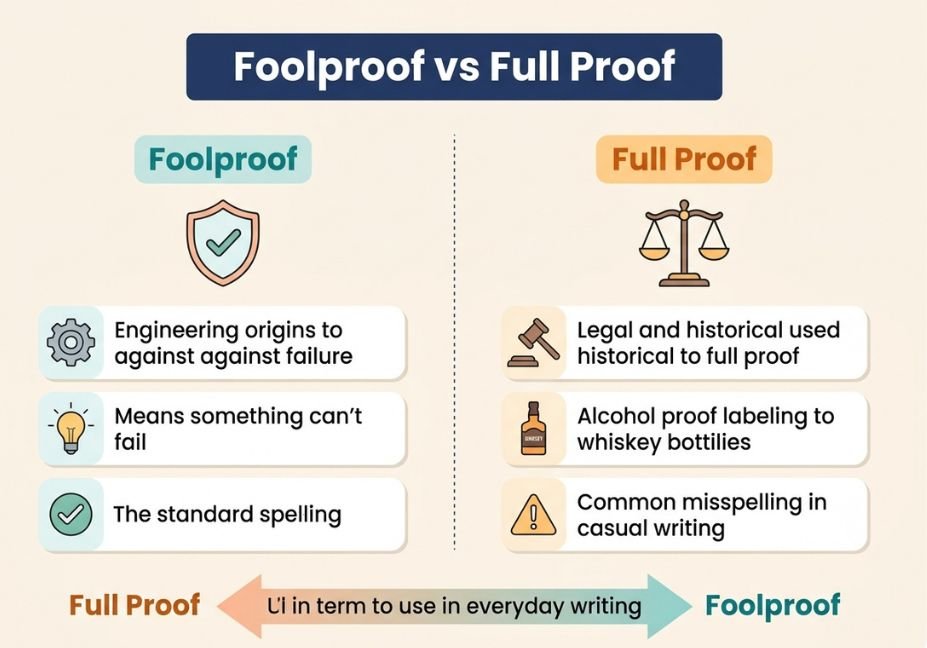
What Does “Full Proof” Mean?
“Full proof” is most often a misspelling of “foolproof.” When people type it, they almost always mean something that is simple, reliable, and impossible to mess up.
But “full proof” does have its own real meaning too. As two separate words, it can describe evidence that is complete and fully verified. You’ll see this in older legal writing, where a judge might describe testimony as offering “full proof” of a claim. Here, “full” simply modifies “proof” the way it would modify any noun.
So the short version is this. If you mean something cannot fail, you want “foolproof.” If you mean complete or fully verified evidence, “full proof” actually works, though it’s rare in modern writing.
|Also read this article Why These Boxing Pick Up Lines Keep Getting Replies
Full Proof vs Foolproof: What’s the Real Difference?
The words sound almost identical out loud, which is exactly why people mix them up in writing. But their meanings come from completely different places.
“Foolproof” is a compound word built from “fool” and “proof.” A fool is someone who lacks good judgment, and “proof” here means protected against. Put together, foolproof describes something so well designed that even a careless person cannot break it.
“Full proof,” on the other hand, is not a compound word at all. It’s just the word “full” describing the noun “proof.” That’s why it can technically be correct in specific situations, even though it never means the same thing as foolproof.
Here’s a simple way to remember the difference:
- Foolproof means something cannot fail, even if used carelessly.
- Full proof means evidence that is complete or fully verified.
- Fullproof as one word is never correct in standard English.
- Full-proof with a hyphen usually refers to alcohol strength.
- When in doubt, foolproof is almost always the word you want.
|Also read this article Matt Gutman Net Worth 2026 and His Surprising Success
Where Did the Full Proof Mistake Come From?
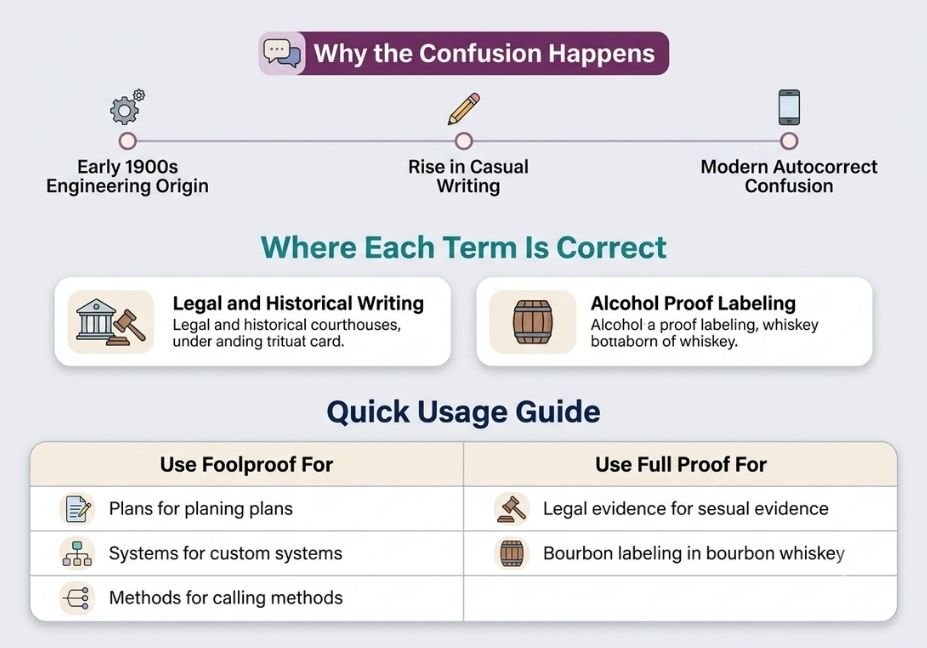
This mix up isn’t random. It comes down to how similar the two phrases sound when spoken quickly. “Fool” and “full” share nearly identical vowel sounds in casual speech, especially in fast conversation or regional accents.
“Foolproof” became popular in the early 1900s, first showing up in engineering and manufacturing contexts. It described machines and systems built to prevent human error, things that would work correctly even if the person operating them made mistakes. As the word spread into everyday language, some people started writing it the way it sounded rather than the way it was actually spelled.
Autocorrect and spell check tools haven’t helped much either. Since “full” and “proof” are both real words on their own, some spell checkers won’t flag “full proof” as an error, even when it’s used incorrectly. This has quietly reinforced the mistake for years, especially in casual writing, texting, and social media posts.
Is Full Proof Ever Correct to Use?
Yes, in two specific situations. Outside of these, you should stick with foolproof.
Full Proof in Legal and Historical Writing
Centuries ago, “full proof” was a real legal term. It described evidence so complete that it left no reasonable doubt. You’ll find this phrasing in old court records and legal texts from the 1600s and 1700s. Over time, the phrase fell out of common use, replaced by more modern terms like “conclusive evidence” or “sufficient proof.”
Today, you’d rarely use “full proof” this way unless you’re writing something formal, historical, or legal in nature. For everyday writing, it will likely read as an error rather than an intentional legal reference.
Full Proof in the Alcohol Industry
The second correct use comes from spirits and liquor labeling. “Full proof” describes a spirit, often bourbon or whiskey, bottled at the same alcohol strength it had when it went into the barrel. Nothing is added or removed to change the proof level before bottling.
You might see a label that reads something like this:
- Full proof bourbon means no water was added before bottling.
- Cask strength and barrel proof mean roughly the same thing.
- Standard bourbon is often diluted to a lower proof before bottling.
- Full proof spirits tend to taste stronger and more intense.
- Distilleries use these terms to highlight an unaltered final product.
Even in this industry, brands don’t always agree on terminology. Some prefer “barrel proof” or “cask strength” over “full proof,” so you may see all three used somewhat interchangeably on different labels.
How to Use Foolproof Correctly (with Examples)
Once you know the difference, using foolproof correctly is simple. It works as an adjective describing plans, systems, methods, or instructions that cannot go wrong.
Here are a few examples of correct usage:
- The new security system was completely foolproof.
- She followed a foolproof recipe that never fails.
- His foolproof method saved the team hours of work.
- They designed a foolproof way to track inventory errors.
- The instructions were foolproof, even for total beginners.
Notice how in every example, foolproof describes something reliable enough to work even if the person using it isn’t an expert. That’s the core idea behind the word, and it’s what “full proof” is missing when people use it by mistake.
Dictionary resources that track modern language use, including Merriam-Webster’s usage notes, continue to list foolproof as the standard spelling, with full proof noted only as a variant or historical form. That consistency across major language resources is a strong signal that foolproof remains the safer choice in nearly every context.
Full Proof vs Foolproof: Quick Comparison
| Term | Meaning | When to Use It |
|---|---|---|
| Foolproof | Cannot fail, even with careless use | Everyday writing, plans, systems, methods |
| Full proof | Complete or fully verified evidence | Legal or historical writing only |
| Full-proof (alcohol) | Bottled at original barrel strength | Describing bourbon or whiskey |
| Fullproof | Not a standard word | Avoid using entirely |
Frequently Asked Questions
Is “full proof” a real word?
Not as one word. As two separate words, it can mean complete evidence, but it’s not interchangeable with foolproof in everyday writing.
What’s the difference between full proof and foolproof?
Foolproof means something cannot fail. Full proof means evidence that is complete or fully verified, mostly used in legal writing.
Why do people confuse full proof and foolproof?
The two phrases sound nearly identical when spoken, which leads many writers to spell foolproof incorrectly as full proof.
What does full proof mean in whiskey or bourbon?
It describes a spirit bottled at the same strength it had straight from the barrel, with no water added to lower the proof.
Is fullproof one word or two?
Fullproof as a single word isn’t standard English. Use foolproof for the idiomatic meaning, or “full proof” as two words for the legal sense.
The Bottom Line
“Foolproof” is the word you want almost every time you’re describing something reliable, simple, or impossible to mess up. “Full proof” only makes sense in a couple of narrow situations, mainly legal writing and bourbon labeling, and even then it’s becoming less common.
The easiest way to avoid this mistake going forward is to picture the word’s actual meaning. You’re talking about something so solid that even a fool couldn’t break it, not something that’s simply “full” of proof. Keep that image in mind, and you’ll spell it right every time.
Pingback: BTS Meaning in Text: Behind The Scenes or the Band? - Celebrity Auraa
Pingback: What Does OMS Mean In Text? The Complete Guide - Celebrity Auraa
Pingback: What Does FN Mean in Text? Slang, Gaming & More Explained - Celebrity Auraa
Pingback: CF Meaning In Text: What It Really Means In Chats - Celebrity Auraa
Pingback: What Does Hru Mean? The Simple Answer, Explained - Celebrity Auraa