
You’re scrolling through a group chat and someone drops “IMO, this is a terrible idea.” No context, no explanation, just three letters. If you’ve ever paused mid-scroll wondering what does IMO mean in text, you’re not alone. It’s one of the most common texting abbreviations out there, and once you know it, you’ll spot it everywhere.
This guide breaks down exactly what IMO means, where it came from, how to use it correctly, and how it’s different from lookalikes like IMHO. You’ll also learn the handful of other things IMO can stand for outside of texting, so you’re never confused again.
Also Read: Birthday Pick Up Lines That Actually Work in 2026
What Does IMO Mean?
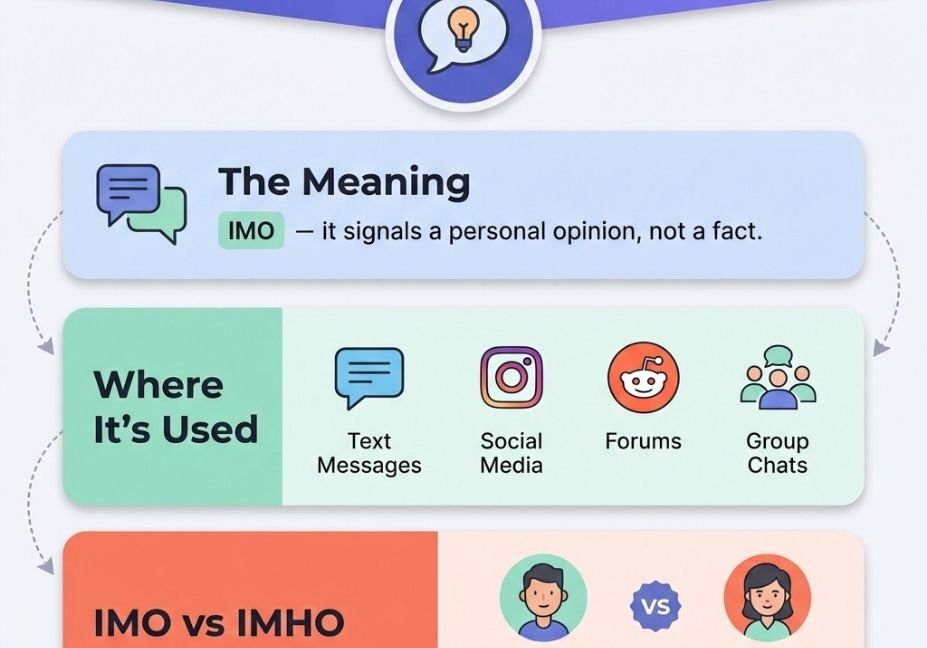
IMO stands for “in my opinion.” People use it in texts, DMs, and social media comments right before or after sharing a personal view. It signals that what follows is one person’s take, not a fact everyone should agree with.
What Does IMO Mean in Text, Exactly?
IMO is a texting abbreviation for “in my opinion.” It’s a small verbal cue that softens a statement. Instead of saying something as if it’s the final word, the sender is flagging it as their own perspective.
Here’s what that looks like in practice.
- “IMO, the sequel was better than the original movie.”
- “That restaurant is overrated IMO.”
- “IMO we should just reschedule the trip.”
In each case, the word “IMO” does a small but useful job. It tells the reader this is a viewpoint, not a command or a claim of fact. That matters more than it seems, especially in group texts where tone is easy to misread.
Merriam-Webster lists “in my opinion” as the standard meaning of IMO, and notes that people have used the phrase this way in casual writing for years. Cambridge Dictionary defines it the same way: a written shorthand people use when giving their opinion.
Where Did IMO Come From?
IMO isn’t a new invention. It grew out of early internet culture, back when people communicated through message boards, chat rooms, and early instant messaging platforms in the 1980s and 1990s. Typing was slower, screen space was limited, and abbreviations helped conversations move faster.
As internet slang, IMO joined a whole family of similar shorthand terms, like BTW (“by the way”) and FYI (“for your information”). These abbreviations let people express common phrases without typing every letter.
When texting took off in the 2000s, and later when social media platforms like Twitter, Instagram, and TikTok became everyday tools, IMO carried over naturally. It fit the same need: fast, casual communication where full sentences felt unnecessary.
IMO also spread through gaming chats and online forums like Reddit, where fast-paced discussions rewarded short replies. A gamer typing during a match, or a Redditor replying to a thread, didn’t have time to type out “in my opinion” every time. IMO solved that problem the same way it does in texting today.
IMO Across Different Apps and Platforms
IMO doesn’t look or feel exactly the same everywhere. The core meaning never changes, but the way people use it shifts slightly depending on the app.
On WhatsApp and iMessage, IMO usually shows up in one-on-one chats or small group threads, often softening advice or a suggestion. On Instagram and TikTok, it’s common in comment sections, where someone is reacting to a video or photo and wants to flag their reaction as personal rather than absolute. On Twitter, now known as X, IMO frequently appears in reply threads during debates, where tone can get heated and the abbreviation helps signal a calmer, more open stance. On Reddit and other forums, IMO often opens a longer comment, letting the writer state upfront that a detailed take is still just one perspective.
Snapchat captions and DMs use IMO too, usually in quick reactions to a photo, a joke, or a plan. Across every platform, the underlying job of the word stays the same. It marks a statement as personal rather than universal.
How People Use IMO in Texts and Social Media
IMO is flexible. You’ll usually see it in one of two spots in a sentence.
IMO at the Start of a Sentence
Placing IMO first sets up the whole sentence as an opinion right away.
- “IMO, that show got worse after season two.”
- “IMO, we’re overthinking this.”
IMO at the End of a Sentence
Placing it last softens a statement that might otherwise sound blunt.
- “That haircut looks great, IMO.”
- “This is the best pizza in town, IMO.”
Both placements work the same way grammatically. It really comes down to personal style or how the sentence flows.
What Does IMO Mean From a Guy or a Girl?
A common search variation is what IMO means “from a guy” or “from a girl,” as if gender changes the definition. It doesn’t. IMO means the same thing no matter who sends it.
What can shift is the context. If a guy texts “IMO, you looked really good tonight,” the abbreviation itself still just means “in my opinion.” The tone and meaning come from the rest of the message, not from the abbreviation. The same goes for a girl using it in a compliment, a debate, or a casual comment. IMO is neutral. It’s a grammar tool, not a hidden signal.
People searching for a gendered meaning are usually really asking about tone, not definition. A guy adding “IMO” before a compliment might be trying to sound less forward. A girl adding it while giving advice might be trying to avoid sounding bossy. The word itself never changes meaning, but it can quietly change how confident or cautious a message feels.
Does IMO Mean Something Different by Generation?
IMO has been around long enough to cross several generations of internet users. People who grew up chatting on early instant messengers in the 1990s and 2000s use it the same way younger texters do today. There isn’t a generational split in meaning, though usage frequency does shift.
Younger texters, especially on platforms like TikTok and Instagram, tend to pair IMO with other shorthand in the same sentence, like “ngl” (not gonna lie) or “fr” (for real). Older texters more often use IMO on its own, closer to how it originally appeared in early online forums. Either way, the abbreviation still means exactly the same thing.
IMO vs IMHO: What’s the Difference?
IMHO stands for “in my humble opinion,” and it’s the closest cousin to IMO. Functionally, they mean almost the same thing and are often used interchangeably.
The small difference is tone. IMHO adds a touch of humility, or sometimes a hint of sarcasm, depending on how it’s used. Someone might type “IMHO, this is obviously the right call” in a joking way that pokes fun at the word “humble” while stating a strong opinion.
IMO tends to read as more direct and neutral. Neither one is more correct. The choice usually comes down to personal texting style.
| Abbreviation | Full Meaning | Typical Tone |
|---|---|---|
| IMO | In my opinion | Neutral, direct |
| IMHO | In my humble opinion | Softer, sometimes playful |
Other Meanings of IMO You Should Know
Texting isn’t the only place IMO shows up. The same three letters mean different things depending on where you see them.
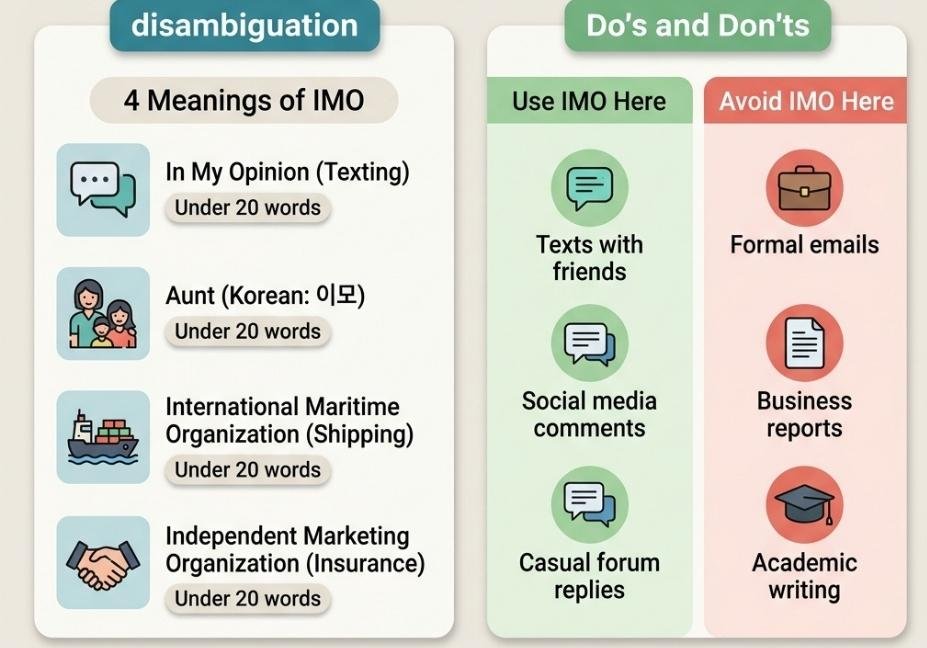
- In Korean, 이모 (imo) means “aunt,” specifically your mother’s sister.
- In shipping and global trade, IMO refers to the International Maritime Organization, a United Nations agency.
- In life insurance, IMO stands for Independent Marketing Organization, a group that supports insurance agents.
- IMO is also the name of a popular messaging and video calling app, separate from the abbreviation.
If you ever see “IMO” in a business document or an article about shipping regulations, it almost certainly isn’t the texting slang. Context makes the meaning obvious pretty quickly.
When to Use IMO and When to Avoid It
IMO fits naturally into casual conversations. It works well in group texts, comments on social media, forum replies, and messages between friends. It’s short, familiar, and instantly understood by most people who text regularly.
It doesn’t belong in formal writing. Emails to a boss, cover letters, official reports, and academic papers should stick to full phrases like “in my opinion,” “from my perspective,” or “in my view.” Texting abbreviations can come across as too casual in those settings, even if the message itself is professional.
A simple rule of thumb: match the other person’s texting style. If a coworker never uses abbreviations like IMO in Slack messages, it’s probably safer to spell things out. If a friend texts in shorthand constantly, IMO will fit right in.
There’s also a middle ground worth knowing. Some workplaces use casual chat tools like Slack or Teams for quick, informal exchanges, even though they’re technically professional platforms. In that setting, IMO can be fine in a fast back-and-forth about lunch plans, but still feels out of place in a message discussing a client deadline or a budget decision. Reading the room, even a digital one, still matters.
Common Mistakes People Make With IMO
A few small habits trip people up when using this abbreviation.
- Writing it in lowercase makes it look like a typo instead of intentional shorthand.
- Using IMO in formal emails or workplace documents can read as unprofessional.
- Assuming IMO always means the same thing regardless of context, ignoring shipping or insurance uses.
- Overusing IMO in every sentence, which can feel repetitive and unnecessary.
Capitalizing texting abbreviations like IMO, BTW, or FYI helps readers instantly recognize them as shorthand rather than mistakes. It’s a small habit that makes messages easier to read.
Another mistake is treating IMO as a way to make a statement sound less harsh than it actually is. Adding IMO in front of a genuinely hurtful comment doesn’t cancel out the impact. The abbreviation signals that something is an opinion, but it doesn’t excuse tone. If a message would sound unkind without IMO, it will usually still sound unkind with it.
Similar Abbreviations You’ll See Alongside IMO
IMO rarely travels alone. It often shows up next to other common texting abbreviations, so it helps to know a few of its neighbors.
- IMHO: in my humble opinion, a softer or occasionally sarcastic cousin of IMO.
- IDK: I don’t know, often paired with IMO when someone is unsure but still sharing a view.
- TBH: to be honest, used to introduce a candid or blunt opinion.
- NGL: not gonna lie, similar to TBH, signaling an honest admission.
- FWIW: for what it’s worth, another way to soften an opinion before stating it.
Learning a handful of these makes texting conversations much easier to follow, especially in group chats where several abbreviations can appear in a single message.
Frequently Asked Questions
What does IMO mean from a girl? The same as it means from anyone: “in my opinion.” Gender doesn’t change the definition of the abbreviation.
Is it rude to say IMO? No. IMO simply flags a personal opinion. It can soften a statement rather than make it sound harsher.
What’s the difference between IMO and IMHO? Both mean roughly the same thing. IMHO adds “humble,” giving it a slightly softer or sometimes joking tone.
Does IMO mean something else in Korean? Yes. In Korean, imo means “aunt,” specifically the mother’s sister, and has no connection to the English abbreviation.
How do you use IMO in a sentence? Place it at the start or end of a sentence expressing an opinion, like “IMO, that movie was underrated.”
Conclusion
IMO is a simple, widely used piece of internet shorthand for “in my opinion.” It shows up at the start or end of casual sentences, works the same way no matter who’s texting it, and has a close relative in IMHO. Outside of texting, the same letters can mean something completely different, from a family term in Korean to a global shipping organization.
Once you know what IMO means in text, you’ll never have to guess again. Use it freely in casual chats, skip it in formal writing, and you’ll always come across as clear and intentional.