
Someone just ended a chat with “syau” and now you’re wondering if that’s a friendly goodbye or something else entirely. You’re not alone. Syau meaning in text is a term more people are searching every month, mostly because it looks unfamiliar at first glance but shows up constantly in casual chats, comments, and DMs. In this guide, you’ll get the real meaning, where it likely came from, and how to read it with confidence the next time it lands in your inbox.
Texting slang moves fast, and syau is a good example of a term that looks confusing on the surface but actually has one clear, dominant meaning once you know what to look for. By the end of this article, you’ll understand the most common use, the rarer alternates, and exactly how to reply.
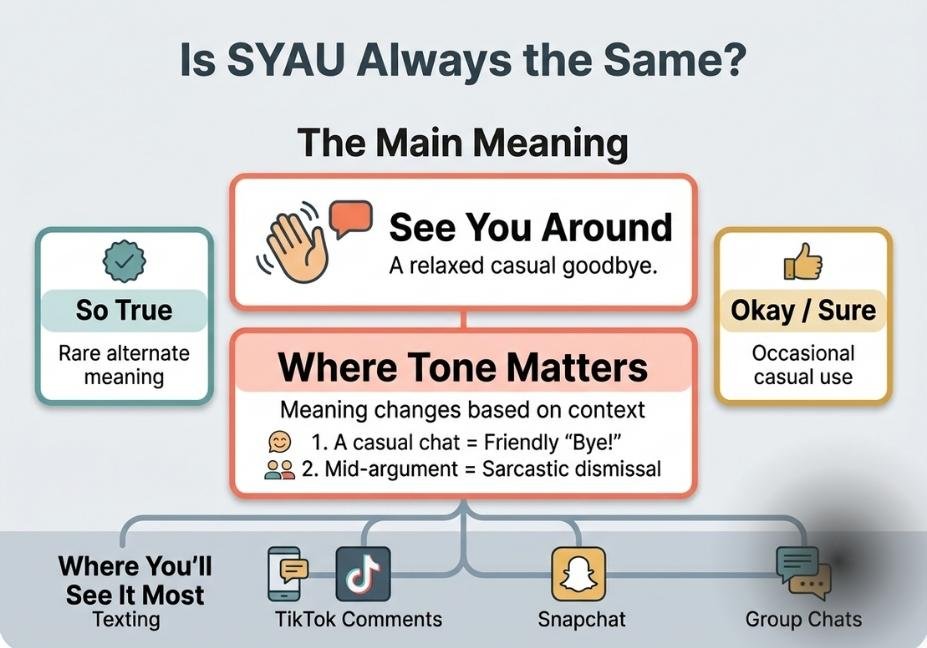
Syau most commonly means “See You Around,” a relaxed, casual way to end a conversation without making it feel too formal or too final. It’s typically friendly or neutral, though tone and context can shift how it lands.
|Also read this article: Sunflower Pick Up Lines: The One Everyone’s Stealing
What Does SYAU Stand For?
Syau most often stands for “See You Around.” People use it as a laid-back sign-off, somewhere between a quick “bye” and a more specific “talk later.” It doesn’t promise a set time to reconnect, it just signals that the conversation is wrapping up for now.
You’ll also come across a few less common interpretations, usually tied to specific corners of the internet:
- On some slang sites, syau is listed as shorthand for “so true,” used as quick agreement.
- In a small number of casual chats, people use syau loosely to mean “okay” or “sure.”
- A rarer, older, and much harsher interpretation exists on some slang dictionaries, tied to a rude phrase telling someone to stop talking.
The “See You Around” meaning is by far the one you’ll actually run into in everyday texting, TikTok comments, and casual DMs. The harsher interpretation shows up occasionally in older slang archives, but it’s uncommon in real, current conversations, which is why context still matters before assuming the worst.
|Also read this article: Matt Gutman Net Worth 2026 and His Surprising Success
Where Did SYAU Come From?
Casual sign-off slang has existed in texting culture for a long time. Terms like cya, cu, and ttyl all grew out of the same basic need: people wanted a quick, low-effort way to end a chat without typing out a full sentence.
Syau fits into that same tradition, but with a twist. Instead of abbreviating letter by letter the way cya does, it compresses the full phrase “see you around” into a single, easy-to-type word that still reads clearly once you know what it stands for. This kind of phonetic-style shorthand has become more common as texting moved from strict character-limited SMS toward apps like iMessage, WhatsApp, and Snapchat, where speed still matters but the old character caps don’t apply the same way.
Slang and language trackers that follow internet vocabulary note that TikTok-driven slang lists are where the “see you around” reading of syau shows up most consistently, which lines up with how the term spreads today. Short-video comment sections and captions move fast, and a quick, casual sign-off like syau fits naturally into that pace. That’s also likely why alternate, older interpretations tied to internet forums and slang archives have mostly faded out of everyday use, while the casual goodbye meaning has stuck around and grown.
|Also read this article: 50+Farmers Market Pick Up Lines No One Warned You About
How SYAU Shows Up Differently Across Platforms
Not every app uses syau the exact same way, and the platform itself often hints at which meaning applies.
- In direct texts and iMessage, syau usually closes out a one-on-one conversation casually.
- On TikTok and Instagram comments, syau often appears at the end of a comment thread or reply chain.
- On Snapchat, syau frequently follows a quick chat exchange, signaling the person is stepping away.
- In gaming chats and Discord, syau can serve as a quick sign-off between rounds or sessions.
- In professional or formal messages, syau almost never appears, since it reads as too casual for that setting.
Across nearly all of these platforms, the sign-off meaning dominates. The rarer alternate meanings are far more likely to show up in old slang dictionary entries than in an actual conversation you’re having today.
How People Actually Use SYAU in Texts
Context still shapes exactly how syau lands, even though the core meaning stays fairly stable compared to some other slang terms.
Here’s how it usually plays out:
- Ending a friendly chat: “Alright, syau” signals a relaxed, no-pressure goodbye.
- Wrapping up a group chat: “Gtg, syau everyone” closes things out casually for the whole group.
- After a short exchange with someone new: “Syau” alone can feel a little distant if the conversation felt one-sided.
- Following a warm conversation: “Syau, talk soon” softens the goodbye and signals genuine interest in reconnecting.
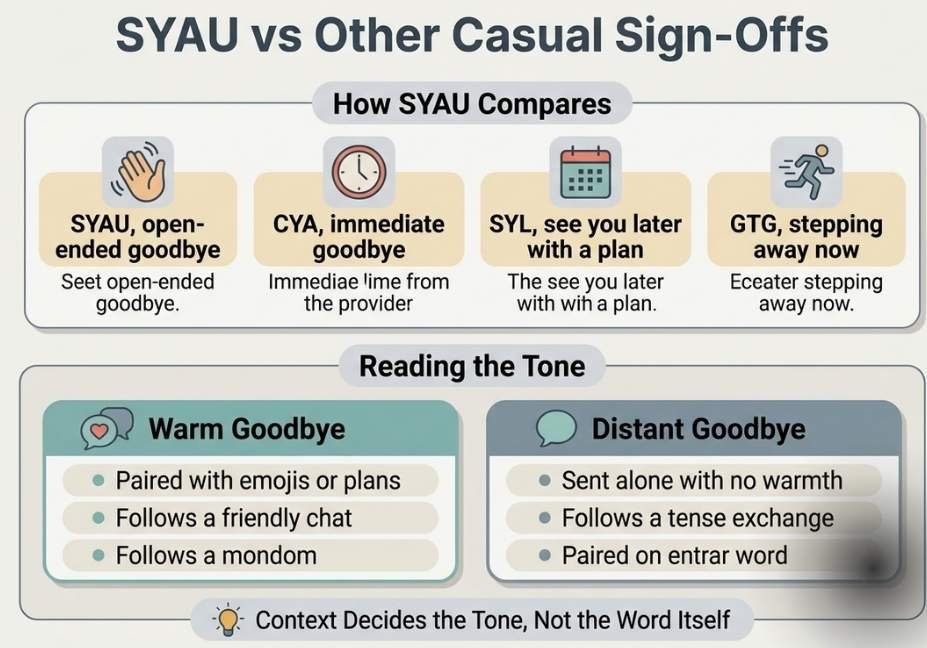
Notice the pattern. When syau shows up with extra warmth, like “talk soon” or a friendly emoji, it reads as a genuine, upbeat goodbye. When it shows up alone with no other context, it can feel more neutral or slightly distant, similar to a short “bye” rather than a warm one.
SYAU From a Guy vs. From a Girl
People searching this term often want to know if the meaning shifts depending on who sent it. It doesn’t change by gender, but it can shift based on relationship and how the rest of the conversation went.
- From a close friend: Usually just a casual, low-stakes way to end the chat.
- From someone you’re getting to know or flirting with: Can feel a little more meaningful, especially if paired with warmth or a follow-up plan.
- From someone the conversation felt tense with: More likely to read as a polite but distant exit.
- In a group chat: Almost always a simple, casual sign-off with no deeper meaning attached.
The relationship and the rest of the message matter far more than whether a guy or girl sent it.
Is SYAU Rude?
Generally, no. The dominant, modern meaning of syau is a neutral to friendly sign-off, not an insult. It only starts to feel rude if the conversation leading up to it was already tense, or if it’s sent abruptly with no other context in an otherwise warm exchange.
A simple check works well here:
- Was the conversation friendly and casual up to this point?
- Did syau show up with any warmth, like a follow-up plan or friendly emoji?
- Does the overall relationship with this person feel positive?
If the answers lean positive, syau is just a casual goodbye. If the conversation already felt off, the abruptness of a bare “syau” might reflect that tension rather than cause it.
SYAU vs. CYA and CU
Syau, cya, and cu all serve the same basic purpose: a quick, informal way to end a conversation. But they carry slightly different weight.
Cya and cu read as more immediate, often used right before someone is about to step away from the conversation or log off entirely. Syau, on the other hand, leans more open-ended. It suggests you’ll cross paths again at some point, without pinning down exactly when. Terms like syl, short for “see you later,” sit somewhere in between, hinting at a clearer, if still loose, plan to reconnect.
So while all of these sign-offs feel casual, syau specifically carries a slightly more relaxed, no-pressure tone compared to the more immediate feel of cya or cu.
How to Respond to SYAU
If the conversation felt warm and casual, the easiest reply is to mirror the tone. A simple “syau” back, or “sounds good, talk soon,” keeps things light and friendly.
If the sign-off felt a little abrupt or the conversation already seemed tense, a short, neutral reply like “okay, take care” works fine without reading too much into it. There’s rarely a need to overanalyze a casual sign-off unless the rest of the conversation gave you a clear reason to.
Does SYAU Mean Something Different by Age or Region?
Age plays a real role in how often you’ll actually see this term. Teens and young adults, especially those active on TikTok and Snapchat, use syau far more often than older texters, since it grew mostly out of short-video comment culture rather than traditional texting habits.
Older texters are less likely to use syau at all, and if they come across it, they’re more likely to default to a more familiar sign-off like cya or “talk later” instead. This generational gap is part of why context matters so much when you’re trying to read the tone. Someone unfamiliar with the term might type it stiffly or use it in an unusual spot in the conversation simply because they picked it up recently rather than growing up with it.
Regionally, the pattern stays fairly steady across English-speaking countries, since the slang spreads mainly through shared platforms rather than local dialects. What shifts a little is familiarity. In friend groups where casual, compressed slang is already common, syau reads as an easy, natural sign-off. In more traditional or formal social circles, the same word might come across as unclear or slightly odd simply because it hasn’t caught on there yet.
Similar Casual Sign-Offs You Might Run Into
Syau isn’t the only compressed, phonetic-style sign-off floating around in casual texting. Recognizing the pattern makes it easier to read similar terms when they show up.
- Cya and cu both shorten “see you” into a quick, immediate goodbye.
- Ttyl compresses “talk to you later” into a slightly more specific sign-off.
- Gtg signals someone is stepping away from the conversation right now, often paired with a casual goodbye like syau.
Once you notice this pattern, a lot of texting shorthand starts to feel less random. Most sign-off slang follows the same basic goal: wrap up a conversation quickly, casually, and without sounding too formal or too final.
Why This Term Has So Many Conflicting Definitions
Part of why syau meaning in text gets searched so often comes down to how scattered the online explanations are. Some pages call it a farewell. Others call it agreement, like a shorthand for “so true.” A few older slang archives even attach it to a much harsher, rude phrase that has little in common with how the word is actually used today.
The most reliable way to sort through that noise is to remember that slang meaning follows real usage, not whichever definition happens to rank first in a search result. Across current TikTok, texting, and comment section usage, the casual “see you around” reading shows up far more consistently than any of the alternates, which is exactly why it’s the meaning worth trusting first.
That’s also why the safest approach, whether you’re reading syau or typing it yourself, is to treat it as a simple, low-stakes sign-off rather than a coded message. Look at the warmth of the conversation around it, and the meaning almost always becomes clear.
Frequently Asked Questions
What does syau mean from a girl?
It doesn’t change by gender. From anyone, it usually means a casual, friendly way of saying “see you around.”
Is syau a rude thing to say?
Generally no. It’s a neutral to friendly sign-off, and it only feels off if the conversation before it already felt tense.
What is the full form of syau?
Syau most commonly stands for “See You Around,” used as a relaxed, casual way to end a chat.
Is syau the same as cya?
They’re similar, but syau feels more open-ended, while cya and cu usually signal a more immediate goodbye.
How do you respond when someone texts syau?
Mirror the tone with a friendly reply like “syau” or “talk soon,” or keep it neutral if the chat felt tense.
Final Thoughts
Syau is one of those texting terms that looks unfamiliar until you see it in context, and then it clicks fast. Most of the time, it simply means “see you around,” a relaxed, low-pressure way to close out a conversation. The rarer alternate meanings exist, but they’re far less common in everyday chats than the casual sign-off use. The real skill isn’t memorizing every possible definition, it’s reading the warmth, or lack of it, in the message around it. Do that, and syau stops feeling confusing and starts feeling like just another casual way people say goodbye online.
Pingback: What does cm mean in text? The Full Meaning Explained Simply - Celebrity Auraa
Pingback: What Does FN Mean in Text? Slang, Gaming & More Explained - Celebrity Auraa
Pingback: What Does DND Mean in Text? Full Meaning and Examples - Celebrity Auraa
Pingback: BFFR Meaning in Text: What It Really Stands For Explained - Celebrity Auraa